
In the 1950s, artificial intelligence (AI) began its captivating journey. Alan Turing, a pioneer in the field, introduced the Turing Test to gauge a machine’s ability to mimic human intelligence. Fast forward to the 1960s, AI research gained momentum with the birth of the first AI programming language called LISP, credited to John McCarthy. Early AI efforts focused on symbolic reasoning and rule-based systems, setting the stage for expert systems’ rise in the 1970s and 1980s. This journey unfolds in our exploration of artificial intelligence from mechanical minds to ethical algorithms.
A Concise History of Artificial Intelligence From Mechanical Minds to Ethical Algorithms
The fascinating journey of artificial intelligence (AI) commenced in the 1950s, when Alan Turing, a trailblazing figure in the field, introduced the Turing Test as a benchmark to assess a machine’s capacity to emulate human intelligence. By the 1960s, AI research had gained substantial momentum with the creation of the very first AI programming language, LISP, attributed to John McCarthy. The early stages of AI primarily focused on symbolic reasoning and rule-based systems, laying the groundwork for the emergence of expert systems in the 1970s and 1980s.
The 1990s witnessed a notable shift in focus, as the AI community began to gravitate toward machine learning and data-driven methodologies. This shift was largely driven by the increasing availability of digital data and the remarkable advancements in computing power. During this era, neural networks gained prominence, and the development of support vector machines enabled AI systems to glean insights from data, resulting in improved performance and adaptability.
Fast forward to the 2000s, and AI research broadened its horizons, venturing into new and exciting domains such as natural language processing, computer vision, and robotics. This expansion paved the way for the contemporary AI revolution we witness today, with AI technologies penetrating nearly every facet of our lives.”
Machine Learning vs. Deep Learning: A Breakdown
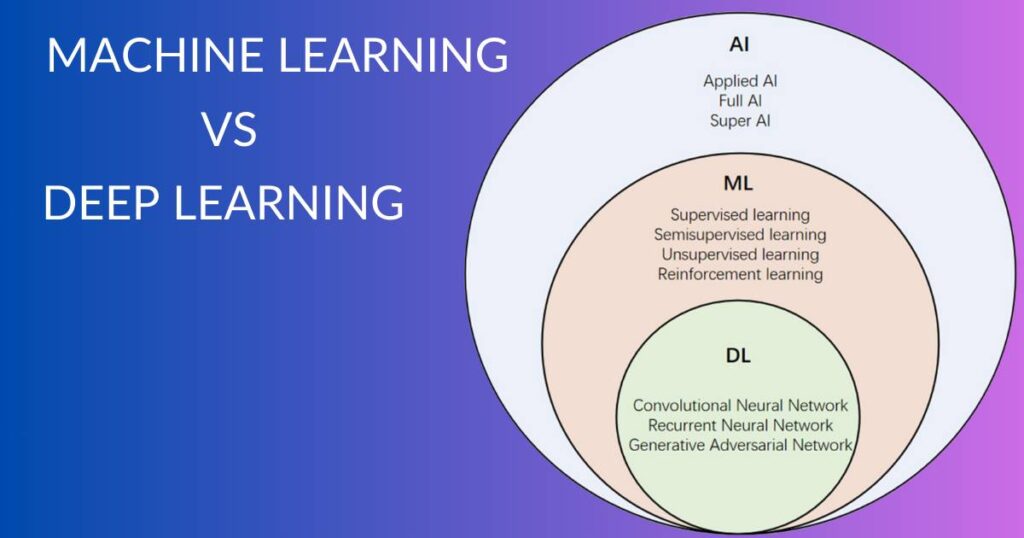
The terms “machine learning” and “deep learning” are often used interchangeably, but they represent distinct approaches within the broader realm of AI.
Machine Learning
Machine learning is the process of teaching computers to learn from data. It entails the creation of algorithms that let computers recognize patterns, anticipate outcomes, and gradually become more efficient. Machine learning algorithms have found applications in various domains, from email filtering and recommendation systems to fraud detection and autonomous vehicles.
The historical development of machine learning is a testament to human ingenuity. Early machine learning models, such as linear regression and decision trees, paved the way for more advanced techniques like neural networks and support vector machines. The availability of vast datasets and increased computational power have led to remarkable advancements in machine learning, enabling applications like natural language processing and computer vision.
Deep Learning
Deep learning, a subset of machine learning, aims to replicate the functioning of the human brain’s neural networks. It consists of artificial neural networks with multiple layers (hence the term “deep”) that can automatically extract hierarchical features from data. Significant advances in natural language processing, autonomous robotics, image and audio recognition, and other fields have been made possible through deep learning.
Historically, deep learning has been around for a while, but it has gained more prominence in the 21st century due to the availability of extensive datasets and the development of powerful hardware, particularly graphics processing units (GPUs). Deep learning is transforming fields like marketing, finance, and healthcare by becoming superior at tasks like image categorization and machine translation.
Ethical Considerations in AI Applications
In the journey of artificial intelligence from mechanical minds to ethical algorithms, it’s clear that as AI advances, ethical concerns grow more critical. Applying artificial intelligence in various domains raises significant questions regarding privacy, bias, and accountability.
AI Ethics and Regulations
The field of AI ethics has gained prominence in response to these concerns. Researchers, policymakers, and organizations are actively working to establish ethical guidelines and regulations that ensure AI technologies serve humanity without causing harm. Initiatives like “AI Ethics Principles” and “Ethics by Design” promote the responsible use of AI.
Ethical Dilemmas in AI
Historically, there have been instances where AI applications have resulted in ethical dilemmas. One prominent example is algorithmic bias, where AI systems may perpetuate discrimination or unfairness due to biased training data. Understanding these historical cases is crucial to preventing similar issues in the future.
Privacy Concerns
Regarding AI technology, privacy is a major problem. Robust rules and procedures are required to safeguard people’s personal data when AI systems gather and evaluate enormous volumes of information. Developers must prioritize implementing measures that ensure data security and privacy rights are respected.
Bias Mitigation
Bias in AI algorithms is another essential consideration. Since machine learning models learn from existing data sets, there’s a risk that the algorithms can perpetuate biases in those datasets. This is not merely a theoretical concern; it has real-world consequences. Biased AI can lead to discriminatory outcomes, unfair treatment, and the perpetuation of societal prejudices.
Developers should actively mitigate these biases and strive for fairness in their models by ensuring diverse and representative training data. The development of AI should prioritize ongoing efforts toward fairness and transparency to make sure that systems do not aggravate already-existing disparities or introduce new ones.
Accountability and Transparency
Accountability is also paramount when deploying AI technologies. It’s essential to establish clear lines of responsibility so that any negative consequences or errors caused by AI systems can be appropriately addressed. Accountability goes beyond theory and is crucial in real-world scenarios. AI systems may make life-altering decisions in healthcare, legal, or financial domains, and ensuring accountability is a fundamental aspect of responsible AI deployment.
Developers should emphasize transparency by making the decision-making process of their algorithms understandable and auditable. Understanding how AI systems arrive at their decisions is not just a matter of curiosity but a practical necessity to address issues and ensure that AI operates fairly and responsibly.
Collaboration between developers, policymakers, ethicists, researchers, and other stakeholders becomes crucial to ensure the responsible use of AI technologies. Open dialogue among these groups allows for comprehensive guidelines and regulations that address ethical concerns effectively. In the absence of such collaboration, AI development may proceed without adequate oversight and ethical considerations, potentially leading to unintended consequences.
Taking these ethical issues into account will help build public trust, support the long-term success of AI technologies in many areas, and reduce the harm that could happen.
AI-Driven Innovations in Entertainment: A Transformative Force
“In the fascinating journey of artificial intelligence from mechanical minds to ethical algorithms, the impact of AI on the entertainment industry cannot be overstated. AI-driven innovations have transformed how we experience and consume media, ushering in a significant shift in the entertainment landscape. These advancements are enhancing user experiences and revolutionizing content creation processes.
Personalized Recommendations
One of the most visible uses of AI in entertainment is content recommendation. Streaming services like Netflix and music platforms like Spotify leverage AI algorithms to analyze user preferences and behavior, providing personalized recommendations. This improves the user experience while also assisting these platforms in keeping users as subscribers. The impact of these recommendations goes beyond convenience; they shape our choices, preferences, and, ultimately, our entertainment experiences.
Immersive Virtual Reality

Additionally, AI has been important in producing compelling virtual reality experiences where users can dive into entirely new worlds and engage with content like never before. By harnessing the power of artificial intelligence, developers have created lifelike simulations that blur the line between reality and digital entertainment. These VR experiences are not just novelties; they offer new ways of storytelling and interaction, pushing the boundaries of what’s possible in entertainment.
Efficient Content Creation
AI-driven innovations have not only transformed but propelled the entertainment industry forward. Artificial intelligence is automating content creation processes. From generating scripts to automating video editing, these intelligent systems have expedited production timelines while maintaining high-quality standards. The impact on the industry is profound, as it enables content creators to be more productive and innovative. This translates to more content, more creativity, and, ultimately, more choices for consumers.
AI in Healthcare and Transportation: A Transformative Force
In addition to its impact on the workplace, AI is revolutionizing numerous industries and shaping the future in profound ways. This transformative force extends to healthcare and transportation, two sectors where AI is making a significant impact.
AI in Healthcare
AI is transforming healthcare by analyzing massive patient data sets to produce more precise diagnoses and individualized treatment regimens. It’s enabling healthcare professionals to make data-driven decisions with greater accuracy, improving patient care and outcomes. The impact on healthcare is not just theoretical; it’s a matter of life and death. Accurate diagnoses and personalized treatment plans are saving lives and improving the quality of healthcare.
AI in Transportation
In the transportation sector, AI-powered autonomous vehicles are enhancing road safety and efficiency. These vehicles rely on AI algorithms for real-time decision-making, making roads safer and more efficient. The impact on transportation is not merely a matter of convenience; it’s a matter of safety and efficiency. In addition to lowering traffic jams and fuel consumption, autonomous cars have the ability to prevent accidents and save lives.
AI Across Industries
Across various sectors, businesses recognize AI technologies’ immense potential in streamlining processes, boosting operational efficiency, and reducing costs. AI’s impact on industries is not just theoretical; it’s practical and financial. By leveraging these cutting-edge solutions, companies can automate manual tasks, maximize productivity, and stay competitive in dynamic markets. The ability of AI to analyze large datasets quickly enables organizations to make data-driven decisions with greater accuracy and confidence. This empowers businesses to stay ahead of their competition by identifying trends, predicting customer behavior, and tailoring their strategies accordingly.
The Metamorphosis of GPT: A Game-Changing Enigma
The current AI explosion owes much of its growth to the development of smarter learning techniques and the rise of big neural networks like OpenAI’s GPT series. Think of GPT-3, which debuted in 2020, as a shining example. It’s powered by a whopping 175 billion parts and can understand and create human-like language in ways we’ve never seen before.
GPT-3’s success has ignited more research in the AI field. Now, we have GPT-4, the latest version. It’s building on the strong foundation of its predecessors and taking AI capabilities to new heights. This progress is remarkable, and it’s reshaping the AI landscape in a profound way.
Conclusion
The evolution of Artificial intelligence is a captivating journey through time. By understanding its historical roots and ongoing development, we can make informed decisions about AI’s future applications and navigate the ethical considerations surrounding its use. It’s critical to carefully utilize AI’s potential as it gets more ingrained in our daily lives to make sure that society as a whole gains from it. Embracing AI, learning from its history, and staying attuned to its present innovations will be key to a brighter, AI-enhanced future.
With rapid advances in AI and ongoing discussions about ethical considerations, the responsible and innovative use of AI technology is essential. As we witness the evolution of artificial intelligence unfold before our eyes, it is clear that this technology holds immense potential for positive change. However, we must approach its development and implementation with a robust ethical framework to harness its benefits responsibly. The future of AI is bright, but it requires responsible stewardship to ensure that it continues to serve humanity in ways that are safe, fair, and beneficial.


Leave a Reply
You must be logged in to post a comment.