



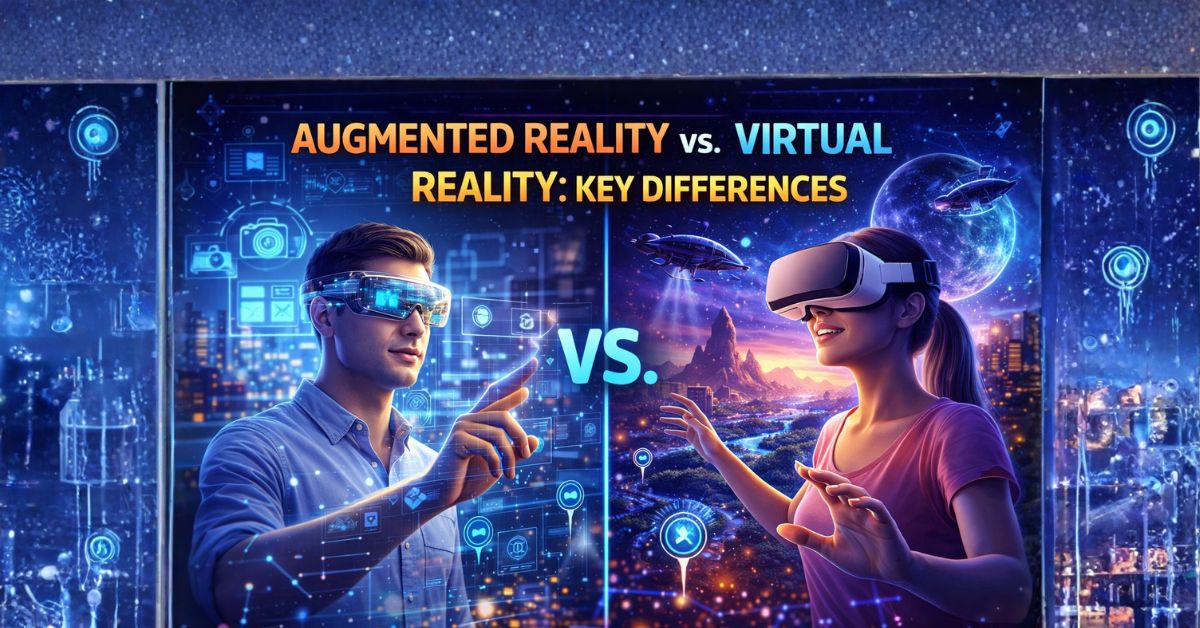
Augmented reality and virtual reality are two of the most frequently confused technologies in consumer tech. Both involve digital content layered onto or replacing the physical world, but they work differently, serve different use cases, and are at different stages of mainstream adoption. Understanding the distinction matters because the applications, hardware requirements, and business opportunities differ significantly.
This article clearly explains what AR and VR are, how they differ technically and practically, where each is being deployed in the real world, and which one is more relevant to you based on your context, whether you are a consumer, developer, or business leader.
What Is Augmented Reality (AR)?
Augmented reality overlays digital content onto the real physical world. When you use your smartphone camera to see furniture placed in your living room before buying it, that is AR. When a surgeon sees a digital overlay of a patient’s CT scan mapped onto their body during a procedure, that is AR. The physical world remains fully visible; digital content is added on top of it.
AR can run on smartphones, tablets, smart glasses, and specialized headsets. The hardware ranges from devices already in everyone’s pocket (smartphones) to enterprise-specific wearables like Microsoft HoloLens and Apple Vision Pro.
What Is Virtual Reality (VR)?
Virtual reality replaces the physical world entirely with a digital environment. When wearing a VR headset, you see only the digital world; the physical world around you is blocked out. This creates a sense of presence and immersion that AR cannot fully replicate, but it also requires dedicated headset hardware and means you cannot interact with or see your physical surroundings.
Major VR platforms include Meta Quest, PlayStation VR, and PC-connected headsets like Valve Index. These range from standalone devices to systems that require a connected computer for processing power.
Key Differences: AR vs. VR at a Glance
World interaction: AR enhances the real world; VR replaces it. This is the fundamental distinction that drives all other differences in use cases, hardware, and user experience.
Hardware: AR can run on smartphones, making it far more accessible. VR requires dedicated headsets. Enterprise AR uses specialized glasses; consumer AR is largely smartphone-based today.
Immersion: VR provides deeper immersion because it blocks the physical world entirely. AR is less immersive but more practical for use while staying aware of your surroundings.
Use context: VR is typically a dedicated session experience. AR can be used passively or in brief interactions throughout a workday or daily routine.
Maturity: Smartphone AR is already mainstream through apps like Google Maps Live View, IKEA Place, and Snapchat filters. Consumer VR has a smaller but growing installed base centered on gaming and fitness.
Real-World Applications of AR
Retail and e-commerce: IKEA, Wayfair, Sephora, and Warby Parker allow customers to virtually place furniture, try on makeup, or see glasses on their face before purchasing. This reduces returns and improves purchase confidence.
Healthcare: Surgeons use AR overlays to visualize internal anatomy during procedures. Medical education uses AR to teach anatomy in interactive 3D rather than flat images. Physical therapy apps use AR to guide patients through exercises with real-time form feedback.
Manufacturing and maintenance: Technicians use AR glasses to see step-by-step repair instructions overlaid on equipment they are working on, reducing errors and training time. Boeing and Lockheed Martin have used AR for aircraft assembly guidance.
Navigation: Google Maps Live View uses AR to show directional arrows overlaid on the real world through a smartphone camera, reducing wrong turns in unfamiliar cities.
Real-World Applications of VR
Gaming and entertainment: VR gaming is the most mature consumer application. Meta Quest has driven significant adoption with accessible, standalone hardware. Beat Saber, Half-Life: Alyx, and sports simulation games demonstrate what VR entertainment can deliver.
Training and simulation: VR excels at training for scenarios that are dangerous, expensive, or impractical to replicate in the real world. Military, medical, aviation, and emergency response training all use VR simulations that would be impossible to replicate safely at scale.
Therapy and mental health: VR is showing clinical promise in treating phobias, PTSD, and chronic pain through immersive exposure therapy. Several FDA-registered VR therapy applications are in active clinical use.
Architecture and design: Architects and interior designers use VR to walk clients through spaces before they are built, enabling real-time feedback and reducing costly design changes during construction.
Mixed Reality: The Space Between AR and VR
Mixed reality (MR) blends elements of both AR and VR. Digital objects can appear anchored to the physical world and interact with it, not just overlaid on top. Apple Vision Pro and Microsoft HoloLens 2 are mixed reality devices. MR represents the most technically sophisticated end of the spectrum and is where the most ambitious enterprise applications are being developed.
Expert Take: Which Technology Has More Practical Impact Right Now?
For consumer applications, smartphone-based AR has broader near-term impact because the hardware is already in everyone’s pocket. The friction of requiring a dedicated VR headset limits VR to users willing to make that investment, which is currently a smaller segment.
For enterprise applications, both have clear ROI in specific contexts. AR for maintenance guidance and VR for training simulation are the two highest-value current applications. The decision should be driven by use case requirements, not technology preference.
Frequently Asked Questions
Do I need expensive hardware for AR? For smartphone AR, no. Any modern smartphone supports AR applications. For enterprise AR glasses or Apple Vision Pro, the hardware investment is significant.
Is VR bad for your health? Extended VR use can cause motion sickness in some users, eye strain, and disorientation. These effects vary by individual and improve with shorter sessions and better display technology. Current headsets include time limit recommendations, particularly for children.
The Bottom Line
AR enhances the real world; VR replaces it. Both have legitimate and growing use cases. AR is more accessible today thanks to smartphones, while VR delivers deeper immersion for dedicated experiences. The most significant near-term opportunities are enterprise AR for maintenance and training, and VR for simulation, therapy, and high-stakes training scenarios. For more, explore our articles on top emerging technologies to watch in 2026, the role of IoT in smart homes and cities, and top tech gadgets that will dominate 2026.