San Francisco, January 29, 2024: In a groundbreaking announcement on X, formerly Twitter, Elon Musk, the tech magnate and founder of Neuralink, revealed that the first human patient has successfully received a brain implant developed by his company. The Neuralink startup has successfully implanted a brain chip in a human patient for the first time. This marks a significant milestone in the field of brain-computer interfaces (BCIs) and holds immense potential for revolutionizing healthcare and human capabilities.
Musk Tweeted the News:
“The first human received an implant from Neuralink yesterday and is recovering well,” Musk declared on X, formerly known as Twitter.
“Initial results show promising neuron spike detection,” he added, hinting at the implant’s ability to pick up on the brain’s electrical activity
The first human received an implant from @Neuralink yesterday and is recovering well.
Initial results show promising neuron spike detection.
Neuralink’s Ambitious Project: Blurring the Lines Between Brain and Machine
Neuralink, founded in 2016 by Elon Musk with a team of world-renowned neurotechnologists, harbors a vision as audacious as it is groundbreaking: to forge a direct connection between the human brain and the boundless potential of computer technology. This isn’t simply about creating gadgets and apps; it’s about fundamentally reshaping our understanding of what it means to be human in the digital age.
The project’s ambitions are multifaceted. At its core, Neuralink seeks to establish a neural lace, a network of ultra-thin, flexible threads implanted into the brain that can seamlessly translate its complex electrical signals into digital communication. This opens a realm of possibilities, including:
Augmenting human capabilities: Imagine controlling external devices directly through thought, boosting learning and memory, or even enhancing your senses to perceive the world in entirely new ways. Neuralink envisions a future where our minds become extensions of the digital world, allowing us to interact with information and technology in ways previously unimaginable.
Combatting neurological disorders: For millions battling debilitating conditions like paralysis, Parkinson’s, and ALS, Neuralink offers a flicker of hope. By bypassing damaged neural pathways or restoring lost functionalities, these brain-computer interfaces could potentially alleviate symptoms and empower individuals to regain control over their lives.
Unlocking the potential of AI: Ultimately, Neuralink’s vision extends beyond individual enhancement. The company aspires to foster a symbiotic relationship between humans and artificial intelligence. By establishing a two-way flow of information between our minds and machines, we could unlock unprecedented levels of collaboration and problem-solving, propelling humanity to new heights of innovation and understanding.
Details of the Link: A Bridge Between Brain and Machine
The revolutionary “Link” implant, the cornerstone of Neuralink’s human trials, is more than just a piece of hardware. It’s a meticulously crafted bridge between the intricacies of the human brain and the boundless potential of computer technology.
Size and Scope:
Roughly the size of five stacked coins, the Link is surprisingly compact considering the complexity of its tasks. It sits comfortably within the skull, housed in a biocompatible enclosure designed to withstand the harsh conditions of the human body.
Unlike some competitors, the Link requires invasive surgery for placement. While this may raise concerns, Neuralink has developed a sophisticated robotic system that speeds up the process and minimizes risks.
Technology Within:
The Link is far more than just a passive implant. It boasts a miniaturized marvel of engineering, packed with advanced features, including:
Thousands of hair-thin electrodes: These delicate threads seamlessly integrate with the brain tissue, capturing the subtle electrical symphony of neurons firing.
Custom-designed chips: Powerful yet energy-efficient, these chips process the neural signals in real-time, deciphering their meaning and transmitting them wirelessly for external interpretation.
Wireless charging: Gone are the days of invasive battery replacements. The Link charges wirelessly from outside the body, ensuring long-term functionality and comfort.
FDA Approval and Beyond:
The Link’s journey to the human brain wasn’t a simple one. Years of rigorous testing and meticulous refinement culminated in Neuralink receiving FDA approval for human trials, marking a crucial milestone in the field of brain-computer interfaces.
This first successful implant is just the beginning. As Neuralink continues its trials and gathers data, the Link has the potential to evolve, becoming even more refined and capable of facilitating even more complex interactions between brain and machine.
The Link, therefore, is not just a device; it’s a symbol of human ingenuity and ambition. It represents a bold step towards a future where technology seamlessly augments our lives, opening doors to unimaginable possibilities in healthcare, cognition, and our understanding of the human mind itself.
Future Implications:
While Musk’s announcement is undeniably exciting, it’s important to remember that this is still early days.
Further research and rigorous testing are necessary to fully assess the safety, efficacy, and long-term implications of these technologies.
Ethical considerations surrounding BCIs remain a crucial discussion point, requiring careful navigation as this field evolves.
Despite these uncertainties, Elon Musk’s announcement undoubtedly marks a significant milestone in the field of neurotechnology. As Neuralink continues its human trials and progresses in its research, the world will be watching with keen interest to see how this technology shapes the future of human-computer interaction and, potentially, the lives of countless individuals.
Brain transplant is a medical procedure that involves replacing a person’s brain with another brain. It is a highly complex and controversial procedure that has been the subject of much debate in the medical community.
In this article, we will explore the history of brain transplants, the science behind it, and the ethical considerations that surround it. We will also discuss the potential benefits and risks of brain transplants, as well as the current state of research in this field.
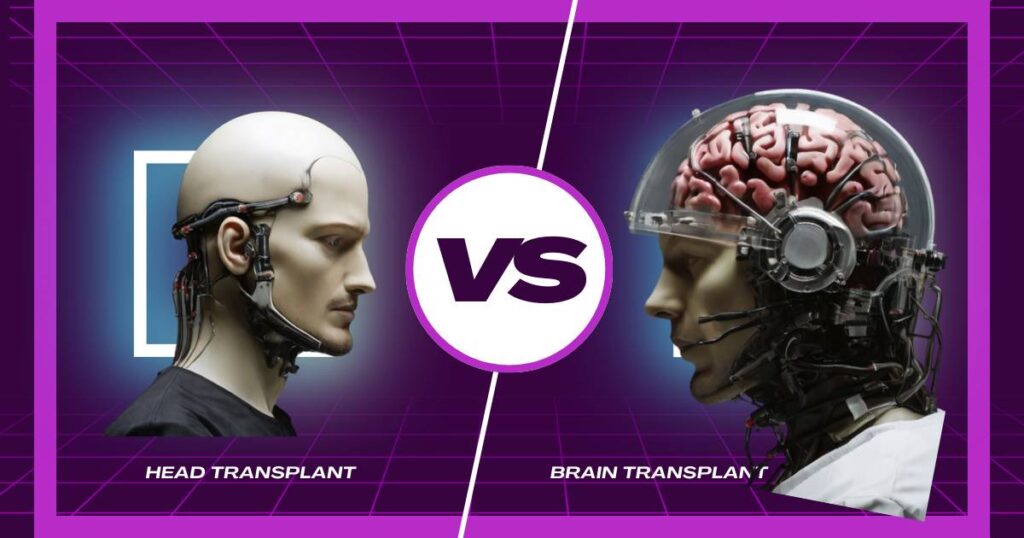
Brain transplantation is a highly controversial and theoretical procedure involving the transplant of one organism’s brain into the body of another. This differs from head transplants, where the entire head is transplanted into a new body rather than just the brain.
In theory, individuals facing total organ failure could receive a new and functional body through this procedure, maintaining their personality, memory, and consciousness. However, several challenges exist, including the inability of nerve tissue to heal properly, leading to scarring that hinders signal transmission.
What is a brain transplant?
A brain transplant, also known as a whole-brain transplant, is a hypothetical surgical procedure in which a human brain is removed from its original body and placed in a new, healthy body. It is important to distinguish this from a head transplant, which involves transferring the entire head, including the brain and face, into a new body.
It’s a concept that once belonged only to science fiction and has ignited the curiosity and debate of scientists and philosophers alike. It is an idea that is both fascinating and unsettling, promising the possibility of defying death and redefining our understanding of consciousness.
Imagine a scenario where a damaged or diseased brain is carefully removed from its original host and placed inside a new, healthy body. This is the essence of a brain transplant, also known as a whole-brain transplant. It is a hypothetical surgical feat, similar to a heart or kidney transplant, but on an entirely different plane of complexity, penetrating the very core of our being.
Brain vs. Head: A Matter of Distinction
It’s crucial to differentiate brain transplants from head transplants. While both involve placing a human head onto another body, the key distinction lies in what gets transferred. A head transplant involves the entire head, including the brain, skull, face, and all its underlying structures. This intricate procedure remains largely theoretical and faces insurmountable challenges in terms of nerve reconnection and facial reconstruction.
In contrast, a brain transplant focuses solely on the brain itself, leaving behind the original body’s head and face. The extracted brain is then meticulously connected to the new body’s vascular and nervous systems, aiming for seamless integration. While equally complex, this approach avoids the additional challenges associated with transplanting facial features and preserving facial identity.
Brain transplants, while currently in the realm of scientific speculation, offer a tantalizing glimpse into a future where biological boundaries might be redefined. However, the journey towards this future is paved with immense challenges, demanding a cautious and responsible approach that prioritizes ethical considerations and scientific rigor. Only time will tell if this bold venture will become a medical marvel or remain a figment of our scientific imagination.
Is it possible?
Brain transplantation is a highly speculative and controversial topic that is unlikely to become a reality anytime soon due to the many technical and ethical challenges that must be overcome.
Some of the technical challenges include keeping the brain alive during the transplant process, ensuring that the transplanted brain is properly attached to the recipient’s body, and preventing the recipient’s immune system from rejecting the transplanted brain. Ethical concerns include issues of identity, autonomy, and the definition of death.
Although there have been some successful brain transplant experiments in animals, the procedure is far from safe or practical for humans. The living brain is soft and squishy, and it’s easily damaged trying to get it out of one skull and into another. Attempting to transplant a severed brain would require reconnecting many delicate cranial nerves, which would be challenging.
In summary, brain transplantation is a highly speculative and controversial topic that is unlikely to become a reality anytime soon due to the many technical and ethical challenges that must be overcome.
Currently, brain transplants are not possible with our existing technology. The brain is incredibly complex and delicate, and interrupting its blood supply for even a short period of time can cause irreparable damage.
First-Ever Brain Transplant
first ever brain transplant,” it’s important to clarify that no successful brain transplants have been performed on humans to date. It remains a purely hypothetical procedure due to the immense technical and ethical challenges involved.
The history of attempts and research related to brain transplants:
Alexis Carrel and the Two-Headed Dog (1908):French surgeon Alexis Carrel, a Nobel laureate for his work in vascular surgery, embarked on a controversial experiment in 1908. He attempted to transplant the head of one dog onto the body of another. While the surgery appeared successful initially, with the grafted head showing some reflexes, the animal only survived for a few hours. The main challenges Carrel faced included severed nerve connections, inadequate blood supply to the transplanted brain, and rejection by the recipient’s body.
Robert White and the “Reanimated” Monkey Brain (1970s): However, in 1970, neurosurgeon Robert J. White performed a head transplant experiment on two monkeys. He successfully attached the head of one monkey to the body of another. While electroencephalography (EEG) readings initially indicated some brain activity, suggesting function, the procedure wasn’t a complete success. While early reports proclaimed the brain as an immunologically privileged organ due to the lack of immediate rejection, this proved inaccurate. After nine days, the recipient monkey unfortunately succumbed to immune system reactions, highlighting the significant challenges associated with head transplants.
The first successful human brain transplant has not been performed yet. However, in 1970, neurosurgeon First-Ever Brain Transplant conducted an experiment in which he grafted the head of one monkey onto the headless body of another. EEG readings indicated normal brain functioning initially, suggesting the brain’s immunological privilege. However, immunorejection led to the monkey’s death after nine days.
How does this procedure work?
Brain transplant procedures are still largely theoretical and have not yet been performed on humans. However, some researchers propose a method involving the transplant of one organism’s brain into another’s body.
In this procedure, the surgeon first makes an incision at the back of the patient’s head to expose the brain. They then cut through all the connective tissue and vessels linking it to its host body. The spinal cords are severed, and the recipient’s brain and head are transplanted into the new body.
The recipient’s body serves as a transfusion source, and the spine is fused with metal plates while blood supply loop catheters are individually removed as the blood vessels are sutured together.
It’s important to note that brain transplantation is still a highly experimental procedure, and much remains unknown about its safety and efficacy. Therefore, it’s unclear whether the potential benefits outweigh the associated risks and ethical concerns.
In summary, while the process of brain transplantation is largely theoretical, some researchers propose the possibility of transplanting one organism’s brain into another’s body. The procedure involves exposing the brain through an incision in the patient’s head, cutting connective tissue and vessels, and transplanting the brain and head into the new body.
However, brain transplantation remains a highly experimental and controversial procedure, raising numerous ethical questions.
The Challenges for Brain Translation
Brain transplantation is a highly complex and controversial topic that remains largely in the realm of science fiction. While there have been some successful brain transplant experiments in animals, the procedure is currently far from safe or practical for humans.
Overcoming numerous technical and ethical challenges is necessary before brain implants become a reality, and significant progress in this field may take years if not decades.
Technical challenges include keeping the brain alive during the transplant process, ensuring proper attachment of the transplanted brain to the recipient’s body, and preventing the recipient’s immune system from rejecting the transplanted organ. Ethical concerns encompass issues of identity, autonomy, and the definition of death.
In summary, brain transplantation is a highly speculative and controversial topic that is unlikely to become a reality anytime soon due to the many technical and ethical challenges that need to be overcome.
The ethical considerations
If brain transplants ever become possible, there would be a host of ethical issues to consider. Who would be eligible for the procedure? How would we ensure informed consent from both the donor and recipient? What would happen to the original body? And what would the psychological and legal implications be of having one brain in two different bodies?
The ethical implications of brain transplantation are complex and multifaceted. One primary concern is the potential misuse of the method for unethical purposes, such as creating a race of superhumans or prolonging life indefinitely. Additionally, there are worries about the psychological impact on the recipient and the potential loss of identity or personality.
Another ethical consideration is the issue of consent. Since brain transplantation is a highly experimental procedure not yet performed in humans, uncertainties about its safety and efficacy raise questions about how informed consent can be obtained from patients considering the procedure.
Concerns also extend to resource allocation, with the possibility that brain transplantation could exacerbate existing healthcare disparities. Given the high cost and complexity of the procedure, it is likely that only a few individuals will be able to afford it, potentially widening the gap in healthcare access.
In summary, brain transplantation, though holding the potential for significant benefits in cases of complete organ failure, remains a highly controversial and theoretical procedure, posing numerous ethical questions. The challenges and limitations associated with this approach must be carefully considered.
What are the potential benefits of a brain transplant?
The potential benefits of brain transplantation are primarily theoretical, as the procedure has not yet been performed on humans.
Nonetheless, researchers suggest that brain transplants could serve as a means to extend life and enhance the quality of life for individuals with total organ failure. Theoretically, this procedure could provide a new and functional body while retaining the patient’s personality, memory, and consciousness.
Another potential benefit lies in using brain transplantation to treat certain neurological diseases, such as Parkinson’s disease, by transplanting healthy brain tissue into damaged areas. Although promising results have been observed in animal studies, human trials have not yet been conducted.
It’s crucial to note that brain transplantation remains a highly experimental procedure, and much remains unknown about its safety and efficacy. Consequently, the assessment of whether the potential benefits outweigh the associated risks and ethical concerns remains unclear.
In summary, while brain transplantation holds the potential for significant benefits in treating total organ failure and specific neurological disorders, it is currently a highly experimental and controversial procedure, prompting numerous ethical questions.
The future of brain transplants
Some scientists believe that brain transplantation may become a reality in the future despite the challenges involved. Advances in regenerative medicine, artificial intelligence, and neural interface technology may pave the way for this intricate surgery. However, the concept of brain transplantation raises numerous ethical and practical concerns and remains a subject of debate among experts.
Regenerative medicine focuses on developing therapies to replace or regenerate damaged tissues and organs. Artificial intelligence (AI) involves creating intelligent machines capable of tasks requiring human intelligence, such as visual perception, speech recognition, decision-making, and language translation. Neural interface technology encompasses the use of electronic devices to communicate with the nervous system, including brain-computer interfaces (BCIs).
While the idea of brain transplantation may sound like science fiction, some experts believe it could become a reality in the future. However, several challenges must be overcome, including the development of new surgical techniques, ensuring compatibility between donor and recipient, and addressing ethical concerns. Some argue that the idea of brain transplantation is not only impractical but also immoral, raising questions about personal identity, consciousness, and the nature of the self.
In conclusion, although brain transplantation may become a reality in the future, it remains a subject of debate among experts, and numerous challenges must be addressed. Developments in regenerative medicine, artificial intelligence, and neural interface technology may pave the way for this complex surgery, but ethical and practical concerns need careful consideration.
What is Machine Learning? And how do I become an ML Engineer? All your questions were answered! Master the ML workflow, libraries, projects, and salary secrets!
Machine learning (ML) is a subfield of artificial intelligence (AI) that focuses on the development of computer algorithms that can learn from data and improve their performance on a specific task over time. Imagine a child learning to identify different types of cars. Initially, they might need you to point out each car and tell them its name. But over time, they start to identify the patterns that distinguish cars from other objects, and eventually, they can do it on their own.
Imagine a computer that not only follows instructions but also learns from them. That’s the magic of machine learning (ML), a field of artificial intelligence (AI) where algorithms evolve with experience, unlocking a world of possibilities.
Before we delve into its intricate workings, let’s crack the code on its core concepts.
Learning on Autopilot: Unlike traditional, rule-based programs, ML algorithms don’t need explicit instructions. Instead, they devour training data, and sets of examples used to identify patterns and build models. Think of these models as brain maps, constantly refining their understanding of the world through the data they consume. This allows them to make predictions, whether it’s classifying an email as spam, recommending the perfect movie for you, or recognizing a loved one’s face in a photo.
A Historical Timeline: Though the term “machine learning” first surfaced in the 1950s, its roots date back centuries. Early pioneers like Ada Lovelace laid the groundwork for theoretical algorithms, while Alan Turing envisioned “learning machines” capable of intelligent behavior. Key breakthroughs throughout the 20th century, like artificial neural networks and statistical learning methods, paved the way for the explosive growth we witness today.
Everyday Encounters with ML: Look around, and you’ll see machine learning fingerprints everywhere. Search engines predict your next query based on past searches, recommendation systems suggest music you might love, and image recognition powers your phone’s face unlock. The list goes on: from speech recognition in voice assistants to spam filters shielding your inbox, ML has become an invisible friend, quietly enhancing our lives.
Embarking on a career as a Machine Learning Engineer is an exciting journey that requires a combination of education, skills development, and practical experience. In this guide, we will outline the essential steps to help you pave the way to becoming a proficient Machine Learning Engineer.
What is a Machine Learning engineer?
A Machine Learning Engineer is a professional at the intersection of software engineering and machine learning, specializing in creating programs that empower computers to learn and adapt autonomously. Much like software engineers, they exhibit proficiency in programming languages and are well-versed in tools such as IDEs, GitHub, and Docker.
Core Responsibilities:
Programming Proficiency: Machine learning engineers are adept programmers, utilizing their skills to develop software that enables computers to learn from data.
Integration of Software Engineering and ML: The distinguishing feature of a machine learning engineer is the fusion of software engineering expertise with in-depth knowledge of machine learning principles.
Focus on Self-Learning Systems: Unlike traditional software engineers, machine learning engineers center their efforts on creating programs that facilitate self-learning in computers.
Data-to-Product Conversion: The primary objective is to convert data into a tangible product. Machine learning engineers play a crucial role in transforming raw data into predictive models and automated systems.
Research and Development: Engaged in continuous research, machine learning engineers explore innovative approaches to improve and refine self-learning algorithms.
Model Building and Design: Machine learning engineers are involved in the entire lifecycle of model development, from conceptualization and design to implementation and optimization.
Key Distinctions:
Autonomous Learning Emphasis: The primary focus is on developing systems that can autonomously learn and adapt, distinguishing them from conventional software engineering roles.
Predictive Modeling: Machine learning engineers specialize in creating predictive models, enabling computers to make informed decisions based on patterns and data.
Automation of Processes: They contribute to the automation of various processes by leveraging machine learning algorithms, leading to increased efficiency and accuracy.
Technical Soundness:
Research-Driven Approach: Machine learning engineers approach problem-solving with a research-oriented mindset, staying abreast of the latest advancements in both machine learning and software engineering.
Technical Design and Implementation: Proficient in designing and implementing technically sound solutions, machine learning engineers ensure that the developed systems meet the desired objectives.
In summary, a Machine Learning engineer is a skilled professional who harmoniously blends the principles of software engineering with the intricacies of machine learning, working towards the goal of transforming data into intelligent, self-learning products and systems.
Cracking the Machine Learning Code: Algorithms, Models, and Methods
Explore the intricate world of ML, from cutting-edge algorithms to advanced models. Elevate your understanding with insightful methods. Let the journey to mastering Machine Learning begin!
Behind the Curtain of Algorithms: But how do these algorithms learn? Imagine a vast network of interconnected nodes, each representing a “neuron” in a digital brain. As data flows through, these nodes adjust their connections, strengthening some and weakening others, until patterns emerge. This iterative process, known as optimization, helps the model refine its understanding of the data.
Model Mayhem: Just like tools in a toolbox, different ML models serve distinct purposes. Neural networks, mimicking the human brain’s structure, excel at complex tasks like image recognition and language translation. Support vector machines, on the other hand, are champions of classification, drawing clear boundaries between distinct data points. Other models, like Bayesian networks and decision trees, offer unique strengths, each tailor-made for specific problems.
Learning Paradigms: But how do these models “know” what to learn? This depends on the learning paradigm. Supervised learning is the teacher-student relationship, where labeled data (with both inputs and outputs) guides the model towards making accurate predictions. Think of spam filters trained on labeled emails—each “spam” or “not spam” example teaches the model to identify new emails correctly.
Unsupervised learning throws away the training wheels. With unlabeled data, the model must discover patterns on its own. Imagine clustering customer data to identify distinct market segments—the model finds hidden groupings without any prior labels. Finally, reinforcement learning takes a trial-and-error approach. Imagine an AI playing a game; its actions receive rewards or penalties, shaping its future decisions through a “learn by doing” process.
Methodological Toolbox: Now, let’s explore the arsenal of methods these models wield. Classification puts data into pre-defined categories, like sorting emails or identifying objects in images. Regression models relationships between variables, predicting trends like stock prices or housing values. Clustering uncovers hidden patterns and groupings, ideal for market segmentation or anomaly detection. Finally, dimensionality reduction tackles data overload by condensing complex datasets into manageable forms, facilitating better understanding and analysis.
ML vs. Traditional Software: A Face-Off: So, why choose ML over traditional software? ML’s superpowers lie in its adaptability and flexibility. It thrives on data, constantly improving its predictions over time. However, traditional software still reigns supreme in tasks requiring well-defined rules and deterministic outcomes. The key is understanding where each shines—think of ML as a creative problem solver, while traditional software excels at predictable, rule-based tasks.
Limitations and Challenges: Of course, ML isn’t perfect. Its dependence on data exposes vulnerabilities like bias and interpretability. Biases in training data can lead to unfair or discriminatory outcomes, highlighting the need for responsible data sourcing and model development. Additionally, understanding how complex models arrive at their conclusions can be challenging, making it difficult to explain their decisions or gain trust in their predictions.
This is just the first step in our journey through the intricate world of machine learning algorithms. In the next section, we’ll dive deeper into the practical aspects of ML development, from data handling to real-world case studies, and explore the exciting future possibilities this field holds.
The Machine Learning Development Workflow
Building an effective machine learning model isn’t simply an act of inspiration; it’s a meticulously crafted journey from data collection to real-world application. Buckle up as we dissect the key stages of this fascinating process:
1. Data, the Indispensable Fuel: Every ML journey starts with data, the raw material fueling the learning process. Collection involves gathering relevant data from various sources, be it internal databases, sensors, web scraping, or external datasets. But data isn’t always pristine. Cleaning becomes crucial in tackling issues like missing values, inconsistencies, and duplicates. Imagine scrubbing a dirty canvas before painting; clean data lays the foundation for a clear and accurate model.
2. Model Training: Where Magic Happens: Now, the cleaned data gets fed to the chosen algorithm. This is where the training phase kicks in. Think of it as the model going to school, learning from the data to identify patterns and relationships. This iterative process, involving optimization techniques, fine-tunes the model’s parameters, gradually sharpening its predictive abilities.
3. Deployment: From Sandbox to Reality: Once trained, the model graduates to the real world. Deployment involves integrating it into the target application, be it a website, mobile app, or even physical machinery. This can involve challenges like scaling the model to handle large volumes of data, ensuring its security and reliability, and monitoring its performance in production.
Real-World Case Studies: ML in Action
Now, let’s witness the power of ML in action, exploring how companies are harnessing its magic:
Netflix: Recommends movies and shows you’ll love based on your past viewing habits, a testament to the power of collaborative filtering algorithms.
Spotify: Creates personalized playlists that match your musical taste, using clustering techniques to group similar songs and identify your preferences.
Fraud Detection: Banks and financial institutions utilize anomaly detection algorithms to identify suspicious transactions and prevent fraud in real time.
Medical Diagnosis: AI-powered systems are being developed to analyze medical images and assist doctors in diagnosis, potentially leading to earlier and more accurate detection of diseases.
These are just a glimpse into the vast potential of ML. As the field continues to evolve, we can expect even more transformative applications in healthcare, climate change, and beyond.
Remember, the ML development workflow is an iterative process. Data insights can inform model refinement, leading to improved performance and real-world impact. The key lies in fostering a culture of continuous learning and experimentation, which will allow us to unlock the full potential of this revolutionary technology.
How to Become a Machine Learning Engineer?
So, the magic of machine learning has captivated you, and you’re eager to join the ranks of those building these intelligent systems. But where do you start? Don’t worry, aspiring engineer, for the path to becoming an ML whiz is paved with excitement and resources. Let’s unveil the essential steps you can take to turn your passion into a fulfilling career:
Undergraduate Degree
For aspiring machine learning engineers, a bachelor’s degree in mathematics, data science, computer science, or computer programming is ideal. Related fields like statistics or physics can also be applicable. Business degrees can be a starting point, but technical training in essential sciences is necessary for a comprehensive skill set.
Master’s or Ph.D.
While a Master’s degree or Ph.D. is not strictly necessary to become a machine learning engineer, it can significantly enhance your opportunities and skill set. Many machine learning roles may require or prefer advanced degrees, especially for research-focused positions or specialized domains within the field.
Hands-On Experience
Practical experience is invaluable for gaining proficiency in machine learning. Hands-on engagement with algorithms and software design allows you to apply theoretical knowledge to real-world scenarios, fostering a deeper understanding of machine learning concepts.
Advanced Mathematics Knowledge
Machine learning engineers must possess advanced knowledge of mathematics and strong data analytical skills. A solid grasp of mathematical concepts is crucial for developing and fine-tuning Machine Learning algorithms.
Fundamentals of Computer Science
Understanding the basics of computer science is essential for Machine Learning engineers. This includes knowledge of data structures, data modeling, algorithms, software, and computer architecture, forming the backbone of a successful career in machine learning.
Automation Practices
Familiarity with essential automation practices is beneficial for those aspiring to excel in the field of machine learning. This understanding enables you to streamline processes and enhance efficiency in developing Machine Learning solutions.
System Design Concepts
System design concepts are critical for machine learning engineers. Knowing how to architect systems ensures the efficient implementation of machine learning models and solutions within broader technological frameworks.
Additional Skills for Machine Learning Engineers
Data Modeling and Evaluation
Developing expertise in data modeling and evaluation is essential. This skill involves creating effective models and assessing their performance, a crucial aspect of refining machine learning solutions.
Application of Machine Learning Algorithms
Aspiring machine learning engineers should learn how to apply machine learning algorithms to various problems. This can be achieved through hands-on practice using datasets, machine learning libraries, and online learning resources.
By combining these qualifications and skills with a structured learning approach, aspiring machine learning engineers can embark on a successful journey in this dynamic and evolving field.
Remember, becoming an ML engineer is a marathon, not a sprint. Be patient, persistent, and passionate. Celebrate your wins, learn from your mistakes, and, above all, enjoy the journey of unlocking the secrets of machine learning. With dedication and the right toolkit, you too can join the ranks of these AI alchemists, shaping the future with every line of code and every innovative model you build.
How to Become a Machine Learning Engineer Without a Degree?
There are several ways to become a Machine Learning engineer without a degree. Here are some steps you can take:
Learn to code: Python is a popular language for machine learning. You can start by learning the basics of Python programming language and then move on to more advanced topics.
Enroll in a machine learning course: There are many online courses available that can teach you the fundamentals of machine learning. Some popular platforms include Coursera, Udemy, and edX.
Try a personal machine learning project: Once you have a basic understanding of machine learning, try building a project on your own. This will help you gain practical experience and build your portfolio.
Join online machine learning communities or participate in a contest: Joining online communities such as Kaggle or GitHub can help you connect with other machine learning enthusiasts and learn from their experiences.
Apply to machine learning internships and jobs: Once you have gained enough knowledge and experience, start applying for machine learning internships or jobs. You can also consider freelancing or working on your own projects.
Remember, becoming a machine learning engineer without a degree is possible but requires hard work, dedication, and a willingness to learn.
How long does it take to become a machine learning engineer?
The time it takes to become a machine learning engineer can vary depending on your background, experience, and the amount of time you can dedicate to learning. According to Syracuse University, it can take about 18 months to two years to become a machine learning engineer. However, this is just an estimate and the actual time it takes can be shorter or longer depending on your individual circumstances.
To become a machine learning engineer, you need to have a strong foundation in programming and mathematics. You can start by learning the basics of Python programming language and then move on to more advanced topics.
There are many online courses available that can teach you the fundamentals of machine learning, such as Coursera, Udemy, and edX. Once you have a basic understanding of machine learning, try building a project on your own. This will help you gain practical experience and build your portfolio.
Joining online communities such as Kaggle or GitHub can help you connect with other Machine Learning enthusiasts and learn from their experiences. Once you have gained enough knowledge and experience, start applying for machine learning internships or jobs. You can also consider freelancing or working on your own projects.
Remember, becoming a machine learning engineer requires hard work, dedication, and a willingness to learn. Good luck!
What are some Machine Learning libraries I can use?
There are many Machine Learning libraries available that can help you with your projects. Here are some popular ones:
NumPy: A popular Python library for multi-dimensional array and matrix processing. It’s ideal for machine learning and artificial intelligence (AI) projects, allowing users to manipulate the matrix to easily improve machine learning performance.
2. Scikit-learn: A very popular machine learning library that is built on NumPy and SciPy. It supports most of the classic supervised and unsupervised learning algorithms, and it can also be used for data mining, modeling, and analysis.
3. TensorFlow: An open-source software library for dataflow and differentiable programming across a range of tasks. It is a symbolic math library, and is also used for machine learning applications such as neural networks.
4. Keras: A high-level neural networks API, written in Python and capable of running on top of TensorFlow, CNTK, or Theano. It was developed with a focus on enabling fast experimentation.
5. PyTorch: An open-source machine learning library based on the Torch library. It is primarily developed by Facebook’s AI Research lab. PyTorch provides two high-level features: tensor computation (like NumPy) with strong GPU acceleration and deep neural networks built on a tape-based autodiff system.
You can find more information about these libraries and others on websites likeCoursera, Educba, and upGrad. Good luck with your projects! 😊
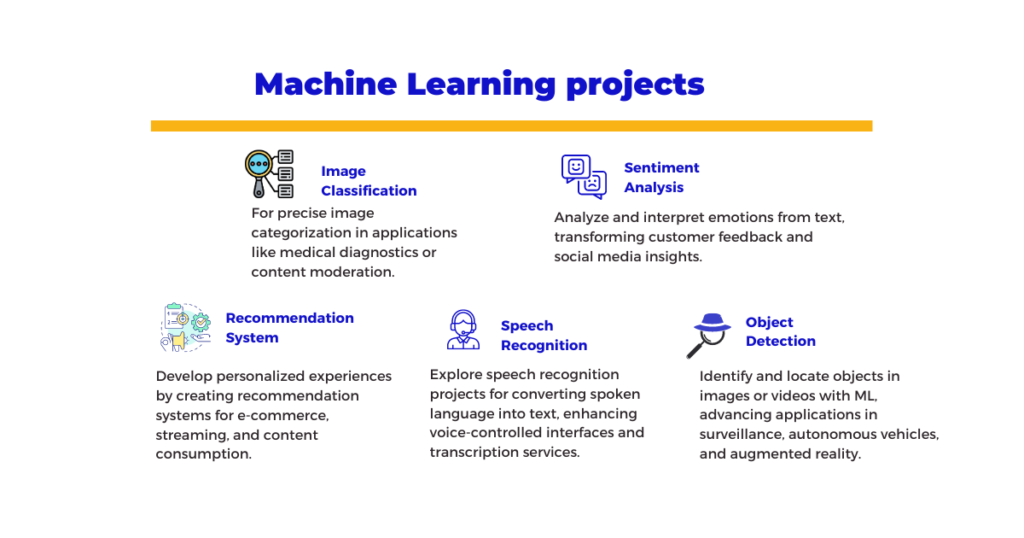
What are some Machine Learning projects I can work on?
There are many machine learning projects that you can work on. Here are some ideas to get you started:
Image classification: Build a model that can classify images into different categories. For example, you can build a model that can identify different types of flowers.
Sentiment analysis: Develop a model that can analyze text and determine the sentiment behind it. For example, you can build a model that can determine whether a movie review is positive or negative.
Recommendation system: Build a model that can recommend products or services to users based on their preferences. For example, you can build a model that can recommend movies to users based on their viewing history.
Speech recognition: Develop a model that can recognize speech and convert it into text. For example, you can build a model that can transcribe audio recordings into text.
Object detection: Build a model that can detect objects in images or videos. For example, you can build a model that can detect cars in traffic footage.
According to various salary aggregate sites, the average salary for a machine learning engineer in the United States ranges from $116,416 to $140,180 depending on experience, industry, and location. The average salary for a machine learning engineer in the United States is $161,555 per year. The salary range for a machine learning engineer is $44K-$170K.
It’s important to note that the salary of a machine learning engineer can be influenced by many factors, such as experience, industry, and geographic location. According to Glassdoor, the experience breaks down as follows:
0-1 years: $127,350
1-3 years: $144,572
4-6 years: $150,193
7-9 years: $154,779
10-14 years: $162,356
15+ years: $170,603
Machine learning engineers are in high demand in many industries, including healthcare, transportation, finance, agriculture, and cybersecurity. If you’re interested in pursuing a career in machine learning engineering, you can expect to make much more than the median salary in the United States.
Conclusion
We’ve embarked on a whirlwind journey through the fascinating world of machine learning, exploring its inner workings, potential applications, and real-world examples. Now, as we stand at the crossroads of the present and future, let’s reflect on the key takeaways and peer into the exciting possibilities that lie ahead.
A Recap of Wonders: Machine learning has unveiled its magic, demonstrating its ability to learn, adapt, and evolve. We’ve witnessed how algorithms decipher patterns in data, generating predictions from spam filtering to image recognition. Different models, like neural networks and support vector machines, tackle diverse tasks, while supervised, unsupervised, and reinforcement learning offer unique learning paradigms.
We’ve also acknowledged the strengths and limitations of ML, its dependence on data, and the challenges of bias and interpretability. Importantly, we’ve delved into the intricate development workflow, from data collection and cleaning to model training and deployment, highlighting the critical role of continuous learning and refinement.
Open Questions Remain: Despite its advancements, several questions remain open for exploration. Can we achieve true artificial general intelligence, replicating the vast learning capabilities of the human brain? How do we mitigate biases and ensure the ethical development of ML systems? Can we make complex models more interpretable, fostering trust and transparency? These are crucial questions that will shape the future trajectory of this field.
Predictions for an ML-Powered Future: As we gaze into the crystal ball, the future seems ablaze with the potential of machine learning. Imagine personalized healthcare with AI-powered diagnosis and treatment plans. Envision self-driving cars that navigate city streets with superhuman precision. Picture an education system tailored to individual learning styles, maximizing the potential of every student. These are just a few glimpses of the transformative world that awaits, where ML acts as a silent co-pilot, enhancing every aspect of our lives.
The journey of machine learning has just begun. As we continue to delve deeper into its intricacies, harness its potential responsibly, and address its challenges, we stand poised to unlock a future brimming with possibilities. This is not just a technological revolution; it’s a chance to reshape our world for the better, one algorithm at a time.
What exactly is machine learning?
Machine learning is a subfield of artificial intelligence (AI) that focuses on the development of algorithms and statistical models that enable computer systems to improve their performance on a specific task through experience and learning from data, without being explicitly programmed. In other words, machine learning allows computers to learn patterns and make predictions or decisions based on data inputs.
What are the real-world applications of machine learning?
From recommending your next favorite movie to detecting fraudulent transactions, ML powers diverse applications across various industries. It helps doctors diagnose diseases more accurately, personalizes your online experience, and even fuels self-driving cars!
What skills do I need to become a machine learning engineer?
Strong mathematical and coding skills are essential, especially in areas like statistics, linear algebra, and programming languages like Python or R. Additionally, understanding data structures, algorithms, and software engineering principles is crucial. Bonus points for a grasp of business acumen to understand the practical needs of different applications.
Do I need a degree to become an ML engineer?
While a degree in computer science, data science, or mathematics can provide a strong foundation, it’s not a mandatory requirement. The field welcomes self-driven learners who acquire relevant skills through online courses, bootcamps, and hands-on projects. Dedication, passion for learning, and a knack for problem-solving are key ingredients for success.
Where do I start my journey to becoming an ML engineer?
Start by building your knowledge base through online courses, books, and tutorials. Focus on core concepts like training data, algorithms, and different types of learning. Next, get your hands dirty with personal projects, participating in online communities like Kaggle, and taking on freelance gigs. Finally, stay relevant by continuously learning new tools and keeping up with the ever-evolving landscape of ML.
In today’s digital world, keeping your children safe online feels like a tightrope. The fear of online predators, cyberbullying, and inappropriate content is a constant worry for parents. Enter the Bark Phone, a kid-focused phone with built-in parental controls designed to provide peace of mind and a secure phone experience for your children.
This innovative device seamlessly integrates the renowned Bark app, offering advanced monitoring capabilities and granular control over app usage and communication, all in one convenient package. In this Bark Phone review, we will talk about everything in detail.
Bark Phone: The Safest Phone for Kids and Teens
The Bark Phone offers a user-friendly activation process where users, post-purchase, can opt for a monthly data plan based on their preferences: Starter Plan: $29/mo. Wi-Fi Only: $49/mo. 4GB: $59/mo. 8GB: $69/mo. Unlimited GB: $89/mo.
This device features state-of-the-art monitoring capabilities, providing alerts for potential issues across various communication channels. Users can receive notifications regarding their child’s texts, emails, and activities on 30+ social media platforms and apps. The monitoring system scans for potential concerns such as online predators, sexting, suicidal ideation, bullying, violence, drugs and alcohol, and more.
Parents can actively manage their child’s digital environment by having the ability to approve specific apps for installation and control who their child can contact through calls and texts. The tamper-proof parental controls ensure that the rules set by parents remain in place, and texts cannot be deleted without parental permission.
This Bark Phone review details how the complete Bark Phone package seems heaven-sent for families like mine needing that extra level of confidence and comfort when our kids are playing in the wild west of the online world. I’m resting easier already.
Hardware and Software Deep Dive
Hardware
Let’s pop the hood and dissect the Bark Phone’s physical prowess. The processor, the powerhouse at its core, is a Snapdragon 765G, outperforming similar phones in its category. This translates to impressive speed and performance, making it a reliable device for your child’s digital needs.
With ample RAM and storage, multitasking and app handling are seamless. The 6.6-inch display provides vivid visuals, and the camera’s capabilities capture life’s moments in detail. The battery life is commendable, lasting a full day under normal usage scenarios. The build quality feels sturdy enough to withstand typical kid-related wear and tear.
Software: The AI Guardian Within
Bark OS, the brains behind the operation, is where the magic happens. Its parental controls are like a Swiss army knife of digital safety, allowing you to:
Filter apps: Curate a whitelist of age-appropriate apps and block the rest.
Monitor texts, emails, and social media: See what your child is saying and to whom, without invading their privacy.
Track screen time: Set limits on daily and weekly usage, ensuring a healthy digital balance.
Track location: Know where your child is with GPS accuracy, providing peace of mind on the go.
Identify at-risk behavior: The AI, the true guardian angel, scans content for signs of cyberbullying, sexting, suicidal ideation, and predatory interactions. It then alerts you discreetly, allowing for proactive intervention and open communication.
Bark OS is surprisingly user-friendly, with a clean interface for both parents and children. Parents can manage everything from a dedicated app, while children enjoy a familiar Android experience without feeling overly monitored.
Connectivity: Bark Phone Review
The Bark Phone offers flexible data plans and is compatible with major networks. So, it’s not possible to integrate Bark with your current AT&T, T-Mobile, or Verizon plan. The Bark Phone operates through Bark Wireless, an MVNO that is likely dependent on AT&T’s network. Wi-Fi performance is robust, ensuring strong signal strength and stability.
While potential security concerns might arise with parental monitoring, Bark assures users of data encryption and privacy measures. For international travel, some network compatibility limitations might require additional considerations.
While Bark might be the reigning champion in the kid-safe phone arena, it’s not the only warrior worthy of your consideration. Let’s explore what its rivals offer before crowning the king (or queen) of child-friendly tech.
Gabb: Think of a flip phone with modern sprinkles. Gabb champions basic communication and robust parental controls, perfect for the pre-teen crowd. But if your child’s a budding gamer or social media guru, its limited app pool and restricted internet access might feel like a digital dungeon.
FamilyWall: Boasting similar controls to Bark, FamilyWall keeps tabs on your child’s digital escapades with eagle-eyed vigilance. However, Bark’s AI edge shines here. Unlike its rival, Bark proactively scans for warning signs, not just content flags, potentially preventing a stumble before it becomes a fall.
Finding Your Fit
Ultimately, the phone you choose hinges on your family’s unique needs. Gabb’s simplicity and affordability might charm younger kids, while FamilyWall’s control prowess could appeal to parents yearning for ultimate digital oversight. Bark, however, strikes a different balance. It’s not just about control; it’s about creating a safe and healthy digital environment through:
AI Guardian: Bark Phone’s AI Guardian stands as a testament to the power of artificial intelligence in child safety. Unlike traditional parental control software that relies on keyword filtering and blacklists, Bark Phone leverages the ever-evolving capabilities of AI to proactively detect potential dangers before they escalate.
Customizable Kingdom: Unlike walled gardens, Bark lets you choose the apps your child can explore and craft a personalized digital playground. While keeping our children safe in the digital world is paramount, simply monitoring their online activity falls short. With the Customizable Kingdom, you become the architect of your child’s digital world.
Communication Bridge: Monitoring alone isn’t enough. Bark fosters open dialogue, transforming digital oversight into a springboard for stronger parent-child connections. While keeping our children safe in the digital world is paramount, simply monitoring their online activity falls short. Bark Phone recognizes this and goes a step further by offering a Communication Bridge, a feature that transforms digital oversight into a springboard for deeper, more meaningful conversations between parents and children.
Bark’s price tag might raise eyebrows compared to budget-friendly competitors. But remember, this is an investment in peace of mind and proactive safety. Think of it as buying an invisible shield, one that deflects cyberbullying, sexting, and other digital dangers before they can harm your child.
Choose wisely, dear parent. Whether it’s Bark’s AI shield, Gabb’s simplicity, or FamilyWall’s control fortress, finding the right phone is about protecting your child’s digital journey, not stifling it.
Drawbacks and Unleashing Taming Strategies
No device is perfect, and Bark has its limitations. Acknowledging them openly demonstrates your honesty and helps readers make informed decisions. The limited app pool, while ensuring safety, might not satisfy tech-hungry teenagers. Similarly, high-end gaming enthusiasts might find the phone’s specs underwhelming. Finally, some parents might have privacy concerns regarding data collection.
The Limited App Pool Challenge
Drawback: For some tech-savvy teens accustomed to an app buffet, Bark’s curated app store might feel like a desert landscape. Cravings for the latest social media sensations, trendy games, or niche productivity tools could leave them feeling parched.
Taming Tips:
Embrace the Oasis: Frame the limited app pool as a refreshing respite from digital overload. Highlight how focused communication and quality family time flourish when distractions are minimized.
Carve Out a Designated Digital Watering Hole: Consider offering supervised tablet use or a family computer for specific gaming or app needs. Set clear boundaries and time limits to ensure balance.
Turn Scarcity into a Treasure Hunt: Encourage your child to explore the available apps with a sense of discovery. Help them find hidden gems that align with their interests and hobbies, showcasing the joy of quality over quantity.
Specs that Might Not Cut the High-Octane Chase
Drawback: Gaming enthusiasts accustomed to high-performance rigs might find the Bark Phone’s processing power lacking, leading to frustrated sighs and pixelated disappointment.
Taming Tips:
Shift the Focus: Remind your child that the Bark Phone prioritizes communication and safety, not competitive e-sports dominance. Showcase the phone’s strengths in fostering real-world connections and open communication.
Build a Shared Gaming Arena: Consider creating a family gaming space equipped with consoles or a dedicated gaming PC. This allows teens to enjoy their passion while maintaining open communication and family engagement.
Embrace Analog Adventures: Encourage board games, outdoor activities, and creative pursuits as alternative forms of entertainment. Help your child discover the joy of offline adventures and connect with friends in face-to-face interactions.
Privacy Paranoia
Drawback: Some parents might feel uneasy about data collection and AI monitoring, even if it’s for safety purposes. Concerns about overstepping privacy boundaries or potential misuse of information may linger.
Taming Tips:
Transparency is key: Be upfront about Bark’s data encryption and parental control features. Explain how you, as the parent, have complete control over what information the AI analyzes and what alerts you receive.
Open Communication Bridge: Foster a dialogue with your child about the phone’s features and the reasons behind your choice. Address their concerns openly and honestly, emphasizing your commitment to responsible data management and open communication.
Setting Boundaries with the AI Watchdog: Customize Bark’s monitoring settings to your comfort level. Choose which categories of alerts you want to receive and ensure the system aligns with your values and parenting style.
Remember, the Bark Phone is not a utopian device. Understanding its potential drawbacks and implementing creative taming strategies empowers you to harness its strengths for a safe, connected, and ultimately joy-filled digital experience for your child.
Bark Phone Information
Features and Specs
Brand
Bark
Wireless Carrier
MVNO
Operating System
Android 13.0
Cellular Technology
5G
Memory Storage Capacity
64 GB
Connectivity Technology
Wi-fi
Screen Size
Black
Color
Black
Screen Size
6.6 Inches
Ram Memory Installed Size
4GB
Connector Type
USB Type C
Water Resistance Level
Water Resistant
Audio Jack
3.5 mm
Battery Power
4900
Rear Camera Resolution
50 MP
Display Type
LCD
Display Resolution Maximum
1080 x 2408 Pixels
Pros and Cons
Pros
Excellent range of parental controls
Can be set up for ages 8 and up
Customization for Child’s Needs
Get instant alerts for areas of concern
Automated Content Monitoring
Lots of apps available for approval
Monitoring of Texts and Photos
USB-C Charging Compatibility
Cons
Must use Bark’s wireless service
Can’t buy the phone outright
Limited Customer Service Channels
Absence of Wall Charger
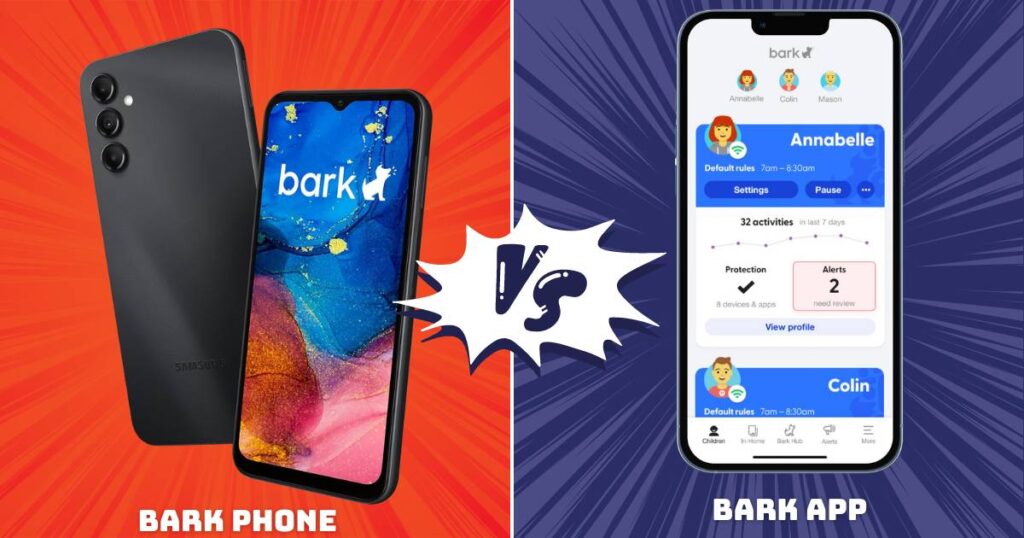
Bark Phone vs. Bark App
While both the Bark Phone and the Bark app offer comprehensive parental control solutions, choosing the right one depends on your family’s specific needs and budget. Here’s a breakdown of the key differences:
Features: Keeping your children safe online is paramount in today’s digital age. While both the Bark Phone and the Bark App aim to address this concern, they offer distinct features and levels of control. This detailed comparison will guide you in choosing the option that best suits your family’s needs:
Bark Phone:
Utilizes advanced AI to identify potential issues like cyberbullying, suicidal ideation, and online predators.
Exclusive features like location tracking, SOS alerts, and panic buttons.
Bark App:
Monitors texts, emails, social media posts, and some app activity on existing devices.
Can be installed on multiple devices (phones, tablets, computers) under a single subscription.
No tamper-proof settings: Children can potentially uninstall the app or bypass some monitoring.
Cost:
Bark Phone: Starts at $29/month, including a data plan and Bark app access for other devices.
Bark App: Starts at $14/month for the basic plan, with tiered pricing for additional features.
Ease of Use:
Bark Phone: Pre-configured and ready to use out of the box. No installation is required on other devices.
Bark App: Requires installation on each device and parental setup on each platform.
Privacy:
Bark Phone: Stores flagged content on Bark’s secure servers for parental review.
Bark App: Allows parents to see flagged content directly on their device, potentially raising privacy concerns for some families.
Overall: Both the Bark Phone and Bark App offer valuable functionalities, but their ideal applications differ. Here’s a quick guide to help you decide:
Choose Bark Phone if:
You want the most comprehensive monitoring and tamper-proof control.
You’re looking for an all-in-one solution with a phone included.
Cost isn’t the primary concern.
Choose Bark App if:
You already have devices you want to monitor.
You need a more budget-friendly option.
You’re comfortable with installing and managing the app on multiple devices.
Ultimately, the best choice for your family depends on your individual needs and priorities. Weigh the features, cost, ease of use, and privacy considerations before making your decision.
Conclusion
The digital world can be a scary place for kids, but it doesn’t have to be for parents! The Bark Phone offers a powerful set of tools to help you keep your child safe online, all while fostering open communication and building trust.
Think of it as a helping hand, not a magic solution. It empowers you to create a safe space for your child to explore the online world while learning the skills they need to be responsible digital citizens.
Ultimately, the decision is yours. But the Bark Phone is worth considering if you’re looking for a way to create a calmer, more connected family dynamic in the digital age.
It’s an investment in your child’s future, equipping them to navigate the online world with confidence and build meaningful connections.
Big Data architects are the masterminds behind the infrastructure that tames the data tsunami. They design and implement sophisticated systems that can ingest, store, process, and analyze massive datasets, transforming chaos into clarity.
In this article, we embark on an exploration of the captivating realm inhabited by Big Data architects. Our journey will take us through the fundamental role these professionals play in shaping data landscapes and shedding light on the promising career path within the domain of Big Data.
Additionally, we’ll delve into the intricacies of Big Data salaries, certifications, and the essential skills that pave the way for success in this dynamic and evolving field. Join us as we navigate the multifaceted world of Big Data architecture, uncovering its nuances and the keys to a rewarding career in this ever-expanding domain.
Master big data, and build your architect blueprint. Technologies, skills, salaries, paths of a Big Data Architect– all unveiled. Dive in and sculpt your data-driven future.
What Does a Big Data Architect Do?
A Big Data architect is tasked with designing the infrastructure and systems to effectively manage, process, and derive meaningful insights from this massive volume of data. This includes implementing storage solutions, integration processes, and analytical tools to ensure that organizations can harness the power of Big Data for informed decision-making and strategic advancements.
The role of a Big Data architect is pivotal in creating architectures that can handle the challenges posed by the scale and diversity of Big Data. Now, we will discuss in detail their role.
Designing the Blueprint: The Big Data architect makes the master plan, like an engineer planning a new city. They design pipelines to bring in data smoothly from many sources. They build storage that can hold huge amounts of structured and unstructured data. They ensure all data flows to the right place. They also choose processing tools to turn raw data into useful insights. They manage complex workflows to analyze giant datasets efficiently.
Technology Toolbox: A Big Data Architect’s tool belt is more than just screwdrivers and wrenches. Their arsenal boasts cutting-edge technologies like Apache Kafka, which acts as a nerve center for real-time data movement, ensuring insights flow as swiftly as the data itself. They speak the languages of databases, NoSQL, and SQL alike, choosing the optimal storage solution for each data type and purpose.
The Bridge Between Business and Tech: The architect connects business needs and technical possibilities. They listen to stakeholders, understand their vision, and translate it into data-driven solutions. They grasp business goals like optimizing marketing, predicting customer behavior, or finding operational inefficiencies. Then they build the tech architecture to deliver those insights. They speak both business and technical language, ensuring the data infrastructure drives real business impact.
Why Big Data Architects are Indispensable?
Big Data architects are really important in today’s tech world. They do more than just handle data—they help find valuable stuff hidden in it. Think of them as guides in a big sea of data, using special tools to discover things that are hard to see.
They can predict things like customers leaving, catch fraud happening right away, and make marketing really exact. Big Data architects are like magicians turning raw data into something super valuable. This helps a lot with new ideas and makes businesses stand out.
But it’s not just about finding cool patterns. They also make sure these discoveries help businesses in real ways. Imagine making factories better using live data, stopping machines from breaking, and avoiding big problems. Big Data architects make this happen. Their work affects how much money a business makes, how well it runs, and how happy customers are. They’re like builders of a future where decisions are all based on smart insights.
And they don’t stop there. Big Data architects are like protectors, ready for whatever new tech comes. They plan ahead so that the systems they create can handle new stuff like blockchain, the Internet of Things, or super-smart AI. They make sure everything stays strong and can change when needed. They know the future is always moving, not stuck in one place. In short, Big Data architects are vital—they’re the builders of cool ideas, better businesses, and a future where data is super powerful.
The Big Data Architect Career Path
The journey to becoming a Big Data architect is an exciting one, paved with continuous learning and the thrill of pushing the boundaries of data-driven possibilities. If you’re drawn to this exciting realm, becoming a Big Data architect could be your perfect career blueprint. But where do you start? Let’s navigate the path together.
Education and Skills:
Formal Foundation: A bachelor’s degree in computer science, information technology, data science, or related fields provides a solid foundation in programming, databases, data analysis, and computer architecture. Master’s programs and specialized boot camps offer further learning and career-specific skills.
Sharpening the Tools: Hone your expertise in key technologies like SQL, Hadoop, Spark, Kafka, and cloud platforms like AWS, Azure, or GCP. Hands-on experience through projects and internships is invaluable.
Statistical Prowess: Develop proficiency in statistics and data visualization to navigate the complex world of data. Learn to uncover patterns, tell compelling stories with charts and graphs, and effectively communicate insights to diverse audiences.
Bridging the Gap: Strong communication and collaboration skills are vital. You’ll bridge the gap between technical expertise and business needs, translating complex data into actionable insights for stakeholders.
Charting Your Course:
Entry Points: Fresh graduates or professionals seeking a career change can enter through positions like Data Analyst, Data Engineer, or Junior Big Data Architect. Gaining experience and building a portfolio are keys to climbing the ladder.
Career Progression: As you navigate the data landscape, advancement could lead to Senior Big Data Architect, Enterprise Architect, Chief Data Officer, or even venturing into data science or related specialties. The possibilities are vast.
Skill Sharpening: Continuous learning is your mantra. Online courses, certifications like Cloudera Certified Professional (CCP) or Apache Spark Certified Developer, and active participation in online communities and conferences keep you at the forefront of the ever-evolving big data scene.
Big Data Certifications
In the world of big data, knowledge is power, but validated expertise holds the key to unlocking doors of opportunity. Big data certifications act as your professional passport, showcasing your skills and boosting your resume in the eyes of potential employers. So, if you’re looking to build a career as a Big Data architect and accelerate your ascent, consider polishing your credentials with these valuable certifications:
1. Cloudera Certified Professional (CCP):
Imagine this certification as your master’s degree in big data architecture. The CCP program tests your proficiency in designing, building, and managing Hadoop infrastructure, the cornerstone of the big data ecosystem. Earning this badge signifies industry-recognized expertise, opening doors to senior-level roles and commanding top salaries.
2. Apache Spark Certified Developer Associate:
Think of Spark as the rocket engine of big data, and this certification as your pilot’s license. Mastering Spark, the high-performance data processing framework, empowers you to analyze vast datasets in real time, making you a sought-after asset for any organization navigating the fast-paced world of big data.
3. AWS Certified Big Data Specialty:
If you’re a cloud aficionado, this certification is your golden ticket. It validates your ability to design and implement big data solutions on Amazon Web Services, the reigning champion of cloud infrastructure. Employers across industries crave professionals with this cloud-focused expertise, making you a prime candidate for lucrative opportunities.
4. Microsoft Certified Azure Data Engineer Associate:
Not a fan of Amazon? No problem! The Microsoft Azure platform reigns supreme in some corners of the cloud universe, and this certification proves your mettle in building and managing big data solutions using Azure’s robust data services. With Azure’s rising popularity, mastering this platform gives you a competitive edge in the job market.
5. Open Certified Data Scientist (OCDS):
Want to bridge the gap between big data analysis and data science? This vendor-neutral certification validates your proficiency in the entire data science lifecycle, from data wrangling and cleansing to model building and evaluation. It positions you as a versatile data expert capable of extracting actionable insights from complex datasets, making you a valuable asset for any data-driven organization.
Beyond the Badge:
Remember, certifications are just the first step. Continuously hone your skills, stay updated on emerging technologies, and build a strong portfolio showcasing your practical expertise. Combine your validated knowledge with real-world experience, and you’ll be well on your way to becoming a Big Data architect in high demand.
Take the first step towards building your certified roadmap to success in the world of big data. Invest in your knowledge, showcase your expertise, and watch your career take flight!
Big Data Architect Salaries
The allure of big data extends beyond the thrill of unlocking hidden insights; it also translates to real-world rewards, and Big Data architects sit at the helm of this lucrative realm. If you’re considering this career path, understanding the earning potential is key to building your financial blueprint.
The average Big Data Architect salary in the US stands at a healthy $160,950 annually or $77.38 per hour, according to Talent.com. Those just starting as big data architects make approximately $135,000 per year. Most experienced big data architects take home up to $192,500 per year. However, much like the data they wrangle, salaries can vary significantly based on several factors:
Experience: Early-career architects can expect to start around $112,326, while seasoned professionals with extensive experience can reach $192,500 per year.
Location: Big data hubs like Washington, California, New York, Maryland, and Virginia tend to offer higher salaries, with major metropolitan areas boasting figures exceeding $150,000. As of January 2024, ZipRecruiter reports top-paying cities for big data architects in the US. Leading the list are San Jose, Oakland, and Hayward, CA. Other lucrative options include San Francisco, CA, Baltimore, MD, and Jersey City, NJ, according to Zippia.
Industry: Specialization plays a role, with sectors like tech, finance, and healthcare offering some of the most lucrative opportunities. According to Glassdoor, Amazon, IBM, and DXC Technology are the top 10 highest-paying companies for big data architects in the US. Glassdoor also says that information technology is one of the top-paying industries for big data architects.
Skills & Certifications: Demonstrating mastery of advanced technologies like Spark or Kafka, coupled with industry-recognized certifications, can significantly boost your value and earning potential.
Beyond the Numbers:
While the numbers paint a promising picture, remember that financial rewards are just one piece of the puzzle. Big Data Architects enjoy:
Job Security: The demand for skilled architects is skyrocketing, with the Bureau of Labor Statistics projecting 12% job growth over the next decade, much faster than the average for all occupations.
Career Growth: Advancement opportunities abound, with the potential to climb the ladder to senior architect, chief data officer, or even venture into data science specialties.
Intellectual Challenge: The ever-evolving landscape of big data keeps the job intellectually stimulating, demanding continuous learning and adaptation.
Making a Difference: Your work directly impacts organizations, shaping data-driven decisions that can improve efficiency, optimize operations, and even transform lives.
The blueprint to a rewarding Big Data architect career starts with investing in your skills and experience. Seek opportunities to hone your expertise in key technologies, build your portfolio through projects, and pursue relevant certifications. Networking with other professionals and staying updated on industry trends are also crucial for career advancement.
Navigating the vast ocean of big data requires more than just a compass; it demands a well-equipped toolkit filled with the right skills. For Big Data architects, this toolkit is a blend of technical prowess and soft skills, allowing them to chart a course through complex data landscapes and deliver actionable insights. So, let’s explore the essential tools you need to add to your own Big Data Architect toolkit:
Technical Prowess:
Programming Languages: SQL remains the bedrock, enabling you to query and manipulate relational databases. But mastering languages like Python, Java, or Scala opens doors to advanced data analysis and distributed computing frameworks.
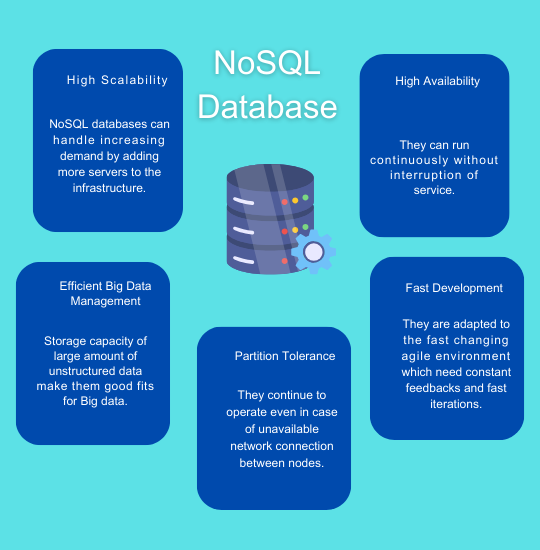
Big Data Technologies: Familiarity with Hadoop, Spark, Kafka, and NoSQL databases is crucial. Understanding their strengths and weaknesses allows you to design efficient data pipelines and architectures.
Cloud Platforms: The cloud is the future of data storage and processing. Familiarity with AWS, Azure, or GCP empowers you to build scalable and cost-effective data solutions.
Data Analysis and Visualization: Tools like Tableau, Power BI, and Python libraries like Matplotlib and Seaborn equip you to transform raw data into compelling stories and insights for stakeholders.
Statistics and Probability: Understanding statistical concepts like hypothesis testing and regression analysis allows you to draw meaningful conclusions from data and make informed decisions.
Soft Skills:
Communication and Collaboration: You’re the bridge between technical data and business needs. Effective communication with diverse stakeholders, from executives to data scientists, is paramount.
Problem-solving and Critical Thinking: Big Data is inherently messy. You need the analytical skills to identify problems, troubleshoot issues, and develop creative solutions.
Project Management and Leadership: Big data projects involve teams and deadlines. Mastering project management methodologies and leading teams effectively ensure smooth execution.
Continuous Learning: The big data landscape is constantly evolving. A growth mindset and a commitment to continuous learning are essential to staying ahead of the curve.
Imagine a carpenter tackling a complex project without the right tools. Just like any craftsman needs a hammer, saw, and chisel, Big Data architects rely on a powerful arsenal of technologies to tame the deluge of data. Let’s explore some of the essential tools in their toolbox:
1. Hadoop: The Distributed Workhorse
Think of Hadoop as the lumberyard of the big data world. It provides a distributed file system that breaks down massive datasets into smaller chunks and distributes them across a cluster of computers. This parallel processing power allows Big Data architects to analyze massive datasets quickly and efficiently. It’s like having hundreds of workers simultaneously tackle different parts of a large construction project, significantly speeding up the overall process.
2. Spark: The Speedy Analyzer
While Hadoop excels at storing and distributing data, Spark shines at analyzing it. Imagine Spark as a high-powered drill, effortlessly crunching through those data chunks. It offers in-memory processing, meaning data is stored in RAM for faster computation, significantly increasing processing speed compared to Hadoop’s disk-based approach. This makes Spark ideal for real-time analytics and iterative tasks where quick insights are crucial.
3. Kafka: The Streamlining Streamlining Agent
Think of Kafka as the conveyor belt of the data processing pipeline. It continuously ingests and routes data streams like a fast-moving river, ensuring they reach the right destinations for analysis. Whether it’s sensor data from IoT devices, social media updates, or website clickstream data, Kafka keeps the information flowing smoothly without overwhelming other systems.
4. NoSQL Databases: The Flexible Storage Solutions
Imagine traditional SQL databases as neatly organized filing cabinets, while NoSQL databases are like flexible storage bins. Traditional databases struggle with the unstructured and diverse nature of big data. NoSQL databases, on the other hand, offer greater flexibility and scalability, readily accommodating different data types and formats. They’re ideal for storing social media posts, sensor readings, and other non-traditional data sources.
5. Cloud Platforms: The Scalable Infrastructure
Think of cloud platforms like Google Cloud Platform or Amazon Web Services as the expansive canvas on which Big Data architects build their data infrastructure. These platforms offer on-demand access to virtual servers, storage, and other resources, allowing architects to scale their systems up or down as needed. This flexibility and cost-effectiveness make cloud platforms crucial for building robust and adaptable big data infrastructures.
Beyond the Tools
These technologies are just instruments in the hands of a skilled Big Data architect. Their real power lies in the architect’s ability to select the right tools for the job, combine them into an efficient workflow, and ensure smooth data flow from ingestion to analysis. They act as conductors, orchestrating the data symphony across platforms and technologies and extracting the valuable insights hidden within the data’s cacophony.
By understanding the strengths and weaknesses of each technology, Big Data architects can design systems that handle the ever-growing volume, velocity, and variety of data in today’s world. Whether it’s optimizing marketing campaigns, predicting customer behavior, or identifying operational inefficiencies, these technological tools, wielded by the expertise of Big Data architects, are shaping the data-driven future of every industry.
Conclusion
In the age of big data, information is not just power; it’s the very fabric of how we live, work, and make decisions. But data, in its raw state, is like a vast, uncharted ocean—gloomy and full of hidden potential. It’s the Big Data Architect who acts as the navigator, charting the course, building the bridges, and guiding us toward the invaluable insights buried within.
These masterminds of the data age are much more than just technologists. They are strategists, translators, and visionaries who understand the language of both machines and humans. They possess the technical prowess to design and implement complex data infrastructure, the analytical ability to unlock hidden patterns in chaos, and the business acumen to translate those insights into tangible outcomes.
They are the architects of the future, where every decision is fueled by data-driven precision, where customer experiences are crafted with laser-sharp personalization, and where operational efficiency soars to unprecedented heights. Their work not only drives revenue and optimizes business processes but also shapes the fabric of our daily lives – from predicting traffic patterns to personalizing healthcare interventions.
The world of Big Data architecture is not just a career path; it’s an invitation to be a part of something bigger. It’s an opportunity to be at the forefront of innovation, solve complex challenges, and shape the future with the power of information.
If you’re looking for a career that is both intellectually stimulating and deeply impactful, look no further. The world of Big Data architecture awaits, with its vast oceans of information and the promise of shaping the insights that will guide us all toward a brighter tomorrow.
Juggling data caps? Taming sky-high bills? Dodging robo-call clowns? Big Tech’s mobile circus might be making you the unwilling star. But step right up, fellow data warriors, because there’s a new act in town. Forget the Big Four—Cox Mobile, the MVNO underdog, is stealing hearts with its killer deals, 5G reliability, and no-contract bliss!
This ain’t no cheesy sideshow. Cox Mobile’s 5G magic sends buffering into oblivion, while their plans bend to your data cravings, from bottomless buckets to bite-sized snacks. And the best part? No long-term contracts, no hidden fees, just transparent pricing and the freedom to switch whenever the mood strikes.
Think of it as ditching the Big Tech drama for a mobile oasis. Imagine crystal-clear calls, uninterrupted streaming, and customer service that listens. Yeah, Cox Mobile is rewriting the rules.
So, let’s crack open this MVNO magic box and see why ditching the Big Tech blues for Cox Mobile might just be your smartest move yet. Ready to say goodbye to data dramas and hello to mobile bliss? Buckle up! The Cox Mobile revolution is about to begin!
Cox Mobile as an MVNO
An MVNO, or a Mobile Virtual Network Operator, is a company offering mobile phone services, including calls, data, and texting, without having its wireless network infrastructure. Instead, it opts for a leaner approach by leasing wireless services from major carriers such as T-Mobile or Verizon and subsequently reselling them to customers under its brand. This streamlined model allows MVNOs to reduce costs and offer attractive deals directly to consumers who crave data.
In contrast to the big four, with their extensive networks and substantial overhead, MVNOs emerge as nimble underdogs. They don’t own the radio towers; rather, they rent bandwidth from major carriers, akin to borrowing a friend’s Wi-Fi to stream your favorite show. Similar to Spectrum and Xfinity’s cable MVNOs, Cox Mobile functions as a Verizon MVNO. Additionally, it enhances Verizon’s coverage by utilizing Cox Communications’ network of 4 million WiFi hotspots. However, it’s essential to note that not all MVNOs are created equal, adding a unique twist to this dynamic landscape.
But here’s the twist: not all MVNOs are created equal. Enter Cox Mobile, the cool kid on the block with a 5G phone in one hand and a customer-centric philosophy in the other. They leverage the robust network you know and trust but infuse it with tech-savvy plans, flexible options, and a genuine commitment to making your mobile life awesome. Think of them as the Robin Hood of MVNOs, redistributing data riches from the Big Tech barons to your mobile kingdom.
So, what makes Cox Mobile unique? First, they’re passionate about 5G, delivering lightning-fast speeds that make buffering a distant memory. Then, they understand that one-size-fits-all doesn’t fly, offering a diverse range of plans to suit your data cravings, from bottomless buckets for binge-watchers to budget-friendly bites for casual scrollers. But the cherry on top is their focus on you, the customer. No more robocalls or endless hold times; Cox Mobile’s team speaks the language of humor and wants to help.
In short, MVNOs are the disruptors, the Robin Hoods, the cool kids of the mobile world, and Cox Mobile is their tech-savvy captain. They’re here to bring down the data walls, break free from contracts, and offer you an experience that’s enjoyable. So, are you ready to join the MVNO revolution and see what Cox Mobile has in store?
Cox Mobile vs. the Rest: A Tale of Two Worlds
So, you’ve cast your gaze upon Cox Mobile, the MVNO shaking the mobile landscape with its 5G thunder and flexible plan whispers. But before you jump ship from the Big Tech galleons, let’s raise the anchor and see how Cox Mobile navigates the choppy waters compared to its rivals:
Speed Demons: 5G Showdown:
Big Tech Titans: Some Big Tech carriers boast expansive 5G coverage, but their networks can get congested, slowing down your data highway to a dusty country lane.
Cox Mobile: While their 5G footprint might not be as vast yet, Cox Mobile leverages a robust network to ensure smoother sailing and consistently high speeds, often rivaling the big players. Cox Mobile utilizes Verizon’s 4G LTE and 5G networks, ensuring reliable speeds and excellent coverage. Cox Mobile’s 4G LTE signal coverage stands at 70%, surpassing AT&T’s 68% and T-Mobile’s 62%.
Plan Puzzlers: Finding Your Fit:
Big Tech Labyrinths: Navigating Big Tech plan options can be like solving a complex Rubik’s cube. Rigid contracts, data caps that vanish faster than a magician’s rabbit, and hidden fees make budgeting a nightmare.
Cox Mobile Oasis: Cox Mobile’s plans are refreshingly straightforward. From bottomless data oceans for the data krakens to bite-sized packages for the occasional scrollers, there’s a plan for every pocket and data appetite. And the best part? No contracts, no hidden fees, just transparent pricing and flexibility.
Commitment Conundrums: Freedom or Shackles?
Big Tech Chains: Big Tech loves long-term contracts, chaining you to your plan like an anchor in a hurricane. Switching providers becomes a bureaucratic hassle, leaving you feeling trapped.
Cox Mobile Open Seas: Cox Mobile offers month-to-month plans, which means you can switch to another plan without penalty or drama. If you like your current plan, you can stay aboard and continue using it. Cox Mobile’s flexible plans are designed to fit your mobile needs, whether you’re a data guzzler or a casual scroller.
[wptb id=7717]
Family Savings: Sharing the Treasure
Big Tech Pricey Pirate Plunder: Family plans from Big Tech often come with hefty price tags, making mobile magic an expensive treasure hunt.
Cox Mobile Family Bounty: Cox Mobile’s family plans are designed for sharing, offering generous data allotments and cost-effective bundling options. With these plans, you can combine lines and enjoy significant savings, making mobile services affordable for the entire family. The option to add up to 5 lines to your account allows for more savings; for instance, you can pay as little as $30 per line per month when adding four or more Gig Unlimited lines.
Coverage Cartographers: Charting the Unknown
Big Tech Empire Maps: While Big Tech carriers have extensive coverage maps, dead zones, and signal disruptions can still lurk in the corners.
Cox Mobile Treasure Map: Cox Mobile utilizes a robust network, providing extensive coverage in key areas and expanding consistently. Their coverage map indicates nationwide 4G LTE and 5G support, ensuring strong connections across the country. Additionally, Cox Mobile supports 4G LTE on all devices nationwide, ensuring connectivity even in areas without 5G. The network is designed for reliable coverage, reducing the likelihood of encountering signal issues, even in less-traveled areas.
Bonus Baubles: The Hidden Gems:
Big Tech Limited Goodies: While some Big Tech carriers offer bonus perks like international calling or mobile hotspots, they often come with conditions or extra fees.
Cox Mobile Surprise Chest: Cox Mobile throws in additional features like international calling, mobile hotspots, and top-notch customer service as standard, enriching your mobile experience without hidden costs.
So, there you have it: the tale of two worlds: Big Tech’s rigid empires and Cox Mobile’s flexible oasis. If you crave speed, transparency, freedom, family-friendly options, reliable coverage, and a sprinkle of bonus magic, then Cox Mobile might just be the hidden treasure map you’ve been searching for. Weigh anchor from the big tech chains and set sail for a mobile experience that’s truly your own.
How does Cox Mobile compare to other carriers in terms of pricing?
When it comes to mobile plans, deciphering pricing can feel like cracking a cryptic crossword. One wrong move, and you’re swimming in an ocean of overage charges and confusing terms. Fear not, dear data voyager, for we’ve charted the course with a spotlight on Cox Mobile’s pricing landscape.
Two Towers of Choice: Cox Mobile offers two clear-cut plans, like beacons in the pricing haze:
Pay As You Gig: Ideal for the minimalist data user, this plan is like a treasure chest where each gigabyte costs $15. Use a little, pay a little. Use a lot; well, the math still works!
Gig Unlimited: For the data krakens among us, this plan is a bottomless ocean of data for a flat $45 a month. Dive in, stream, download, and let your digital flag fly without fear of data caps.
Picking Your Path: So, which path should you choose? Think of it like traversing a fantasy realm:
Pay As You Gig: The budget-conscious adventurer, slaying data dragons with strategic swipes and scrolls. Perfect for casual social media explorers and light web wanderers.
Gig Unlimited: The data warrior, wielding streaming marathons and online gaming sessions like enchanted weapons. Ideal for binge-watchers, content creators, and mobile maestros.
Competitive Compasses: Now, let’s compare Cox Mobile’s pricing to other carriers, shall we? Here’s a glimpse of the landscape:
Xfinity Mobile & Spectrum Mobile: Close companions in the pricing realm, offering similar options to Cox Mobile. It’s a battle of the budget-friendly MVNOs!
Verizon (Cox Mobile’s network partner): While sharing the same network, Verizon’s plans can often be steeper, making Cox Mobile a more tempting treasure chest for value-seekers.
MVNO Squad (Mint Mobile, Visible, US Mobile): These digital pioneers offer unique pricing structures, some with upfront annual payments or limited data allotments. Cox Mobile’s flexibility lets you choose your data adventure without the long-term commitment.
Cox Mobile’s pricing isn’t just competitive; it’s like a refreshing oasis in the pricing desert. Whether you’re a budget knight or a data-hungry dragon, there’s a plan crafted for your needs. Remember, it’s your mobile journey, and Cox Mobile invites you to choose your pricing path wisely.
How does Cox Mobile compare to other carriers in terms of coverage?
Forget patchy signal purgatory and dropped-call dungeons! Regarding coverage, Cox Mobile paints a different picture, one where your data flows freely and video chats don’t resemble abstract art. Why? Because they leverage the mighty towers of Verizon’s 4G LTE and 5G networks, ensuring reliable speeds and clear connections across the land.
But numbers speak louder than metaphors, so let’s dive into the coverage details:
70% 4G LTE coverage: That’s Cox Mobile’s signal footprint, stretching across the country like a digital blanket. WhistleOut confirms it, placing Cox Mobile slightly ahead of major players like AT&T (68%) and T-Mobile (62%).
5G on the horizon: While still expanding, Cox Mobile’s 5G network is already lighting up select areas, promising lightning-fast downloads and lag-free online gaming. Think of it as a glimpse into the future of mobile, and Cox Mobile is leading the charge.
Coverage Caveats: No carrier boasts perfect coverage, and Cox Mobile is no exception. Rural areas might still experience the occasional signal hiccup, and concrete jungles can sometimes dampen the data flow. But compared to its competitors, Cox Mobile’s reach is impressive, especially for an MVNO.
The Coverage Compass: So, how does Cox Mobile stack up against its rivals in the coverage game? Here’s a peek at the landscape:
Verizon (Cox Mobile’s network partner): Obviously, the king of the castle has wider coverage, but their plans can be pricier. Cox Mobile offers a budget-friendly alternative with access to the same impressive network.
The Big Four Titans (AT&T, T-Mobile): While their coverage footprints are similar to those of Cox Mobile, with dedicated networks built from the ground up, their data caps and contract commitments can sting. Cox Mobile offers flexibility and transparency, letting you enjoy good coverage without the hidden fees.
MVNO Squad (Mint Mobile, Visible, and US Mobile): These scrappy underdogs often rely on limited networks or older technologies, offering lower costs but sometimes sacrificing coverage quality. Cox Mobile bridges the gap, bringing MVNO affordability with a reliable network as its backbone.
The Verdict: Cox Mobile’s coverage might not be flawless, but it’s certainly impressive for an MVNO, especially with its 5G future on the horizon. If you’re looking for a reliable network with budget-friendly options and flexibility, Cox Mobile is worth exploring. Remember, signal strength can vary depending on your location, so check their coverage map to see if it suits your specific needs.
Why choose Cox Mobile?
So, you’re done with Big Tech’s data charades and sky-high bills. You crave blazing speed, flexible options, and a network that doesn’t play hide-and-seek with coverage. Look no further than Cox Mobile, the MVNO ready to rock your mobile world. Here’s why ditching the Big Four and embracing Cox Mobile could be the smartest move you’ll make:
1. 5G Speed That Won’t Quit: Ditch the buffering purgatory and download cat videos in under a millisecond (okay, maybe not that fast, but close!). Cox Mobile rides on a lightning-fast 5G network, ensuring your streaming binges, online gaming, and downloads happen at warp speed. No more waiting like a dial-up dinosaur—it’s the Internet future in your pocket.
2. Plans Tailor-Made for You: One-size-fits-all doesn’t fly with Cox Mobile. They offer a spectrum of plans to suit your data cravings, from bottomless buckets for data guzzlers to budget-friendly bites for the occasional scroller. Unlimited options, gig-based packages, family plans—you name it, they’ve got it. No more paying for data you don’t use; it’s your data, your rules.
3. Freedom Rings True: No Contracts, No Drama: Forget the shackles of long-term commitments. Cox Mobile lets you experience mobile bliss month-to-month. Like your plan? Stick with it. Not feeling the vibe? Say “hasta la data” and switch without penalty. It’s your mobile life, your way.
4. Family Savings: Sharing is Caring: Sharing is caring, especially when it comes to data. Cox Mobile’s family plans let you bundle lines and save big, making mobile magic affordable for the whole crew. Watch movies together on the go, share funny memes, and scroll social media without breaking the bank. It’s family time.
5. Reliable Network, Strong Signal, Always: No more dropped calls in the middle of an important conversation or pixelated video chats that look like abstract art. Cox Mobile taps into a robust network, ensuring crystal-clear calls, uninterrupted streaming, and a signal that’s stronger than your coffee.
Bonus Perks: The Sweeteners on Top: International calling? Mobile hotspots to turn your phone into a Wi-Fi oasis? Top-notch customer service that actually listens? Cox Mobile ticks all the boxes. These bonuses are like the sprinkles on your mobile sundae, making the experience even sweeter.
So, why choose Cox Mobile? Because it’s the antidote to Big Tech’s data blues. It’s 5G speed, flexible plans, freedom from contracts, family savings, and a reliable network, all wrapped up in one awesome package. It’s time to say goodbye to data drama and hello to mobile bliss.
So, you’ve explored the Cox Mobile magic box, and peeked at its blazing 5G, flexible plans, and commitment-free bliss. But the question remains: Is Cox Mobile the perfect match for your mobile needs? Let’s play cupid and see if our arrows hit their mark:
Are you tired of:
Are data caps vanishing like Houdini, leaving you high and dry?
Bills that resemble a small mortgage payment?
Customer service that makes you long for dial-up days?
One-size-fits-all plans that leave you feeling like a data orphan?
Do you crave:
Lightning-fast 5G that makes buffering a forgotten term?
Plans that bend to your data cravings, whatever they may be?
The freedom to switch and explore without the drama of long-term contracts?
Family savings that let you share the mobile love at a discount?
A reliable network that’s always there, like a digital guardian angel?
If you answered “yes” to the first set and a resounding “HECK YES!” to the second, then Cox Mobile might just be your mobile soulmate. Whether you’re a data-hungry streamer, a casual scroller, or a family looking for affordable connectivity, Cox Mobile has a plan and perks that fit your budget and lifestyle.
Think of it this way: Cox Mobile is the cool, tech-savvy friend who ditches the Big Tech drama and offers you a refreshing mobile experience. It’s like dating outside the usual circle, and who knows, you might just find something truly awesome.
So, why not take the plunge and consider switching to Cox Mobile? It’s a commitment-free trial run, like a test drive for your mobile life. You might discover that the 5G speed, flexible plans, and customer-centric approach make you say “I do” to your new mobile provider.
Conclusion
The curtain has been lifted on the mystery of Cox Mobile, the MVNO shaking up the mobile world with its 5G magic, flexible plans, and commitment-free bliss. Forget the Big Tech blues, the data caps, and the sky-high bills. It’s time to embrace a new era of mobile freedom, where speed is lightning-fast, plans bend to your needs, and customer service cares.
Are you ready to ditch the drama and experience the Cox Mobile difference? Head over to their website and see for yourself what the buzz is all about. Explore the blazing 5G, discover the perfect plan for your data cravings, and say goodbye to long-term contracts and hidden fees. It’s like taking a test drive for your mobile life, and who knows, you might just find the perfect fit.
Here’s your cheat sheet to mobile bliss:
Visit Cox Mobile’s website: It’s like a treasure trove of data waiting to be unlocked.
Browse the plan options: From bottomless buckets to budget-friendly bites, there’s a plan for every data appetite.
Unleash the 5G power: stream, game, download—experience internet speeds that make buffering a distant memory.
Ditch the contract drama. Month-to-month freedom lets you say “hasta la data” whenever you please.
Join the family savings program: Bundle lines and share the mobile love with affordable family plans.
Enjoy reliable coverage. Never get stuck in a signal dead zone again. Cox Mobile’s network is your trusted companion.
So, what are you waiting for? The Cox Mobile revolution has begun, and it’s time for you to join the party. Ditch the big tech woes, embrace the MVNO magic, and unlock your mobile bliss. The future of data is here, and it’s Cox Mobile’s to share.
Is Cox Mobile a good deal?
Cox Mobile offers the same advantages as major carriers but at approximately half the cost. Exclusive to Cox Internet customers, it presents two competitively priced mobile phone plans – opt for pay-as-you-go at $15 per month or unlimited data at $45 per month.
Is Cox better than T-Mobile?
When comparing Cox and T-Mobile, Cox offers more options and faster speeds, although it tends to be somewhat pricier and more intricate. The choice often boils down to whether you prioritize Cox’s faster speeds over T-Mobile’s affordability and convenience.
How fast is Cox Mobile?
To determine the speed of Cox Mobile, you need to add a Cox Internet plan first. Prices mentioned do not include taxes, devices, activation, roaming data, international usage, and other potential fees, which may change. Speeds are reduced to a maximum of 1.5 Mbps download / 750 Kbps upload after exceeding 5 GB of monthly data usage.
Does Cox mobile use SIM cards?
Cox Mobile does not provide a dedicated portable wifi hotspot plan. However, all Cox Internet customers can access over 4 million wifi hotspots across the nation at no extra cost. Locate the nearest hotspot through the Cox Hotspots map.
Can I bring my own phone to Cox Mobile?
Yes, you can bring your own phone to Cox Mobile. The process may involve ensuring compatibility and potentially performing a SIM card replacement or swap, depending on whether you have a new or existing device.
Knee pain holding you back? Dive into this Robotic knee replacement surgery guide to understand the procedure, benefits, recovery process, and how to decide if it’s the key to reclaiming your active life. Take control of your knee health today!
The days of invasive, excruciating knee surgeries are gradually fading into the past. A new era of precision and comfort has arrived, spearheaded by the innovative technology of robotic knee replacement surgery.
Robotic knee replacement uses a surgeon-guided robotic arm for precise bone preparation and implant placement, aiming for faster recovery and improved joint function.
Imagine this: a surgeon guiding a robotic arm with unwavering accuracy, meticulously placing and aligning your new knee joint, all while minimizing tissue damage and maximizing your post-operative comfort. This is the reality of robotic knee replacement, a procedure quickly gaining traction thanks to its unparalleled benefits and transformative outcomes.
Gone are the days of large incisions and extensive blood loss associated with traditional knee replacement. Robotic surgery relies on smaller incisions, allowing for a minimally invasive approach that reduces tissue trauma, minimizes blood loss, and translates to faster recovery times and less pain.
But the advantages extend far beyond speed and comfort. The robotic arm, guided by pre-operative 3D imaging and the surgeon’s expertise, operates with unmatched precision. This translates to perfectly aligned knee components, improved joint function and range of motion, and a significantly lower risk of complications.
So, if you’re struggling with debilitating knee pain and considering surgery, it’s time to explore the cutting edge of joint repair. Robotic knee replacement surgery offers a powerful alternative, ushering in a new era of hope and mobility for patients like you.
In the following sections of this guide, we’ll delve deeper into:
Who is a candidate for robotic knee replacement?
What to expect during the procedure
The key benefits compared to traditional surgery
Recovery and rehabilitation tips
Important factors to consider
This comprehensive guide will equip you with the knowledge and confidence to make informed decisions about your knee health and explore the potential of robotic surgery to regain your freedom and joy in movement.
Who is a Candidate for Robotic Knee Replacement?
Not everyone with knee pain automatically qualifies for robotic knee replacement. This high-tech procedure is best suited for individuals suffering from advanced stages of knee joint degeneration, where non-surgical measures like medication, physical therapy, or injections have proven ineffective.
The primary conditions that often pave the way for robotic knee replacement include:
Severe osteoarthritis: This progressive joint disease causes cartilage breakdown, leading to excruciating pain, stiffness, and limited mobility. When conservative treatments fail to provide relief, and daily activities become significantly impacted, robotic knee replacement surgery can offer a lasting solution.
Rheumatoid arthritis: This autoimmune condition inflames the joint lining, causing swelling, pain, and deformity. In advanced cases, the inflammation can significantly damage the knee joint, warranting surgical intervention.
Post-traumatic arthritis: Following a severe knee injury, such as a fracture or ligament tear, cartilage damage can occur and gradually develop into arthritis. For individuals with persistent pain and joint instability despite rehabilitation, robotic knee replacement can restore function and alleviate pain.
Determining if robotic surgery is the right fit for you involves a comprehensive evaluation by your orthopedic surgeon. This will typically include:
Detailed medical history: Understanding your overall health and previous medical conditions is crucial for assessing surgical suitability.
Physical examination: The surgeon will assess your knee’s range of motion, tenderness, and stability to determine the extent of the damage.
Imaging tests: X-rays and MRIs provide detailed views of the joint structure and cartilage deterioration, aiding in surgical planning.
Blood tests: These assess overall health and rule out any potential complications during surgery.
Additionally, factors like your age, activity level, and overall fitness play a role in determining candidacy. Younger, active individuals who lead demanding lifestyles may benefit more from the precise and durable implants used in robotic surgery.
Ultimately, the decision to proceed with robotic knee replacement is a collaborative one, driven by open communication between you and your surgeon. By carefully evaluating your individual needs and considering all options, you can confidently choose the path to a pain-free, mobile future.
In the next section, we’ll delve deeper into the intricacies of the robotic knee replacement procedure itself, exploring the steps involved and the advanced technology powering it.
Navigating the Choice: Exploring Different Types of Knee Replacement
Your journey towards pain-free movement through knee replacement starts with understanding your options. While robotic technology is revolutionizing the field, it’s crucial to be familiar with the different types of knee replacement surgeries available:
1. Total Knee Replacement (TKR):
The most common type, replacing the entire damaged joint surface with artificial components.
Suitable for patients with advanced arthritis affecting all three compartments of the knee.
Offers significant pain relief and improved mobility.
2. Partial Knee Replacement (PKR):
Replaces only the damaged portion of the knee joint, typically the inner compartment.
Less invasive than TKR, with potentially faster recovery times.
Ideal for patients with early to moderate arthritis focused on a single compartment.
Offers good pain relief and functionality with minimal bone removal.
3. Unicompartmental Knee Arthroplasty (UKA):
Similar to PKR, this replaces only one compartment of the knee, often the medial (inner) side.
Highly specialized procedure requiring specific anatomical conditions.
Offers excellent long-term results for qualified patients, with even faster recovery than PKR.
4. Complex or Revision Knee Replacement:
Addresses complications or failures from previous knee replacements.
Requires specialized techniques and implants to address unique challenges.
Aims to restore joint stability and function after unsuccessful prior surgeries.
5. Patellofemoral Arthroplasty (PFA):
Focuses solely on replacing the kneecap (patella) and the groove it glides in (femoral trochlea).
Suitable for patients with isolated arthritis in the patellofemoral joint.
Minimally invasive, with shorter recovery times than TKR.
6.Robotic-Assisted Knee Replacement (RAKR):
Utilizes a surgeon-guided robotic arm for precise bone preparation and implant placement.
Can be applied to any type of knee replacement (TKR, PKR, UKA, etc.).
Offers potential advantages like increased precision, minimally invasive approach, and faster recovery.
May not be available everywhere due to cost and limited adoption.
The choice between these options depends on several factors:
Severity and location of arthritis
Individual anatomy and bone health
Previous surgeries and medical history
Activity level and lifestyle goals
Open communication with your doctor is key. They will assess your specific case and recommend the type of knee replacement best suited to your needs and expectations. This ensures you embark on the journey towards a pain-free future with the most beneficial and lasting solution.
The Key Steps of The Robotic Knee Replacement Surgery
The day of your robotic knee replacement surgery arrives, and with it, a wave of both excitement and apprehension. Knowing what to expect at each stage can alleviate anxiety and pave the way for a smoother experience. So, let’s embark on this journey together, step by step:
Pre-operative Preparation:
A week before surgery: You’ll undergo routine blood tests, an EKG, and a chest X-ray to ensure your overall health is optimal for the procedure.
The day before surgery: Discuss anesthesia options with your doctor and stop taking any medications that may interfere with blood clotting. Prepare an overnight bag with comfortable clothes and necessities.
On the day of surgery: Arrive at the hospital approximately two hours before the scheduled time. Your doctor will review your medical history and anesthesia plan, and answer any last-minute questions you may have.
The Procedure:
General anesthesia: You’ll be put to sleep to ensure comfort throughout the surgery.
Positioning: You’ll be positioned comfortably on your back, with your knee secured in a specialized holder.
Incisions: Your surgeon will make small incisions around your knee joint.
Bone preparation: Using the robotic arm guided by pre-operative 3D maps, your surgeon will carefully remove the damaged cartilage and bone surfaces.
Implant placement: Precisely measured and sterilized implants are positioned with the robotic arm’s unwavering accuracy, ensuring perfect alignment and stability.
Joint alignment: The robotic arm meticulously fine-tunes the positioning of the implants, optimizing joint stability and range of motion.
Closure: The incisions are carefully closed with stitches or staples.
Recovery:
Hospital stay: You’ll typically spend one to two nights in the hospital under the care of medical professionals.
Pain management: Receive medication to manage post-surgical pain effectively.
Physical therapy: Begin gentle exercises guided by a physiotherapist to promote healing and regain joint mobility.
Discharge: When your condition stabilizes and you can safely manage stairs and basic activities, you’ll be discharged home with detailed recovery instructions.
Remember: This is a general overview, and your individual experience may vary depending on your specific case and surgeon’s preferences. Don’t hesitate to ask your doctor questions and clarify any concerns you might have along the way.
By understanding the process and preparing yourself mentally and physically, you can approach your robotic knee replacement surgery with confidence and optimism. In the next section, we’ll explore the key benefits this advanced technology offers compared to traditional knee replacement methods.
Benefits of Robotic Knee Replacement
Traditional knee replacement surgery, while a life-changing solution for many, isn’t without its drawbacks. Large incisions, extensive tissue damage, and prolonged recovery times can add a layer of apprehension to the journey. But with the arrival of robotic knee replacement surgery, a new dawn of precision, speed, and comfort has emerged.
Here’s why robotic surgery is setting a new standard for regaining your freedom and joy in movement:
1. Surgical Pinpoint Precision: Imagine your surgeon wielding a scalpel with the unwavering accuracy of a robotic arm. That’s the magic of robotic technology. Guided by pre-operative 3D maps, the robotic arm removes damaged bone and cartilage with near-perfect precision, minimizing unnecessary tissue compromise. This translates to:
Better implant fit and alignment: Precise placement ensures optimal joint stability and reduces the risk of complications like implant loosening or instability.
Enhanced joint mechanics: Perfectly aligned components promote natural-feeling movement and improved range of motion.
Minimized risk of nerve or blood vessel damage: The robotic arm’s delicate maneuvers reduce the chance of injuring surrounding structures, further improving recovery and long-term outcomes.
2. Minimally Invasive Approach: Imagine replacing extensive, open incisions for smaller, keyhole-like portals. The robotic approach relies on these smaller access points, significantly reducing tissue trauma and blood loss compared to traditional surgery. This leads to:
Faster healing: Less tissue disruption means your body can focus on its natural healing process, leading to a shorter recovery time and quicker return to your daily activities.
Reduced risk of infection: Smaller incisions minimize the potential entry point for bacteria, lowering the risk of post-operative infections.
Less scarring: Smaller incisions generally translate to less visible scarring, enhancing your aesthetic outcomes.
3. A Shield Against Pain and Blood Loss: Imagine a surgery where blood loss is minimized and pain management is more effective. Robotic knee replacement utilizes advanced techniques that achieve just that:
Reduced blood loss: The precise nature of the procedure and smaller incisions contribute to significantly less blood loss compared to traditional surgery. This lowers the risk of needing blood transfusions and associated complications.
More effective pain management: Minimized tissue damage leads to less post-operative pain. Additionally, robotic surgery allows for targeted pain management techniques, further promoting your comfort.
4. Embracing a Faster Journey Back to Activity: Picture yourself ditching the crutches and regaining your mobility sooner than ever. Robotic knee replacement boasts faster recovery times due to:
Reduced tissue trauma: Less muscle and surrounding tissue damage translates to quicker healing and less rehabilitation needed.
Earlier physiotherapy: With less pain and faster healing, you can begin physical therapy exercises sooner, accelerating your progress towards regaining strength and range of motion.
Shorter hospital stay: Due to the minimally invasive nature and faster recovery, you’ll likely spend less time in the hospital after robotic surgery compared to traditional methods.
5. Unlocking Untapped Potential: Improved Joint Function and Range of Motion: Imagine bending your knee deeper, climbing stairs with ease, and experiencing pain-free movement. Robotic surgery paves the way for:
Enhanced joint stability: The precise placement of implants and superior alignment lead to a more stable joint, allowing for greater confidence and functionality.
Increased range of motion: Improved joint mechanics fostered by robotic surgery translate to wider range of motion, enabling you to perform everyday activities with ease.
Long-lasting results: The precision and stability achieved with robotic surgery contribute to potentially longer implant lifespan and a more durable joint repair.
By embracing the advanced benefits of robotic knee replacement, you can step into a future where pain-free movement and newfound mobility are not just hopes, but tangible realities. In the next section, we’ll explore the recovery process and provide invaluable tips to navigate your journey towards regaining your full potential.
Risks and Complications
While robotic knee replacement offers revolutionary advantages, it’s essential to approach any surgery with an informed mind. Transparency about potential risks and complications empowers you to make confident decisions and navigate your recovery with realistic expectations.
Here’s a look at some potential risks associated with robotic knee replacement, similar to those encountered in traditional surgery:
Infection: Although minimized due to the minimally invasive approach, there’s still a small risk of infection at the incision site. This typically requires antibiotic treatment and, in rare cases, additional surgery.
Blood clots: Deep vein thrombosis (DVT) is a risk factor after any surgery, and robotic knee replacement is no exception. Wearing compression stockings and engaging in early mobilization exercises can significantly lower the risk.
Implant loosening or instability: While rare, implant loosening or instability can occur over time, potentially requiring revision surgery.
Stiffness or limited range of motion: Post-operative stiffness is manageable through consistent physical therapy exercises. In rare cases, additional procedures might be necessary to improve range of motion.
Nerve or blood vessel damage: The robotic arm’s precision significantly reduces this risk compared to traditional surgery. However, there’s still a very small possibility of nerve or blood vessel injury during the procedure.
It’s important to remember that these risks are generally rare and often comparable to those associated with traditional knee replacement surgery. Additionally, advances in technology and surgical techniques are constantly improving the safety and efficacy of robotic procedures.
Open communication with your doctor is crucial throughout your journey. Discuss your individual risk factors and any concerns you might have. Additionally, these resources can provide further information about potential risks and complications of robotic knee replacement.
By having realistic expectations, educating yourself about potential risks, and maintaining open communication with your doctor, you can confidently navigate the recovery process and embrace the life-changing benefits robotic knee replacement has to offer.
You’ve embarked on the journey of robotic knee replacement, and now it’s time to navigate the exciting path of recovery. Remember, this is a partnership between you and your healthcare team, so embrace their guidance and celebrate every milestone along the way. Here are some invaluable tips to ensure a smooth and successful journey back to your fullest potential:
Physical Therapy and Rehabilitation Exercises:
Embrace the Power of Physio: This is your new mantra! Regular physical therapy is crucial for regaining strength, flexibility, and range of motion in your new knee. Your therapist will design a personalized exercise program tailored to your specific needs and progress.
Start Small, Achieve Big: Don’t be intimidated by complex exercises. Begin with gentle movements like leg lifts and ankle pumps, gradually progressing to activities that mimic your daily routines. Consistency is key – small, regular efforts lead to significant gains over time.
Listen to Your Body: While pushing yourself is part of the process, respect your body’s limitations. If you experience pain, discomfort, or swelling, slow down and inform your therapist. Recovery is a marathon, not a sprint, so pace yourself and celebrate every step of the way.
Pain Management Strategies:
Medication Marvels: Your doctor will prescribe pain medication to manage post-operative discomfort. Follow the instructions carefully and don’t hesitate to reach out if the pain feels beyond manageable. Remember, proper pain management allows you to participate in physical therapy more effectively and facilitates faster recovery.
Ice is Your Ally: Cold therapy reduces inflammation and promotes healing. Apply ice packs to your knee for 15-20 minutes at a time, several times a day. Remember to never place ice directly on your skin – a towel barrier is your best friend.
Elevating Elevation: Keeping your knee elevated above your heart level helps reduce swelling and promotes drainage. Invest in comfortable pillows or specialized wedges to elevate your knee while resting or sleeping.
Returning to Daily Activities:
The Gradual Climb Back: Start small – ditch the crutches when you feel confident, reintroduce simple tasks like showering and cooking, and gradually build up to activities you enjoy. Walking short distances will become easier over time, and soon you’ll be tackling stairs and conquering daily routines with your newly empowered knee.
Listen to Your Doctor: Don’t rush the process. Your doctor will provide a timeline for resuming specific activities based on your individual progress. Trust their expertise and avoid pushing yourself too hard, as it can hinder your recovery.
Embrace Support: Don’t be afraid to lean on your loved ones for help during this time. Delegate tasks, accept assistance, and allow yourself to focus on your recovery. Remember, a supportive network is your strength and can significantly influence your emotional and physical well-being.
By following these tips, maintaining clear communication with your healthcare team, and embracing a positive mindset, you can navigate the recovery process with confidence and emerge stronger and more mobile than ever before. As you regain your strength and rediscover your freedom of movement, remember that this journey is a testament to your courage and resilience. Celebrate every milestone, big or small, and bask in the joy of reclaiming your active life.
The Conclusion of Your Journey
Robotic knee replacement surgery isn’t just a procedure; it’s a gateway to a future brimming with newfound mobility and pain-free movement. We explored the revolutionary advances this technology offers, unveiling a world where:
Unwavering precision: The robotic arm guides your surgeon with unparalleled accuracy, ensuring optimal implant placement and improved joint mechanics.
Minimally invasive approach: Smaller incisions translate to faster healing, less blood loss, and reduced risk of infection, paving the way for a smoother recovery.
Faster return to activity: Embrace shorter hospital stays, quicker rehabilitation, and a faster journey back to the activities you love.
Enhanced joint function and range of motion: Experience improved stability, wider range of motion, and long-lasting results for a truly transformative experience.
But remember, choosing the right path for your knee health is a personal decision. While robotic surgery presents a groundbreaking option, explore all avenues and consult with a qualified orthopedic surgeon. Discuss your individual needs, understand your options, and determine if robotic surgery is the key that unlocks your future of pain-free movement.
Take the first step toward a brighter future. Research further, consult with your doctor, and embrace the empowering possibilities that robotic knee replacement surgery offers. Remember, knowledge is your guiding light on this journey, and informed decisions pave the way to a life filled with mobility, joy, and endless possibilities.
What is Robotic Knee Replacement Surgery?
Robotic knee replacement surgery utilizes a surgeon-guided robotic arm for precise bone preparation and implant placement.
How Does Robotic Surgery Differ from Traditional Knee Replacement?
Robotic surgery differs by using smaller incisions, reducing tissue trauma, blood loss, and promoting faster recovery compared to traditional methods.
What Conditions Can Robotic Knee Replacement Address?
Robotic knee replacement can address conditions like severe osteoarthritis, rheumatoid arthritis, and post-traumatic arthritis.
How Long Does the Recovery Process Take After Robotic Knee Replacement?
Recovery involves one to two nights in the hospital, pain management, physical therapy, and a gradual return to daily activities.
Is Robotic Knee Replacement Suitable for Everyone with Knee Pain?
No, robotic knee replacement is best suited for those with advanced knee joint degeneration where other treatments have proven ineffective.
How Can Patients Optimize Their Recovery Experience?
Patients can optimize recovery through consistent physical therapy, effective pain management, and gradually resuming activities while respecting their body’s limits.
What is the success rate of robotic knee surgery?
Typically, knee replacement surgery boasts an average success rate of approximately 95%. However, opting for robotic knee surgery significantly lowers the complication rate associated with the procedure.
Which knee replacement is best?
The most prevalent material combination for knee implants is metal-on-plastic. Specifically, cobalt-chromium is the commonly chosen metal due to its biocompatibility and high durability. In the realm of plastics, Polyethylene is the preferred choice over other options.
How much does a robotic knee cost?
The reported cost estimates for Total Knee Arthroplasty (TKA) procedures vary, ranging from $12,380 for government-covered insurance to $16,094 for private or commercial payers.
What if AI could unlock medical mysteries that have baffled doctors for decades? Imagine an algorithm that can scan patient data and detect illness earlier than the sharpest human eye. Or intelligent robots working tirelessly to analyze cancer treatments, identify new cures, and save lives.
The healthcare field has long been ripe for a revolution. An aging population is battling chronic disease. Rising costs that restrict patient access. Systemic inequalities impact the most vulnerable. The need for innovation has never been more urgent.
Enter AI—artificial intelligence. Once the stuff of science fiction, this extraordinary technology is now very real, and very promising for the future of medicine. AI systems can process vast amounts of complex data, and find patterns and connections beyond human capability. Machines never tire and never get distracted. And with the wealth of health data available today, their potential to pinpoint cures and optimize treatments is astounding.
For patients, this offers new hope in the fight against everything from cancer to diabetes, to Alzheimer’s. For doctors, AI promises to free up precious time, allowing greater focus on hands-on patient care. And for the medical system overall, the benefits of cost and efficiency could revolutionize the way we look at healthcare.
So get ready for a thrilling ride into this brave new frontier! AI is the all-powerful engine, and better health for all is the destination. Discoveries once deemed impossible may soon be within our grasp. It’s not hyperbole to say AI can unleash medical superpowers beyond our wildest imagination!
The Role of Technology and AI in Healthcare
Remember the bulky desktop computers of the past that took up entire rooms? My, how times have changed! Today, advanced technology and AI are shrinking down to fit neatly into the pockets and palms of healthcare professionals everywhere. And they’re bringing some serious superpowers along for the ride!
No longer are nurses and doctors tethered to chunky workstations – now lightweight mobile devices follow them from room to room, packed with AI assistants eager to lend a hand. At the tap of a finger, these sidekicks can pull up a patient’s full medical history, analyze test results, suggest treatments, and more. Healthcare pros have instant access to an arsenal of support tools they can wield as skillfully as Marvel’s Avengers!
Cloud computing fuels these magical devices even further by enabling them to link into powerful off-site systems that find insights in oceans of data. Together, AI and the cloud form a kind of Voltron that allows healthcare workers to diagnose and cure like never before!
Big shots are taking notice too. Tech titans like Microsoft’s Satya Nadella and Apple’s Tim Cook are placing their bets on healthcare, unleashing funding and expertise to usher in a new era. An era where short-staffed clinics can serve more people…where overworked professionals get relief…and where patients get the precise, personalized care they deserve.
Diagnosis: Unleashing AI’s Superpowers in Healthcare: Ever wished for a medical superhero with eyes as sharp as an eagle and a mind that rivals the genius of Einstein? Well, AI is here to make that dream a reality. Picture this: no more squinting at blurry X-rays or enduring weeks of nail-biting waits for lab results. AI swoops in like a digital eagle, analyzing medical images with superhuman precision. It spots tumors that might have gone incognito and detects fractures that were attempting a stealth move. But that’s not all—it’s like having a crystal ball for your health. AI predicts heart attacks before they even think about striking, spots the early whispers of Alzheimer’s, and can identify rare diseases faster than flipping through a medical textbook. Imagine living in a world where a simple scan unveils your health future with uncanny accuracy, allowing doctors to intervene before symptoms even make an entrance. That’s the power of AI, turning healthcare into a proactive journey.
Treatment Planning: Your Health, Your Way – Thanks to AI: Goodbye, one-size-fits-all medicine; hello, tailor-made treatment plans! AI algorithms are like personal stylists for your health, crafting therapies as unique as your fingerprint. They dive into your genetic makeup, sift through your medical history, and even take note of your lifestyle choices to create treatments that fit you like a glove. No more crossing your fingers with generic regimens or playing medication roulette. AI brings precision to the party, ensuring the right treatment lands on the right target at the right time. It’s like having a health plan customized just for you, maximizing your chances of bouncing back stronger than ever.
Surgery: AI-Assisted Magic in the Operating Room: Move over, traditional surgery; it’s time for AI-assisted magic! Picture this: nimble robotic arms guided by the keen eye of AI, performing surgeries with surgical precision. Forget days of recovery – these minimally invasive procedures are like disappearing acts, leaving you wondering if you ever underwent surgery at all. Whether it’s delicate brain surgery or complex joint replacements, AI is stealing the spotlight in the operating room, making the seemingly impossible possible. Surgeons, meet your AI co-pilots; they’ve got steady hands and scalpel smarts that redefine the future of surgical excellence.
Drug Discovery: AI – The Rocket Fuel for Medical Breakthroughs: Tired of waiting decades for miracle cures? Enter AI, the rocket ship propelling us into a new era of drug discovery. Say farewell to years of laborious lab work and the sluggish pace of drug development. AI sifts through mountains of data, identifying potential drug candidates and predicting their effectiveness at warp speed. It’s not just stopping there – AI can even design medications tailored to your unique genetic code, bringing the concept of personalized medicine to life. Brace yourselves; the future of medicine is arriving faster than you can say “breakthrough,” and AI is at the helm, shaping it one molecule at a time.
Mental Health: AI, Your Compassionate Companion: Mental health struggles can often feel like a lonely journey, but fear not – AI is here to be your steadfast companion. Picture this: chatbots with the wisdom of a therapist and virtual assistants offering personalized mindfulness exercises. AI is transforming the mental health landscape, providing a friend who listens without judgment, offering evidence-based coping mechanisms, and delivering 24/7 support for anxiety, depression, and more. Imagine having a compassionate, non-judgmental friend right in your pocket or on your bedside table, ready to lend a helping hand whenever you need it. The future of mental health support is here, and AI is extending a friendly hand to guide you through it.
Benefits of AI in Healthcare
In the realm of healthcare, Artificial Intelligence (AI) emerges as a transformative force, yielding an array of advantages. Its influence extends to refining operational efficiency, user interactions, diagnostic processes, and overall safety within healthcare systems. Let’s delve into the multifaceted benefits that AI brings to the healthcare domain:
Augmented Operational Efficiency: Healthcare entities leverage AI to optimize a spectrum of operations, spanning from mundane back-office tasks to the intricacies of patient care. Through the integration of AI and automation, the tedious aspects of daily tasks are alleviated, granting personnel more time for direct patient engagement and face-to-face interactions.
Mitigated Errors: The discerning capabilities of AI contribute significantly to error reduction in healthcare. By scrutinizing extensive datasets, AI can pinpoint patterns and anomalies, offering a proactive approach to identifying errors, such as miscalculations in patient self-administration of medications.
Elevated Patient Care Standards: AI plays a pivotal role in enhancing patient care by tailoring treatment plans to individual needs and forecasting patient survival rates. This personalized approach signifies a paradigm shift towards more effective and patient-centric healthcare delivery.
Streamlined Communication Channels: The integration of AI facilitates the automation of administrative and clinical workflows. This not only enriches the overall patient experience but also enhances the day-to-day functionality of healthcare facilities, streamlining communication and coordination.
Facilitation of Novel Discoveries: AI empowers researchers with the ability to unravel new treatment modalities and potential cures for diseases. Through the meticulous analysis of voluminous data sets, AI identifies intricate patterns that may elude human perception, propelling the healthcare sector towards groundbreaking discoveries.
In conclusion, the integration of AI into healthcare not only marks a technological evolution but also signifies a redefinition of standards, promising a future where efficiency, precision, and patient-centricity converge for the betterment of healthcare services.
How AI is Diagnosing Diseases Faster & Predicting Outbreaks
Remember that scene in Star Trek where Dr. McCoy whips out his tricorder and instantly diagnoses Klingon heartburn? While we haven’t quite reached tricorder territory, AI in healthcare is rapidly turning science fiction into reality, and the implications are nothing short of groundbreaking.
Diagnosing Diseases at Superhuman Speed: Imagine AI algorithms analyzing medical scans with eagle-eyed precision, spotting tumors invisible to the human eye, or identifying rare diseases in a fraction of the time it takes now. This isn’t a fantasy; it’s happening! AI-powered tools are already aiding doctors in early and accurate diagnoses, potentially saving lives and improving patient outcomes.
Predicting Outbreaks Before They Happen: Remember the scramble during the pandemic? AI can help us stay ahead of the curve by analyzing vast datasets of disease patterns, travel information, and environmental factors. This allows for early warnings of potential outbreaks, giving us precious time to prepare for and mitigate their impact. Think of it as having a real-life, disease-fighting crystal ball!
Personalized Drugs: One-size-fits-all medicine is slowly becoming a thing of the past. With AI analyzing a patient’s unique genetic makeup and medical history, we’re on the cusp of creating personalized drugs. These drugs would be specifically designed to target the root cause of a disease in an individual, potentially leading to more effective and less harmful treatments.
But is it all sunshine and rainbows? Like any powerful technology, AI in healthcare comes with its own set of challenges. Data privacy, ethical considerations, and the potential for bias in algorithms are all concerns that need to be addressed. However, the potential benefits far outweigh the risks, and with careful development and implementation, AI has the power to revolutionize healthcare for the better.
What are some challenges of using AI in Healthcare?
While the promise of AI-powered healthcare glitters like a futuristic utopia, it’s important to remember that no revolution is without its roadblocks. As we embrace this technological marvel, we must also confront the potential pitfalls and ethical dilemmas that lurk in the shadows.
Data Privacy: Your Scans, Your Story, Whose Hands?: AI thrives on data, and healthcare provides a treasure trove of sensitive information. From blood test results to genetic blueprints, our medical records paint an intimate portrait of our lives. Ensuring the privacy and security of this data is paramount. We must establish robust safeguards against breaches, empower patients with control over their data, and foster transparency about how their information is used.
Transparency and Trust: Black Box Blues?: AI algorithms can be powerful, but they can also be opaque. How do we trust a machine that spits out diagnoses with little explanation? Without transparency in how these algorithms work, mistrust and bias can fester. We need developers to shed light on their algorithms, explain their decision-making processes, and involve medical professionals in their development to ensure they align with human values and ethical principles.
Job Displacement: Robots Stealing Stethoscopes?: Automation is often a double-edged sword. While AI promises to revolutionize healthcare, it might also lead to job displacement in certain sectors. We must acknowledge this potential challenge and prepare for it. Upskilling and reskilling programs for healthcare workers, coupled with ethical guidelines for responsible AI implementation, can help ensure a smooth transition and protect livelihoods.
Bias in the Code: Algorithms with Unconscious Prejudice?: AI algorithms are only as good as the data they’re trained on. Unfortunately, biases and prejudices can sneak into datasets, leading to discriminatory outcomes in healthcare. Imagine an AI recommending fewer preventative treatments for patients from marginalized communities. We must combat algorithmic bias by diversifying training datasets, fostering inclusive development teams, and constantly testing and monitoring AI systems for fairness and equity.
These challenges are not insurmountable, but they demand serious consideration and proactive solutions. Responsible development, ongoing public discourse, and ethical frameworks are crucial to harnessing the power of AI in healthcare for the benefit of all. The future of medicine may be powered by algorithms, but it must be guided by human values, empathy, and a commitment to ethical advancement.
The Future of AI in Healthcare: Where Humans and Machines Co-Pilot Wellness
Close your eyes. Imagine a world where medical diagnoses are instantaneous, delivered by AI doctors analyzing your genome in real-time. Picture personalized, AI-designed medicines, crafted to your unique biology, targeting diseases with pinpoint accuracy. Envision AI-powered robots, nimble surgeons performing complex procedures with microscopic precision, leaving you with barely a whisper of a scar. Welcome to the future of healthcare, a symphony composed by human ingenuity and conducted by the powerful algorithms of AI.
In this future, AI won’t replace doctors, it will be their superhuman partner. Imagine AI assistants deciphering complex medical literature, suggesting diagnoses, and even proposing treatment plans, all while allowing doctors to focus on the human touch, the empathy, and the nuanced decision-making that only they can provide. This collaboration between humans and machines will be the engine of medical progress, pushing the boundaries of what’s possible.
Get ready for AI-powered nanobots patrolling your bloodstream, hunting down diseased cells before they even have a chance to multiply. Witness AI wearables predicting your health emergencies before they happen, giving you the precious gift of prevention. And prepare to be awestruck by AI therapists building deep connections with patients, offering personalized therapy regimens tailored to their specific needs and emotional landscapes.
The future of healthcare with AI is not just about efficiency and precision; it’s about accessibility and human connection. Imagine AI-powered medical drones delivering life-saving supplies to remote villages, or virtual clinics connecting patients in war-torn regions to specialists across the globe. This is a future where everyone, regardless of location or income, has access to the best possible healthcare.
And what about the ethical concerns? Don’t worry, the future of AI in healthcare is being built on a foundation of robust ethical frameworks and public dialogues. Transparency will be the keyword, with algorithms explainable and biases actively monitored and mitigated. Data privacy will be paramount, with patients empowered to control their information and AI held accountable for its use.
So, are you ready to step into this future? The future where AI isn’t just a science fiction trope, but a trusted partner in our journey towards optimal health? Buckle up, humanity, because the future of healthcare is waiting, and it’s powered by the extraordinary potential of AI. Let’s embrace this technological revolution with open minds and open hearts, knowing that together, humans and machines can create a healthier, happier, and more hopeful tomorrow.
What are some prerequisites for the AI in Healthcare Specialization?
The AI in Healthcare Specialization provided by Stanford University through Coursera comprises a series of five courses. These modules delve into diverse subjects, including recognizing challenges faced by healthcare providers that can be addressed through machine learning, assessing the impact of AI on patient care safety, quality, and research, and applying the fundamental elements of AI to foster innovation and comprehension of emerging technologies. Tailored for both healthcare professionals and computer science experts, these courses aim to foster collaboration between these two disciplines.
While there are no prerequisites for enrollment in this specialization, a foundational grasp of statistics, probability, and programming is recommended. For those eager to explore the realm of AI in healthcare further, consider the following resources:
Coursera’s article on AI in Health Care: Applications, Benefits, and Examples offers a comprehensive overview of how AI is reshaping healthcare, present and future. The article covers types of AI implementations, applications in healthcare, benefits for patients and providers, and potential career opportunities in the field.
IBM’s blog post on The benefits of AI in healthcare provides insights into the diverse applications of AI in healthcare, from answering patient queries to assisting in surgeries, developing new pharmaceuticals, and enhancing overall efficiency and communication.
McKinsey & Company’s report on Transforming healthcare with AI critically evaluates the impact of AI on healthcare across Europe and beyond. This assessment is based on proprietary research and analyses conducted by EIT Health and McKinsey & Company.
Conclusion: A Brave New World of Healthcare – Powered by AI
We’ve caught a glimpse of the future, and it’s nothing short of amazing. AI isn’t just stepping into the role of a doctor – it’s rewriting the entire medical story. From lightning-fast diagnoses to personalized treatment plans, from robots with scalpel finesse to AI companions guiding us through mental health struggles, the potential of AI in healthcare is nothing short of revolutionary.
Yet, it’s not all sunshine and algorithms. Navigating the ethical challenges of data privacy, algorithmic bias, and potential job displacement requires careful consideration. Responsible development, transparency, and a commitment to human values serve as our guiding stars on this exciting journey.
The future of healthcare with AI isn’t a predetermined script – it’s a blank canvas waiting for our collective brushstrokes. Let’s paint a picture where technology enhances human compassion, where precision diagnoses lead to personalized care, and where everyone, regardless of circumstance, has access to top-notch health services.
So, will AI be the hero in our healthcare story? That’s a decision for us to make. Let’s engage in thoughtful discussions, demand ethical development, and actively shape a future where humans and machines co-pilot our well-being. Remember, the power to revolutionize healthcare doesn’t just lie in algorithms – it lies in our choices, our voices, and our unwavering commitment to a healthier future for all.
Ready to be part of this AI-powered healthcare revolution? Dive deeper into specific applications, explore the voices of those already benefiting from these advancements, and raise your voice to ensure ethical development. The future of healthcare is waiting, and it’s time to take the reins, together.
Discover the top 5 innovation management tools of 2024 and learn how they can help your business stay ahead of the curve. Choosing the absolute “best” Innovation Management Tool is tricky, as it depends on your specific needs and priorities.
In this article, we will review the top 5 innovation management tools of 2024: Viima, Brightidea, IdeaScale, HYPE, and MindMeister. We will provide a comprehensive analysis of each tool, including its features, benefits, and limitations. Our goal is to help you make an informed decision about which tool is right for your business.
Innovation management tools are becoming increasingly important in today’s business landscape. With the rapid pace of technological advancements and the ever-changing economic environment, businesses need to stay ahead of the curve to remain competitive.
How Innovation Management Tools Help You
Innovation management tools can help businesses achieve this by streamlining their innovation processes, facilitating collaboration, and enabling effective communication across teams and departments.
Innovation management tools can help businesses to:
Gain a competitive advantage by developing unique products and services that set them apart from competitors.
Meet customer demands by better understanding and responding to customer needs through ongoing innovation.
Anticipate and respond to market disruptions, industry trends, and emerging challenges.
Improve efficiency, productivity, and decision-making across the organization.
Innovation management tools are designed to help businesses of all sizes and industries to innovate more effectively. By providing a structured approach to innovation.
Viima
A variety of features and advantages are provided by the innovation management software Viima to assist companies in growing and streamlining their innovation operations. Viima is an innovation management software that offers a range of features and benefits to help businesses streamline their innovation processes and drive growth. Here are some of the key features and benefits of Viima:
Ideation:Viima makes it easy to collect ideas from employees, customers, and other stakeholders. With Viima, you can gather ideas from anywhere and manage them all in one place. Viima’s ideation tools allow you to engage different stakeholder groups, for different kinds of innovation, and with different processes. Additionally, you may alter your ideation process to fit your goals as a business by using workflows and templates.
Workflow Management:Viima helps you manage your innovation projects from start to finish. With Viima’s workflow management tools, you can track the progress of your projects, assign tasks to team members, and monitor the status of each task. To save time and improve the efficiency of your innovation processes, you can also build up automated workflows.
Reporting Tools:Viima provides powerful reporting tools that help you track the success of your innovation projects. With Viima’s reporting tools, you can generate custom reports that show the progress of your projects, the ROI of your innovation initiatives, and other key metrics. These reports can also be used to pinpoint problem areas and inform data-driven choices.
Viima is highly visual and engaging, with a user-friendly interface that is easy to use and navigate. It supports tens of thousands of users and hundreds of concurrent processes, and it easily adapts to almost any innovation process or use case. Viima offers a range of integrations with other business tools such as Slack, Salesforce, and Microsoft Teams, making it easy to incorporate into your existing workflows.
BrightIdea
Certainly! Brightidea is a top-rated innovation management software that offers a range of features and benefits to help businesses streamline their innovation processes and drive growth. Here are some of the key features and benefits of Brightidea:
Ideation: Brightidea makes it easy to collect ideas from employees, customers, and other stakeholders. With Brightidea, you can gather ideas from anywhere and manage them all in one place. Brightidea’s ideation tools allow you to engage different stakeholder groups, for different kinds of innovation, and with different processes. You can also customize your ideation process with templates and workflows that suit your business needs.
Workflow Management:Brightidea helps you manage your innovation projects from start to finish. With Brightidea’s workflow management tools, you can track the progress of your projects, assign tasks to team members, and monitor the status of each task. You can also set up automated workflows to streamline your innovation processes and save time.
Reporting Tools: Brightidea provides powerful reporting tools that help you track the success of your innovation projects. With Brightidea’s reporting tools, you can generate custom reports that show the progress of your projects, the ROI of your innovation initiatives, and other key metrics. You can also use these reports to identify areas for improvement and make data-driven decisions.
Brightidea is highly visual and engaging, with a user-friendly interface that is easy to use and navigate. It supports tens of thousands of users and hundreds of concurrent processes, and it easily adapts to almost any innovation process or use case. Brightidea is simple to integrate into your current processes because it has a number of connectors with various business applications, like Slack, Salesforce, and Microsoft Teams.
IdeaScale
IdeaScale is a cloud-based innovation management software that helps organizations to collect, prioritize, and manage ideas from employees, customers, and other stakeholders. IdeaScale’s crowdsourcing feature allows organizations to harness the collective intelligence of a large community to solve problems, generate new ideas, and drive innovation.
IdeaScale’s idea prioritization feature enables organizations to evaluate and rank ideas based on their potential impact, feasibility, and alignment with business goals. IdeaScale’s feedback management feature allows organizations to gather feedback from stakeholders and use it to refine ideas and improve innovation processes.
IdeaScale’s ideation tools are highly customizable, allowing organizations to engage different stakeholder groups, for different kinds of innovation, and with different processes. IdeaScale’s workflow management tools help organizations to manage innovation projects from start to finish by tracking progress, assigning tasks, and monitoring the status of each task.
IdeaScale’s reporting tools provide powerful insights into the success of innovation projects, enabling organizations to make data-driven decisions and identify areas for improvement.
IdeaScale is highly visual and engaging, with a user-friendly interface that is easy to use and navigate. It adapts effortlessly to virtually any innovation process or use case, and can support hundreds of simultaneous processes and tens of thousands of users.IdeaScale is simple to integrate into current workflows and procedures because it provides a variety of interfaces with different business tools.
HYPE
HYPE is an innovation management software that offers a range of features and benefits to help businesses streamline their innovation processes and drive growth. Here are some of the key features and benefits of HYPE:
Portfolio Management: HYPE’s portfolio management tools allow you to manage your innovation projects from start to finish. With HYPE, you can track the progress of your projects, assign tasks to team members, and monitor the status of each task. You can also set up automated workflows to streamline your innovation processes and save time.
Innovation Metrics:HYPE provides powerful reporting tools that help you track the success of your innovation projects. With HYPE’s reporting tools, you can generate custom reports that show the progress of your projects, the ROI of your innovation initiatives, and other key metrics. You can also use these reports to identify areas for improvement and make data-driven decisions.
Gamification:HYPE’s gamification features make innovation fun and engaging. With HYPE, you can create challenges and competitions to encourage participation and motivate your team. You can also use HYPE’s gamification features to reward your team for their contributions and achievements.
HYPE is highly visual and engaging, with a user-friendly interface that is easy to use and navigate. It adapts effortlessly to virtually any innovation process or use case, and can support hundreds of simultaneous processes and tens of thousands of users. HYPE is a great choice for businesses looking to streamline their innovation processes and drive growth.
MindMeister
MindMeister is an innovative mind mapping and project management software that offers a range of features and benefits to help businesses streamline their innovation processes and drive growth. Here are some of the key features and benefits of MindMeister:
Mind Mapping:MindMeister’s mind mapping tools allow you to visualize your ideas and organize your thoughts in a clear and concise manner. With MindMeister, you can create mind maps that help you brainstorm new ideas, plan projects, and collaborate with your team. MindMeister’s mind maps are highly customizable, allowing you to add images, videos, and other multimedia elements to your maps.
Brainstorming: MindMeister provides a powerful platform for online brainstorming. With MindMeister, you can connect with your team members in real-time and collaborate on ideas from anywhere in the world. MindMeister’s brainstorming tools are designed to encourage creativity and innovation, making it easy to generate new ideas and solutions.
Project Management: MindMeister’s project management tools allow you to manage your innovation projects from start to finish. With MindMeister, you can track the progress of your projects, assign tasks to team members, and monitor the status of each task. You can also set up automated workflows to streamline your innovation processes and save time.
MindMeister is highly visual and engaging, with a user-friendly interface that is easy to use and navigate. It adapts effortlessly to virtually any innovation process or use case and can support hundreds of simultaneous processes and tens of thousands of users. MindMeister is a great choice for businesses looking to streamline their innovation processes and drive growth.
How Innovation Tools Spark Rekindled Brilliance in Businesses
Think of your company’s innovation like a flickering candle in a cold wind. It once blazed with bright ideas, but somewhere along the way, the flame dipped, fueled by routine instead of inspiration. Fear not, dear reader, for there’s a secret weapon in the arsenal – innovation management tools. These aren’t mere software tweaks; they’re bellows to fan the embers of ingenuity back into a roaring fire.
Here’s how these tools work their magic:
Chaos to Creativity: Imagine brainstorming sessions on steroids. Tools like Viima unleash a digital storm of ideas, from collaborative mind maps to fun challenges.
Sifting Gold from Gravel: Innovation tools like Brightidea offer built-in filters, like feasibility assessments and market research, to separate the sparkling gems from the dull pebbles.
Turning Dreams into Reality: Tools like IdeaScale provide robust project management features, letting you map the journey from spark to success.
Building an Innovation Army: Tools like HYPE gamify the process, turning idea generation into a thrilling competition. Open innovation platforms break down internal walls.
Mind Mapping the Future: Tools like MindMeister turn brainstorming into a vibrant dance of visual connections. Ideas sprout like branches on a tree, their relationships clear and intuitive.
Setting Clear Goals and Objectives: By setting clear goals and objectives for innovation, these tools give everyone a purpose, a beacon to guide their efforts.
Performance Management Systems: Fueled by insights from the tools, reward creativity and tie individual talents to the company’s larger vision.
Catalysts for Change: These tools are more than just software; they’re catalysts for change, the bellows that will rekindle the flames of creativity.
Guiding Your Business Back to the Forefront of Innovation: If your company’s innovation needs a spark, don’t hesitate to reach for these powerful tools.
So, dear reader, if your company’s innovation needs a spark, don’t hesitate to reach for these powerful tools. They’re more than just software; they’re catalysts for change, the bellows that will rekindle the flames of creativity and guide your business back to the forefront of innovation. Remember, it’s not about finding a new light; it’s about remembering how to shine.
Conclusion:
Innovation management tools are increasingly important in today’s business environment, and the top 5 innovation management tools of 2024 include Viima, Brightidea, IdeaScale, HYPE, and MindMeister. These tools can help businesses of all sizes and industries innovate more effectively by providing a structured approach to manage innovation, streamline innovation processes, facilitate collaboration and enable effective communication across teams and departments.
Our analysis of each tool has shown that each has its own unique features, benefits and limitations. For example, Viima offers a highly visual and easy-to-use platform while still providing enterprise-grade flexibility and security. Brightidea offers a range of features and benefits to help businesses streamline their innovation processes and drive growth. IdeaScale provides a comprehensive set of idea management tools, including ideation, collaboration and evaluation. HYPE offers a range of innovation management tools, including idea management, portfolio management and roadmapping. MindMeister is a powerful mind mapping tool that can help businesses generate new ideas and organize them effectively.
If you are looking to implement innovation management tools in your business, our recommendations are as follows:
Identify your specific needs and priorities: Choosing the right innovation management tool depends on your specific needs and priorities. Consider what you want to achieve with the tool, what features are most important to you, and what your budget is.
Explore your options: There are many innovation management tools available, each with their own unique features and benefits. Explore your options thoroughly to find the tool that best suits your needs.
Consider ease of use: Innovation management tools should be easy to use and easy to navigate. Look for tools that offer a user-friendly interface and can be easily customized to your specific needs.
Evaluate security and scalability: Innovation management tools should be secure and scalable, especially if you are a larger organization. Look for tools that offer enterprise-grade security and can support hundreds of concurrent processes and tens of thousands of users.
Choose a tool that fits your budget: Innovation management tools can vary widely in price. Choose a tool that fits your budget but also offers the features and benefits you need to achieve your innovation goals.
In short, innovation management tools can help businesses of all sizes and industries innovate more effectively by providing a structured approach to innovation management, streamlining innovation processes, facilitating collaboration, and enabling effective communication across teams and departments. By identifying your specific needs and priorities, exploring your options, considering ease of use, evaluating security and scalability, and choosing a tool that fits your budget, you can find the right innovation management tool for your business.
Samsung kicked off 2024’s smartphone race with the official launch of the Galaxy S24 series at the Galaxy Unpacked event on January 17th. The much-anticipated lineup boasts three distinct models – the Galaxy S24, S24 Plus, and S24 Ultra – each catering to different user preferences and budgets. While the design language remains familiar, Samsung has packed the S24 series with meaningful upgrades in performance, camera capabilities, and AI features.
The Samsung Galaxy S24 series is the latest addition to Samsung’s smartphone lineup. The phones are equipped with powerful processors, AI-powered features, and long-term update schedules.
Sleek design: Familiar feel with subtle updates, S Pen on Ultra model only.
Brilliant displays: Vivid AMOLED, 120Hz refresh rate, large sizes (6.2″ to 6.8″).
Performance powerhouse: Snapdragon 8 Gen 3, 8GB-12GB RAM, ample storage.
Camera enhancements: Advanced systems, S24 Ultra boasts a groundbreaking 200MP sensor.
AI takes center stage: Intelligent features for optimized photos, edits, and more.
Long-lasting batteries: 4,000mAh to 5,000mAh, fast charging supported.
Ultra connectivity: Wi-Fi 6E and 5G for seamless, high-speed access.
Specifications
The Samsung Galaxy S24 series includes three models: the S24, S24+, and S24 Ultra. The phones have different screen sizes, battery capacities, and camera setups. Here’s a breakdown of the specifications for each model:
S24: 6.2-inch screen, 4000mAh battery, triple rear camera setup (64MP main camera, 12MP ultra-wide camera, and 5MP macro camera), and 10MP front camera.
S24+: 6.7-inch screen, 4500mAh battery, quad rear camera setup (108MP main camera, 12MP ultra-wide camera, 5MP macro camera, and 5MP depth sensor), and 10MP front camera.
S24 Ultra: 6.9-inch screen, 5000mAh battery, quad rear camera setup (200MP main camera, 12MP ultra-wide camera, 5MP macro camera, and 5MP depth sensor), and 40MP front camera.
Processor and Chipset Details
Samsung Galaxy S24 series is powered by the combination of Qualcomm System on Chip (SoC) and Samsung’sown Exynos chipset 3. The S24 Ultra comes with Qualcomm’s latest Galaxy- optimized Snapdragon Series 8 version3rd generation paired with 8GB of RAM for the S24 and S24 Plus, and 12GB for the S24 Ultra. This combination delivers top-notch performance for demanding tasks, multitasking, and even heavy-duty gaming. Storage options range from 128GB to 512GB, with the S24 Ultra offering a new 1TB option for those who need the ultimate storage capacity.
Camera Enhancements
Samsung has refined the camera systems across the S24 lineup. The S24 and S24 Plus feature a triple-lens setup with a 50MP main sensor, a 12MP ultrawide sensor, and a 10MP telephoto sensor with 3x optical zoom. The S24 Ultra takes things a step further with its 200MP main sensor, a 12MP ultrawide sensor, and two telephoto lenses offering 2x, 3x, 10x, and a stunning 5x optical zoom for capturing distant details with clarity. The camera systems are also bolstered by Samsung’s new ProVisual AI Engine, which utilizes AI to optimize image quality and suggest edits for stunning results.
Battery Life and Connectivity
The S24 and S24 Plus pack 4,000mAh and4,500mAh batteries respectively, while the S24 Ultra boasts a sizeable 5,000mAh battery. These batteries promise all-day power for most users, with fast charging support ensuring quick refuels when needed. The S24 series also supports the latest Wi-Fi 6E and 5G connectivity standards, offering blazing-fast internet speeds for streaming, downloading, and online gaming.
AI, Your Personal Sidekick
The S24 series isn’t just about raw power; it’s infused with Samsung’s innovative Galaxy AI. This suite of intelligent features seamlessly blends into your everyday life, enhancing experiences through AI-powered photo editing, intuitive on-the-fly image uncropping with “generative fill,” and even real-time language translation during voice calls. And if struggling with the right words strikes you, Chat Assist offers helpful rephrasing suggestions with various tonal options, ensuring your message lands perfectly.
The Samsung Galaxy S24 series is already available for pre-order starting today, January 17th, 2024. Eager smartphone enthusiasts can secure their device before the official retail launch date of January 31st. However, specific launch dates and carrier availability may vary depending on your region.
Price-wise, the Galaxy S24 series remains familiar in some aspects while presenting a slight shift in the Ultra model. The base Galaxy S24 starts at $799.99, a consistent price point with its predecessor. Similarly, the Galaxy S24 Plus begins at $999.99, maintaining the trend of the past few years.
However, the Galaxy S24 Ultra sees a $100 jump compared to its 2023 counterpart. Its starting price of $1,299.99 reflects the inclusion of a larger 256GB base storage option and the upgraded camera system featuring the 200MP main sensor. Additionally, the Ultra model offers higher storage capacities of 512GB and 1TB, though pricing for these variants may differ depending on your region and carrier.
Seven-Year Update Schedule:
One of the most groundbreaking aspects of the Samsung Galaxy S24 series is its extended software support commitment. In a bold move, Samsung has pledged to provide seven generations of Android OS updates and seven years of security updates for the entire S24 lineup. This commitment surpasses the industry standard and offers unprecedented long-term value for users.
With this guarantee, you can rest assured that your Galaxy S24 will remain up-to-date with the latest features and functionalities for an extended period. No more facing outdated software or potential security vulnerabilities after just a couple of years of use. This extended update schedule truly sets the S24 series apart from the competition and signifies Samsung’s dedication to long-term software support.
Conclusion:
In conclusion, the Samsung Galaxy S24 series stands tall as a compelling choice for the modern smartphone user. Its refined design, powerful performance, AI-powered enhancements, and groundbreaking seven-year update schedule combine to create a truly compelling package. Whether you’re a tech enthusiast seeking cutting-edge features or a practical user prioritizing software longevity, the S24 series caters to diverse needs and delivers undeniable value. So, if you’re looking for a premium smartphone experience with long-lasting performance and peace of mind, the Samsung Galaxy S24 series is definitely worth exploring.