


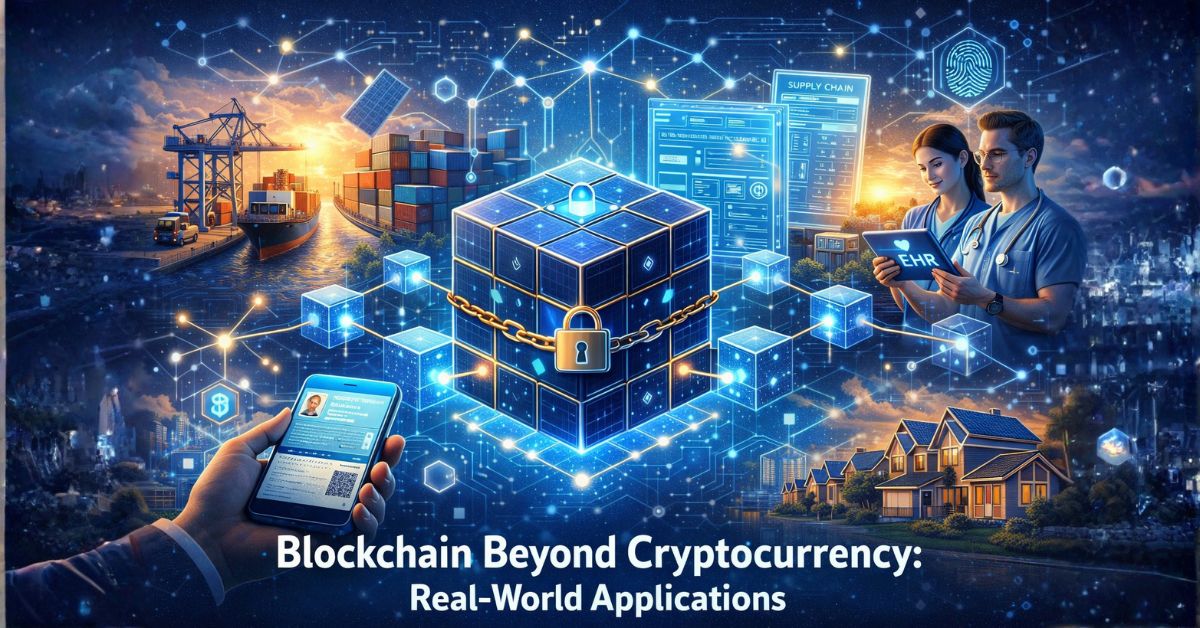
Most Americans know blockchain as the technology behind Bitcoin. That association is understandable but limiting. Blockchain is a distributed ledger technology with properties, including decentralization, immutability, and transparency, that have genuine value in industries far removed from digital currency. In 2026, real-world blockchain deployments are producing measurable results in supply chains, healthcare, legal services, and government operations.
This article cuts through the cryptocurrency noise to explain what blockchain actually is, which real-world applications are producing the most impact, what the honest limitations are, and what American businesses and individuals should understand about this technology right now.
What Is Blockchain?
A blockchain is a shared, distributed database where records (called blocks) are linked together in a chain and stored across multiple computers simultaneously. Once data is recorded in a block and added to the chain, it cannot be altered without changing all subsequent blocks and achieving consensus from the network, making tampering computationally impractical at scale.
The key properties that make blockchain useful are: no single point of control or failure (decentralization), records that cannot be secretly changed after the fact (immutability), and the ability for multiple parties to verify the same information independently without needing to trust each other or a central authority (trustless verification).
Why Blockchain Matters Beyond Crypto in 2026
The cryptocurrency market’s volatility has overshadowed blockchain’s more durable industrial applications. But enterprise adoption has continued steadily beneath the headline noise. By 2026, blockchain infrastructure is embedded in operational systems at major global companies, government agencies, and international trade organizations.
The core value proposition is not financial speculation. It is reducing friction in multi-party processes where trust, verification, and record integrity are costly to establish through traditional means.
How Blockchain Works in Real-World Applications
Enterprise blockchain typically operates differently from public cryptocurrency blockchains. Most real-world deployments use permissioned blockchains, where access is controlled and participants are known entities, rather than fully public networks open to anyone. This addresses the privacy, performance, and regulatory requirements of enterprise environments while preserving the core properties of immutable shared records and distributed verification.
Smart contracts, self-executing code stored on the blockchain, automate processes that previously required manual verification or intermediaries. When predefined conditions are met, the contract executes automatically without requiring trust between parties.
Real-World Blockchain Applications Making an Impact
Supply chain transparency: Walmart and IBM’s Food Trust blockchain tracks food products from farm to shelf. When a contamination event occurs, retailers can trace the source in seconds rather than days, reducing the scope of recalls and minimizing waste. Maersk’s TradeLens platform similarly transformed documentation in global shipping before being retired, leaving lessons that successor platforms are incorporating.
Healthcare records: Patient data interoperability across hospital systems is a persistent challenge in U.S. healthcare. Blockchain-based health record systems allow patients to control access to their records while enabling authorized providers to verify information without duplicating records. MedRec and similar platforms are in operational pilots at major health networks.
Digital identity verification: Self-sovereign identity systems built on blockchain allow individuals to prove their identity without sharing underlying personal data with every service that requests verification. This has significant applications in financial services compliance, age verification, and credential authentication.
Real estate and property records: Recording property transactions and title history on an immutable ledger reduces fraud, eliminates costly title searches, and accelerates closing processes. Several U.S. counties and international land registries are running blockchain title recording pilots.
Intellectual property and content rights: NFT technology, separate from speculative collectibles, is being applied to professional content licensing and rights management. Musicians, photographers, and publishers are using blockchain to record ownership and automate royalty payments when content is used.
Voting and governance: Blockchain-based voting systems offer auditability and tamper-resistance properties that traditional paper or electronic voting lacks. Several countries and organizations have run binding elections on blockchain platforms, and U.S. pilot programs are ongoing at the municipal level.
Cross-border payments: Traditional international wire transfers take days and involve multiple intermediaries. Blockchain-based payment networks like Ripple’s RippleNet enable near-instant cross-border settlements with lower fees. Financial institutions including Santander and Standard Chartered have integrated these systems into their payment infrastructure.
Key Benefits
The core benefits of blockchain in enterprise applications are reduced transaction costs by eliminating intermediaries, faster settlement and verification, audit trails that are tamper-resistant and verifiable by all parties, and the ability to automate compliance and contract execution through smart contracts.
Limitations and Honest Drawbacks
Blockchain is not a universal solution. Its value depends entirely on whether the specific problem involves multiple untrusting parties that need to share and verify records. For single-organization systems, a traditional database is simpler, faster, and cheaper.
Scalability remains a challenge for public blockchains. Energy consumption on proof-of-work networks like Bitcoin is significant, though proof-of-stake networks like Ethereum have reduced this dramatically. Regulatory uncertainty around tokenized assets and smart contracts creates legal ambiguity in some jurisdictions. And the classic garbage-in-garbage-out problem applies: blockchain verifies that data has not been altered after entry, but it cannot verify that the original data was accurate.
Expert Take: Where Blockchain Delivers Real Value
The applications delivering the clearest ROI are those involving multi-party record-keeping where fraud risk, reconciliation costs, or intermediary fees are currently high. Supply chain provenance, trade finance, and healthcare records fit this profile well. Speculative applications, like tokenizing assets with unclear market demand, are delivering less consistent value.
For American businesses evaluating blockchain, the right question is not “can we use blockchain for this?” but “is the core problem one where distributed, immutable, multi-party verification would meaningfully reduce cost, risk, or friction?” If the honest answer is yes, blockchain deserves serious evaluation. If no, a traditional database will serve better.
Frequently Asked Questions
Is blockchain the same as Bitcoin? No. Bitcoin is a cryptocurrency that runs on a blockchain. Blockchain is the underlying technology, which has hundreds of applications unrelated to Bitcoin or cryptocurrency.
Is blockchain technology secure? The blockchain ledger itself is highly resistant to tampering. However, applications built on top of blockchains, including smart contracts and wallets, can contain vulnerabilities. Security depends on the entire implementation stack, not just the ledger.
Do I need to understand cryptocurrency to use blockchain applications? Not for most enterprise and consumer applications. Many blockchain-based systems operate in the background without requiring users to interact with cryptocurrency or wallets at all.
The Bottom Line
Blockchain’s most durable value is not as a speculative asset class but as infrastructure for multi-party record integrity. Supply chains, healthcare records, property registries, and cross-border payments are all being improved by blockchain’s core properties. The technology is not a silver bullet, and it is not appropriate for every use case, but in the right contexts it eliminates real friction and real costs.
For deeper context on related topics, explore our articles on cybersecurity trends every tech enthusiast should follow, the role of IoT in smart homes and cities, and how tech policy and regulation are affecting U.S. innovation.