
Wednesday, March 18, 2026
Google search engine
Home Blog Page 2

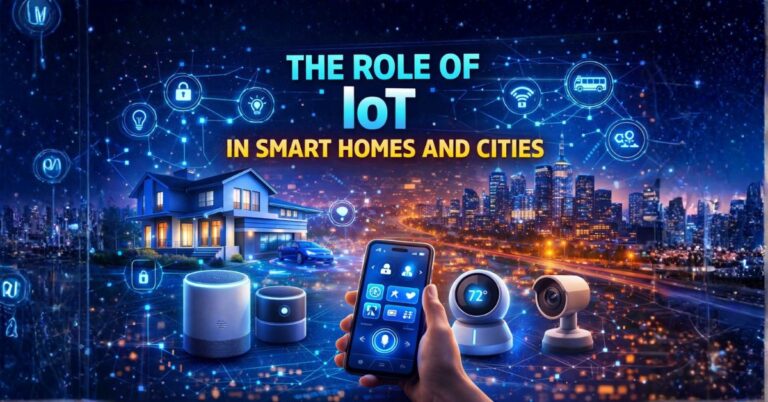
The Role of IoT in Smart Homes and Cities

The Internet of Things (IoT) is quietly reshaping the way we live and govern our cities. From smart thermostats that learn your schedule to city-wide sensor networks that optimize traffic flow, IoT technology is transforming everyday environments into intelligent, connected ecosystems. In 2026, IoT is no longer a futuristic concept — it’s a present-day reality with profound implications for energy efficiency, safety, and urban planning.

This article breaks down what IoT is, how it works in homes and cities, its real-world applications, and what to expect as the technology continues to mature.

What Is IoT?

The Internet of Things refers to a network of physical devices — sensors, appliances, vehicles, and infrastructure — embedded with software, connectivity, and data-processing capabilities. These devices collect and exchange data with each other and with central systems, often without human intervention.

Key components include sensors and actuators, connectivity protocols (Wi-Fi, Zigbee, Z-Wave, 5G), edge computing hardware, and cloud platforms for data storage and analytics. A smart light bulb that adjusts based on natural light levels and a water treatment facility that monitors pipe pressure in real time are both examples of IoT in action.

Why IoT Matters in 2026

With over 18 billion connected IoT devices projected globally in 2026, the technology has reached a tipping point. Several factors are driving this expansion:

  • 5G rollout: Faster, low-latency networks enable real-time IoT communication at scale.
  • Falling hardware costs: Sensors and microcontrollers are cheaper than ever, accelerating deployment.
  • Energy concerns: IoT-enabled efficiency is central to sustainability goals in homes and cities.
  • Urban population growth: Cities need smarter infrastructure to handle increasing population density.

IoT in Smart Homes

Smart home technology has moved well beyond novelty gadgets. Today’s connected homes feature integrated systems that communicate and adapt to resident behavior.

Key Smart Home Applications

  • Smart thermostats: Devices like Nest and Ecobee learn usage patterns and reduce energy consumption by up to 23%.
  • Security systems: AI-powered cameras, smart locks, and doorbell sensors provide real-time monitoring and alerts.
  • Lighting automation: Motion-activated and schedule-based lighting reduces waste and enhances comfort.
  • Appliance control: Smart refrigerators, ovens, and washers can be monitored and controlled remotely.
  • Voice assistants: Amazon Alexa, Google Home, and Apple HomeKit serve as central hubs for device management.
  • Energy monitoring: Smart meters give homeowners granular data on electricity consumption by device or room.

The average American smart home in 2026 contains 15 or more connected devices. Interoperability standards like Matter (developed by Apple, Google, Amazon, and Samsung) are making it easier for devices from different brands to work together seamlessly.

IoT in Smart Cities

At the city level, IoT enables data-driven governance and service delivery. Smart city initiatives use sensor networks, AI analytics, and connected infrastructure to improve quality of life and operational efficiency.

Key Smart City Applications

  • Traffic management: Sensors and cameras feed real-time data to adaptive signal systems that reduce congestion by 20–30%.
  • Waste management: Smart bins with fill-level sensors alert collection crews only when needed, cutting routes and emissions.
  • Water systems: Leak detection sensors and smart meters reduce water waste and improve infrastructure maintenance.
  • Public safety: Gunshot detection systems, smart streetlights with surveillance, and emergency response coordination.
  • Air quality monitoring: Networks of micro-sensors provide hyper-local pollution data to inform policy and public health decisions.
  • Smart grid: Utilities use IoT to balance energy loads, integrate renewable sources, and prevent outages.
  • Connected transportation: IoT enables real-time bus/train tracking, e-scooter networks, and EV charging management.

Cities like Columbus, Ohio; Kansas City, Missouri; and San Jose, California have received federal Smart City funding and are deploying IoT infrastructure at scale. Internationally, Singapore and Amsterdam are often cited as global benchmarks.

Key Benefits of IoT

  • Energy savings: Homes and cities using IoT automation typically reduce energy use by 15–30%.
  • Improved safety: Real-time monitoring reduces response times for fires, break-ins, and infrastructure failures.
  • Cost efficiency: Predictive maintenance of IoT-monitored assets reduces downtime and repair costs.
  • Better data: Continuous sensor data enables smarter decisions at both household and municipal levels.
  • Quality of life: Automated convenience, personalized environments, and reduced commute stress improve daily living.

Challenges and Risks

  • Privacy concerns: Pervasive sensors collect vast amounts of personal data, raising questions about who owns and accesses it.
  • Cybersecurity vulnerabilities: IoT devices are frequent targets for hackers; a compromised smart home device can be a gateway to larger network breaches.
  • Interoperability: Despite the Matter standard, many devices still operate in silos, limiting integration.
  • Digital divide: Smart city benefits are often unevenly distributed, with underserved communities receiving less investment.
  • Infrastructure costs: Deploying city-wide IoT networks requires significant capital investment and ongoing maintenance.

Real-World Examples

  • Google Nest: One of the most widely adopted smart home ecosystems, offering thermostat, camera, doorbell, and alarm integration.
  • Barcelona’s smart water grid: The city saved €75 million annually by using IoT sensors to detect leaks and optimize irrigation.
  • Chicago’s Array of Things: A city-wide sensor network collecting data on air quality, pedestrian traffic, and weather patterns.
  • Amazon Sidewalk: A low-bandwidth network using Ring and Echo devices to extend connectivity for IoT devices even when home Wi-Fi is out of range.

Expert Take

IoT experts emphasize that the technology’s value lies not in individual devices but in integrated ecosystems. A single smart thermostat saves energy; a home where the thermostat communicates with the solar panels, EV charger, and utility grid optimizes the entire energy lifecycle. The same logic applies at the city level — isolated sensors provide data points, but connected networks create actionable intelligence.

Security professionals warn that IoT expansion outpaces cybersecurity investment. Every connected device is a potential attack surface, and many consumer IoT products ship with weak default credentials and infrequent software updates.

Frequently Asked Questions

What’s the difference between IoT and smart home devices?

IoT is the broader technology framework; smart home devices are consumer applications of IoT. Every smart home device is an IoT device, but IoT also encompasses industrial, agricultural, medical, and city infrastructure applications.

Is IoT secure?

Security varies widely. Enterprise and government IoT systems are generally well-secured. Consumer devices vary significantly — it’s important to use strong passwords, keep firmware updated, and segment IoT devices on a separate home network.

How much does a smart home setup cost?

Entry-level setups (smart speaker, a few bulbs, and a thermostat) can cost under $300. Full whole-home automation with security, lighting, climate, and appliance control can range from $2,000 to $20,000+ depending on the level of integration.

Which U.S. cities are the most “smart”?

According to various smart city indices, San Jose, Kansas City, Columbus, and New York City rank among the top U.S. smart cities based on IoT deployment, open data availability, and digital service quality.

The Bottom Line

IoT is transforming homes from passive structures into responsive, intelligent environments — and reshaping cities from static infrastructure networks into adaptive, data-driven organisms. The technology delivers real, measurable benefits in energy savings, safety, and efficiency. But it also introduces serious privacy and security challenges that users, developers, and policymakers must address together. For deeper reading, explore our articles on top emerging technologies to watch in 2026, how 5G is transforming connectivity, and the future of artificial intelligence in everyday life.

How Tech Startups Are Driving Innovation in America

American tech startups are among the most powerful engines of economic growth, job creation, and technological progress in the world. From Silicon Valley to emerging tech hubs in Austin, Miami, and Chicago, U.S. startups are developing solutions to some of the most complex challenges facing industries, governments, and consumers.

In 2026, the startup ecosystem is evolving in response to tighter capital conditions, the rapid maturation of AI tools, and growing interest from corporates and governments in startup-derived innovation. This article explains how American tech startups are driving innovation, which sectors are seeing the most activity, and what the broader economic and social impact looks like.

What Makes American Tech Startups Distinctive?

The U.S. startup ecosystem has several structural advantages that drive sustained innovation. Deep venture capital networks, world-class research universities, a culture that accepts entrepreneurial risk, large and accessible domestic markets, and relatively strong intellectual property protections create conditions that are difficult to replicate elsewhere.

American startups have historically moved faster from idea to market than their counterparts in more regulated or risk-averse environments. This speed-to-market advantage has been particularly pronounced in software, AI, biotech, and clean energy.

Why Startups Matter More Than Ever in 2026

Established companies often struggle to innovate at the pace that technology now demands. Startups, unconstrained by legacy systems, existing business models, and bureaucratic inertia, can experiment, fail, and pivot in ways that large organizations cannot. In an environment where AI is reshaping entire industries in months rather than years, that agility is more valuable than ever.

Startups are also increasingly important as vendors to large enterprises, providing specialized AI tools, vertical software solutions, and infrastructure capabilities that corporations would take years to build internally.

Key Sectors Where Startups Are Driving Innovation

Artificial intelligence: AI startups are developing specialized models, agentic frameworks, developer tools, and vertical applications across every industry. Anthropic, Cohere, Mistral, and hundreds of smaller companies are advancing the state of the art while creating new product categories that did not exist three years ago.

Climate tech and clean energy: Startups are developing next-generation batteries, carbon capture technologies, alternative proteins, grid software, and green hydrogen solutions. Federal incentives from the Inflation Reduction Act have catalyzed significant private investment in this space, and U.S. climate tech startups are attracting record venture capital.

Healthcare and biotech: AI-powered drug discovery, digital health platforms, remote monitoring, and diagnostic tools are emerging from startup labs. Companies like Recursion Pharmaceuticals, Insitro, and dozens of others are using machine learning to compress discovery timelines and identify treatment options that traditional pharmaceutical research would miss.

Fintech: Payment processing, embedded finance, wealth management, lending, and insurance are all being disrupted by startups offering lower costs, better user experiences, and more accessible services. Stripe, Chime, Plaid, and newer companies are reshaping how Americans interact with financial services.

Defense and national security: A new wave of defense technology startups is building drones, autonomous systems, AI-powered intelligence tools, and advanced communications for the U.S. military. Companies like Palantir, Anduril, and Shield AI have demonstrated that startups can compete for defense contracts and deliver capability faster than traditional defense primes.

Space technology: SpaceX has demonstrated the startup model in aerospace, and a broader ecosystem of launch companies, satellite operators, and space infrastructure startups has developed around it. Rocket Lab, Relativity Space, and Astroscale are among many companies developing the commercial space economy.

The Economic Impact of U.S. Tech Startups

Startups disproportionately contribute to job creation, productivity growth, and export competitiveness. Research consistently shows that young, high-growth companies account for a substantial share of net new employment in the U.S. economy. Startup-derived companies including Google, Amazon, Apple, and Microsoft now constitute a significant portion of total U.S. market capitalization.

Challenges Facing American Startups in 2026

The 2022-2023 funding downturn forced many startups to extend runway, cut costs, and focus on profitability earlier than prior cohorts. While funding has partially recovered, the environment remains more selective than the 2021 peak. Startups that raised at high valuations must now demonstrate the fundamentals to justify those multiples or face difficult down rounds.

Talent competition remains intense, particularly for AI engineers and data scientists. Regulatory uncertainty around AI, data privacy, and digital health is creating compliance costs that disadvantage smaller companies relative to larger incumbents with dedicated legal teams.

Expert Take: Where Startup Innovation Is Heading

The next wave of impactful startups will likely emerge at the intersection of AI and domain expertise: healthcare AI that actually integrates with clinical workflows, manufacturing software that connects to factory floor systems, agriculture technology that works with existing farming operations. The pure software play is increasingly commoditized; the differentiated opportunity lies in combining AI capabilities with deep industry knowledge and real operational integration.

Frequently Asked Questions

Where are the most active tech startup hubs in the U.S. today? Silicon Valley and New York remain dominant. Austin has emerged as a major hub following migrations during the pandemic. Miami has a growing fintech and crypto scene. Boston leads in biotech. Seattle is strong in cloud and enterprise software. Chicago is growing in fintech and logistics tech.

How do startups get funding? Early-stage startups typically raise from angel investors and seed-stage venture funds. Later-stage companies raise Series A, B, and C rounds from institutional venture capital firms. Some startups also pursue government grants, particularly in climate tech, defense, and healthcare.

The Bottom Line

American tech startups remain one of the country’s most powerful tools for driving economic growth, creating jobs, and solving hard problems. In 2026, the ecosystem is maturing and becoming more selective, but the underlying engine of innovation is stronger than ever, particularly in AI, climate tech, healthcare, and defense. For more context, explore our articles on the future of artificial intelligence in everyday life, green tech innovations, and the intersection of AI and healthcare.

Cybersecurity Trends Every Tech Enthusiast Should Follow

The cybersecurity landscape in 2026 is more complex than at any point in history. AI-powered attacks are faster and more personalized. Ransomware operations are targeting critical infrastructure. Quantum computing is forcing a rethink of foundational encryption. And the attack surface keeps expanding as more devices, cloud services, and supply chain components come online.According to CISA, cyber threats continue to evolve rapidly.

This article covers the cybersecurity trends that matter most right now, what they mean for individuals, businesses, and policymakers, and what actionable steps can actually reduce risk in 2026.You may also want to read about quantum computing threats.

What Is the Current State of Cybersecurity?

Cybersecurity has evolved from a technical IT function into a strategic business priority and national security concern. The cost of cybercrime globally is estimated in the trillions annually. In the U.S., ransomware attacks have disrupted hospitals, school districts, water utilities, and financial institutions. Supply chain attacks have demonstrated that no organization is too small or obscure to be targeted.

Why Cybersecurity Trends Matter More in 2026

Three developments are making 2026 a particularly consequential moment. First, AI is now a mainstream offensive tool, enabling attackers to craft convincing phishing emails and automate vulnerability discovery. Second, the post-quantum cryptography transition is becoming urgent. Third, state-sponsored cyber operations targeting U.S. critical infrastructure are increasing due to geopolitical tensions.

Top Cybersecurity Trends to Watch

AI-powered attacks and defenses: Attackers use large language models to write convincing phishing emails, generate malware variants, and automate vulnerability discovery. Defenders use AI to detect anomalous behavior, correlate threats across large datasets, and respond faster than human analysts alone can manage.

Ransomware evolution: Modern ransomware operations are professionally organized criminal enterprises using double extortion, targeting critical infrastructure where downtime pressure creates stronger incentives to pay. Total ransomware damage is measured in billions annually.

Zero trust architecture: The traditional perimeter security model is obsolete. Zero trust, where every user and device must continuously verify identity regardless of network location, is becoming the enterprise standard. Federal agencies are required to implement zero trust under Executive Order 14028.

Post-quantum cryptography migration: NIST finalized post-quantum cryptographic standards in 2024. Organizations managing sensitive data need to begin migrating encryption infrastructure now, a process that takes years.

Supply chain security: The SolarWinds and Log4j incidents demonstrated that compromising widely used software can reach thousands of organizations simultaneously. Software bills of materials, secure development requirements, and vendor risk management are becoming standard practice.

Identity and access management: Credential theft is involved in the majority of data breaches. Multi-factor authentication, passwordless authentication, and passkeys are becoming non-negotiable baseline controls.

OT and IoT security: Operational technology and IoT devices are attractive targets due to poor patching practices and long deployment lifetimes. Dedicated OT security platforms and network segmentation are essential for organizations operating physical infrastructure.

Practical Steps to Improve Cybersecurity in 2026

  • Enable multi-factor authentication on all accounts, especially email and financial services
  • Use a password manager and eliminate password reuse
  • Keep operating systems, browsers, and applications updated promptly
  • Back up critical data using the 3-2-1 rule: three copies, two different media types, one offsite
  • For businesses: implement zero trust principles starting with privileged access
  • For businesses: conduct regular phishing simulation and security awareness training
  • For businesses: develop and test an incident response plan before you need it

Expert Take

The most effective cybersecurity posture combines strong technical controls with a realistic understanding of the human element. Most successful attacks still involve phishing, social engineering, or credential theft rather than sophisticated zero-day exploits. The security fundamentals, MFA, patching, backups, and awareness training, remain the highest-ROI investments for most organizations.

Frequently Asked Questions

What is the most important cybersecurity step I can take? Enable multi-factor authentication on your most important accounts, especially email. Email account compromise is a gateway to most other types of account takeover.

How real is the ransomware threat to small businesses? Very real. Small businesses are frequently targeted because they often have less sophisticated defenses. Ransomware-as-a-service platforms have made attacks accessible to criminal actors without advanced technical skills.

The Bottom Line

Cybersecurity in 2026 is an ongoing operational discipline, not a one-time project. Organizations and individuals that treat security as a continuous process manage risk most effectively. For further reading, explore our articles on the rise of quantum computing, blockchain real-world applications, and tech policy and regulation trends affecting U.S. innovation.

The Rise of Quantum Computing: What Americans Need to Know

Quantum computing is transitioning from a laboratory curiosity to a genuine engineering challenge with clear commercial timelines. In 2026, quantum processors are achieving milestones that were considered years away just a decade ago, and the implications for cryptography, drug discovery, financial modeling, and national security are significant enough that the U.S. government, major technology companies, and serious investors are all paying close attention.

This article explains what quantum computing actually is, why it is fundamentally different from classical computing, where it stands today, which industries it will affect first, and what every American should understand about its risks and opportunities.

What Is Quantum Computing?

Classical computers process information as bits: either 0 or 1. Quantum computers use quantum bits, or qubits, which can exist in combinations of 0 and 1 simultaneously through a property called superposition. Combined with entanglement, this allows quantum processors to explore many possible solutions to a problem at the same time rather than sequentially.

For specific types of problems involving massive combinatorial complexity, quantum computers can potentially find solutions exponentially faster than any classical computer. The critical qualifier is specific: quantum computers are not universally faster. They excel at particular problem classes while being slower or equivalent to classical computers at many everyday computational tasks.

Why Quantum Computing Matters in 2026

The industry is approaching fault-tolerant quantum computing, the point at which quantum error correction is reliable enough to run meaningful computations at scale. IBM, Google, IonQ, and Quantinuum are all publishing quantum roadmaps with milestones in the 2026 to 2030 range. U.S. government investment in quantum research has accelerated significantly, alongside parallel investment in post-quantum cryptography defenses.

How Quantum Computing Works

Quantum processors operate at temperatures near absolute zero to maintain qubit stability, a challenge called decoherence. Quantum algorithms are specialized procedures that exploit quantum properties for specific problem types. Shor’s algorithm can theoretically break RSA encryption. Grover’s algorithm can search databases quadratically faster than classical methods. These are targeted tools, not general-purpose programs.

Key Applications and Who Cares Most

Cryptography and cybersecurity: Sufficiently powerful quantum computers could break the encryption protecting most internet traffic and financial transactions. NIST finalized post-quantum cryptographic standards in 2024, and organizations are beginning multi-year migration processes. This is the most urgent near-term concern.

Drug discovery: Quantum computers can simulate molecular interactions with accuracy impossible on classical hardware. This could dramatically compress drug discovery timelines. Pharmaceutical companies and biotech startups are investing heavily in quantum chemistry applications.

Financial modeling: Portfolio optimization, risk analysis, and options pricing involve computational problems that scale poorly on classical hardware. Quantum speedups could provide significant competitive advantages for early-adopting financial institutions.

Logistics optimization: Routing, scheduling, and resource allocation at scale are computationally hard. Quantum optimization could improve efficiency in shipping, manufacturing, and energy distribution in ways that translate to cost savings and emissions reductions.

Risks and Limitations

The cryptographic risk is the most actionable concern for organizations today. The migration to post-quantum encryption must begin now because of how long infrastructure changes take. Waiting until quantum computers are actually capable of attacks is too late.

Technically, quantum computing still faces high error rates, short coherence times, and extreme infrastructure requirements. Commercial quantum advantage over classical computers for real-world problems has only been demonstrated in narrow, controlled cases so far.

Expert Take: Realistic Timeline

Fault-tolerant quantum computers capable of breaking current encryption are probably 5 to 15 years away, not imminent. The most credible near-term applications involve hybrid quantum-classical systems that use quantum processors for specific subtasks where they excel. Pure quantum applications for broadly useful commercial problems likely remain a longer-horizon opportunity.

Frequently Asked Questions

Will quantum computers break my encryption? Not immediately. But organizations handling sensitive long-term data should begin post-quantum migration planning now. The timeline is uncertain, but the cost of waiting is potentially catastrophic.

Can I access a quantum computer today? IBM, Google, Amazon, and Microsoft all offer cloud-based quantum computing access for researchers and developers. These early-stage systems are not yet suitable for most practical applications.

The Bottom Line

Quantum computing’s most urgent near-term implication is cryptographic. Every organization handling sensitive data needs a post-quantum encryption strategy. Beyond that, quantum computing represents a genuine long-term opportunity in drug discovery, finance, and optimization that is worth tracking carefully and investing in understanding now. Explore our related articles on cybersecurity trends and tech policy and regulation trends affecting U.S. innovation for further context.

Blockchain Beyond Cryptocurrency: Real-World Applications

Most Americans know blockchain as the technology behind Bitcoin. That association is understandable but limiting. Blockchain is a distributed ledger technology with properties, including decentralization, immutability, and transparency, that have genuine value in industries far removed from digital currency. In 2026, real-world blockchain deployments are producing measurable results in supply chains, healthcare, legal services, and government operations.

This article cuts through the cryptocurrency noise to explain what blockchain actually is, which real-world applications are producing the most impact, what the honest limitations are, and what American businesses and individuals should understand about this technology right now.

What Is Blockchain?

A blockchain is a shared, distributed database where records (called blocks) are linked together in a chain and stored across multiple computers simultaneously. Once data is recorded in a block and added to the chain, it cannot be altered without changing all subsequent blocks and achieving consensus from the network, making tampering computationally impractical at scale.

The key properties that make blockchain useful are: no single point of control or failure (decentralization), records that cannot be secretly changed after the fact (immutability), and the ability for multiple parties to verify the same information independently without needing to trust each other or a central authority (trustless verification).

Why Blockchain Matters Beyond Crypto in 2026

The cryptocurrency market’s volatility has overshadowed blockchain’s more durable industrial applications. But enterprise adoption has continued steadily beneath the headline noise. By 2026, blockchain infrastructure is embedded in operational systems at major global companies, government agencies, and international trade organizations.

The core value proposition is not financial speculation. It is reducing friction in multi-party processes where trust, verification, and record integrity are costly to establish through traditional means.

How Blockchain Works in Real-World Applications

Enterprise blockchain typically operates differently from public cryptocurrency blockchains. Most real-world deployments use permissioned blockchains, where access is controlled and participants are known entities, rather than fully public networks open to anyone. This addresses the privacy, performance, and regulatory requirements of enterprise environments while preserving the core properties of immutable shared records and distributed verification.

Smart contracts, self-executing code stored on the blockchain, automate processes that previously required manual verification or intermediaries. When predefined conditions are met, the contract executes automatically without requiring trust between parties.

Real-World Blockchain Applications Making an Impact

Supply chain transparency: Walmart and IBM’s Food Trust blockchain tracks food products from farm to shelf. When a contamination event occurs, retailers can trace the source in seconds rather than days, reducing the scope of recalls and minimizing waste. Maersk’s TradeLens platform similarly transformed documentation in global shipping before being retired, leaving lessons that successor platforms are incorporating.

Healthcare records: Patient data interoperability across hospital systems is a persistent challenge in U.S. healthcare. Blockchain-based health record systems allow patients to control access to their records while enabling authorized providers to verify information without duplicating records. MedRec and similar platforms are in operational pilots at major health networks.

Digital identity verification: Self-sovereign identity systems built on blockchain allow individuals to prove their identity without sharing underlying personal data with every service that requests verification. This has significant applications in financial services compliance, age verification, and credential authentication.

Real estate and property records: Recording property transactions and title history on an immutable ledger reduces fraud, eliminates costly title searches, and accelerates closing processes. Several U.S. counties and international land registries are running blockchain title recording pilots.

Intellectual property and content rights: NFT technology, separate from speculative collectibles, is being applied to professional content licensing and rights management. Musicians, photographers, and publishers are using blockchain to record ownership and automate royalty payments when content is used.

Voting and governance: Blockchain-based voting systems offer auditability and tamper-resistance properties that traditional paper or electronic voting lacks. Several countries and organizations have run binding elections on blockchain platforms, and U.S. pilot programs are ongoing at the municipal level.

Cross-border payments: Traditional international wire transfers take days and involve multiple intermediaries. Blockchain-based payment networks like Ripple’s RippleNet enable near-instant cross-border settlements with lower fees. Financial institutions including Santander and Standard Chartered have integrated these systems into their payment infrastructure.

Key Benefits

The core benefits of blockchain in enterprise applications are reduced transaction costs by eliminating intermediaries, faster settlement and verification, audit trails that are tamper-resistant and verifiable by all parties, and the ability to automate compliance and contract execution through smart contracts.

Limitations and Honest Drawbacks

Blockchain is not a universal solution. Its value depends entirely on whether the specific problem involves multiple untrusting parties that need to share and verify records. For single-organization systems, a traditional database is simpler, faster, and cheaper.

Scalability remains a challenge for public blockchains. Energy consumption on proof-of-work networks like Bitcoin is significant, though proof-of-stake networks like Ethereum have reduced this dramatically. Regulatory uncertainty around tokenized assets and smart contracts creates legal ambiguity in some jurisdictions. And the classic garbage-in-garbage-out problem applies: blockchain verifies that data has not been altered after entry, but it cannot verify that the original data was accurate.

Expert Take: Where Blockchain Delivers Real Value

The applications delivering the clearest ROI are those involving multi-party record-keeping where fraud risk, reconciliation costs, or intermediary fees are currently high. Supply chain provenance, trade finance, and healthcare records fit this profile well. Speculative applications, like tokenizing assets with unclear market demand, are delivering less consistent value.

For American businesses evaluating blockchain, the right question is not “can we use blockchain for this?” but “is the core problem one where distributed, immutable, multi-party verification would meaningfully reduce cost, risk, or friction?” If the honest answer is yes, blockchain deserves serious evaluation. If no, a traditional database will serve better.

Frequently Asked Questions

Is blockchain the same as Bitcoin? No. Bitcoin is a cryptocurrency that runs on a blockchain. Blockchain is the underlying technology, which has hundreds of applications unrelated to Bitcoin or cryptocurrency.

Is blockchain technology secure? The blockchain ledger itself is highly resistant to tampering. However, applications built on top of blockchains, including smart contracts and wallets, can contain vulnerabilities. Security depends on the entire implementation stack, not just the ledger.

Do I need to understand cryptocurrency to use blockchain applications? Not for most enterprise and consumer applications. Many blockchain-based systems operate in the background without requiring users to interact with cryptocurrency or wallets at all.

The Bottom Line

Blockchain’s most durable value is not as a speculative asset class but as infrastructure for multi-party record integrity. Supply chains, healthcare records, property registries, and cross-border payments are all being improved by blockchain’s core properties. The technology is not a silver bullet, and it is not appropriate for every use case, but in the right contexts it eliminates real friction and real costs.

For deeper context on related topics, explore our articles on cybersecurity trends every tech enthusiast should follow, the role of IoT in smart homes and cities, and how tech policy and regulation are affecting U.S. innovation.

How 5G is Transforming Connectivity in the U.S.

5G is no longer a coming-soon technology. It is here, it is expanding rapidly across the United States, and it is beginning to enable capabilities that 4G LTE simply could not support at scale. From manufacturing floors using real-time machine control to hospitals performing remote diagnostics, 5G is quietly becoming the connectivity backbone of a new era.

This article explains what 5G actually is, how it differs from previous generations, where it is already deployed in the U.S., what industries it is transforming, and what regular consumers and businesses can realistically expect in 2026 and beyond.

What Is 5G?

5G is the fifth generation of mobile network technology, succeeding 4G LTE. It operates across three spectrum bands: low-band (wide coverage, moderate speeds), mid-band (the sweet spot for most commercial deployments combining coverage and speed), and millimeter wave or mmWave (extremely high speeds over short distances, primarily for dense urban environments).

The defining characteristics of 5G compared to 4G are significantly higher data speeds (peak theoretical speeds of 20 Gbps versus 1 Gbps for 4G), much lower latency (1 millisecond versus 30-50 milliseconds for 4G), and the ability to connect far more devices per square kilometer. That last capability, called massive machine-type communications, is what makes 5G critical for IoT, smart cities, and industrial automation.

Why 5G Matters in 2026

By 2026, 5G coverage in the U.S. has reached the majority of the population through mid-band deployments by the three major carriers: AT&T, Verizon, and T-Mobile. T-Mobile’s mid-band network in particular has driven dramatic expansion of usable 5G speeds across suburban and rural markets that previously had only low-band coverage.

The significance of 2026 is that 5G is moving from consumer handset upgrades into enterprise and industrial applications. The real economic value of 5G is not faster Netflix streaming. It is machine-to-machine communication, autonomous systems, and applications that require both high bandwidth and extremely low latency operating simultaneously.

How 5G Works

5G networks use a combination of new radio technologies and network architecture improvements over 4G. Key technical advances include:

  • Massive MIMO: Base stations use dozens or hundreds of antennas simultaneously to serve multiple users and devices at once, dramatically increasing network capacity.
  • Beamforming: Rather than broadcasting in all directions, 5G base stations direct focused beams of signal toward specific devices, improving efficiency and reducing interference.
  • Network slicing: 5G networks can be divided into virtual networks, each optimized for a specific use case. A hospital could have a dedicated high-reliability slice while a consumer streaming app uses a high-bandwidth slice on the same physical infrastructure.
  • Edge computing integration: 5G networks can process data closer to the source, reducing round-trip time to central data centers and enabling real-time applications that cloud computing alone cannot support.

Key Industries Being Transformed by 5G

Manufacturing: Private 5G networks are enabling real-time monitoring and control of factory equipment with sub-millisecond latency. Companies like BMW and Siemens operate private 5G factory networks that allow machines, robots, and quality control systems to communicate instantly without the reliability risks of shared consumer networks.

Healthcare: 5G supports remote robotic surgery, real-time high-resolution medical imaging transmission, and continuous remote patient monitoring at scale. During the COVID-19 pandemic, the gap between what was possible in connected urban hospitals versus rural under-connected facilities was starkly visible. 5G is beginning to close that gap.

Transportation and logistics: Autonomous vehicles require the ability to communicate with infrastructure and other vehicles in near real time. 5G’s low latency makes vehicle-to-everything (V2X) communication practical. Port operators are using 5G to manage autonomous container-moving vehicles. Railroad operators are testing 5G for positive train control and remote inspection.

Agriculture: Connected sensors, autonomous tractors, and drone monitoring of crop health all benefit from reliable, high-bandwidth connectivity in rural areas. Mid-band 5G expansion is gradually making precision agriculture economically viable for mid-sized American farms.

Public safety and emergency response: First responders are beginning to use 5G networks like FirstNet (AT&T’s dedicated public safety network) for real-time video, situational awareness data, and coordination during emergencies. The higher bandwidth means a dispatcher can receive live video from multiple body cameras simultaneously.

Benefits for U.S. Consumers

For everyday users, 5G’s most immediate benefit is faster, more consistent mobile data speeds. Downloads that took minutes on congested 4G networks complete in seconds on mid-band 5G. Video calls are more stable. Mobile gaming latency drops noticeably. In dense areas like sports stadiums, concerts, and city centers, 5G eliminates the congestion that made 4G unreliable in crowds.

Fixed wireless access (FWA) is a consumer benefit that often gets overlooked. 5G-based home internet services from T-Mobile and Verizon are providing broadband-competitive speeds to households in areas where fiber or cable infrastructure is limited. This is particularly significant for rural and semi-rural communities historically underserved by wired broadband.

Limitations and Risks

Coverage gaps remain: Despite carrier claims of nationwide coverage, usable mid-band 5G still has significant gaps in rural and low-density areas. Low-band coverage is widespread but does not deliver the speed improvements most users expect from 5G.

mmWave limitations: The ultra-fast millimeter wave band is limited to line-of-sight coverage and cannot penetrate buildings well. It remains useful only in high-density urban deployments and indoor enterprise settings.

Device requirements: To benefit from 5G, users need 5G-capable devices. While most new smartphones sold in the U.S. since 2021 are 5G-enabled, older devices and many IoT sensors require hardware upgrades.

Security considerations: The expanded attack surface of 5G networks, particularly with millions of IoT devices connected, creates new cybersecurity challenges. Network slicing and edge computing introduce new points of vulnerability that require dedicated security architectures.

Expert Take: What Comes Next

The near-term focus for U.S. 5G deployment in 2026 is continued mid-band expansion, private network deployments in manufacturing and healthcare, and the growth of fixed wireless access as a broadband alternative. The carriers are simultaneously beginning early 6G research, with standards development expected to accelerate through 2028-2030.

For businesses, the most actionable opportunity right now is evaluating whether a private 5G network makes sense for your facilities. For operations requiring real-time control of machinery, robotics, or quality systems, private 5G can deliver reliability and latency advantages over both public cellular and enterprise Wi-Fi.

Frequently Asked Questions

Is 5G available in my area? Coverage varies significantly by carrier and band. T-Mobile has the widest mid-band coverage in the U.S. Check your carrier’s coverage map and specifically look for mid-band or Ultra Capacity 5G coverage, not just basic nationwide 5G which may be low-band only.

Does 5G pose health risks? All major scientific and health organizations including the WHO, FDA, and FCC have found no evidence that 5G frequencies at regulated power levels pose health risks. The frequencies used by 5G are non-ionizing radiation, the same category as Wi-Fi and 4G LTE.

How is 5G different from Wi-Fi 6? 5G is a cellular technology providing wide-area coverage outdoors and in mobile contexts. Wi-Fi 6 (802.11ax) is a short-range indoor standard. They are complementary technologies, not direct competitors.

The Bottom Line

5G’s most transformative impact will not be felt by individual consumers checking their phone’s signal indicator. It will come from the industrial, healthcare, transportation, and public safety applications that 4G’s latency and reliability limitations made impractical. 2026 marks the point where those applications are moving from pilots into operational deployment at meaningful scale.

For U.S. businesses, understanding where 5G connectivity can create operational advantages is no longer optional strategic planning. It is current competitive strategy. For deeper context, explore our articles on the role of IoT in smart homes and cities, cloud computing innovations reshaping American businesses, and the top emerging technologies to watch in 2026.

Top Emerging Technologies to Watch in 2026

Emerging technologies are advancing at an unprecedented pace.Technology is moving faster than most people can track. From AI agents that can complete week-long projects autonomously to quantum processors solving problems classical computers cannot touch, 2026 is shaping up to be one of the most consequential years in recent tech history.

This article cuts through the noise and highlights the ten technologies most likely to reshape American industries, consumer behavior, and daily life in 2026 and beyond. Each one is past the hype stage and into real-world deployment, investment, or policy discussion.

What Are Emerging Technologies?

Emerging technologies are innovations that are transitioning from experimental or early-adoption stages into mainstream use. They differ from established technologies in that their full impact is not yet fully understood, their applications are still expanding, and the industries they will disrupt are still adapting.

For a technology to qualify as genuinely “emerging” rather than just hyped, it typically shows rapid investment growth, real enterprise or government deployment, meaningful improvements in capability or cost, and early signs of consumer adoption.

Why 2026 Is a Pivotal Year for Tech

Several technology trajectories are converging in 2026. AI is transitioning from tools to agents. Quantum computing is reaching fault-tolerant milestones. 5G infrastructure is maturing across the U.S. Biotech is combining with AI to accelerate drug discovery. And green tech is scaling rapidly as policy incentives align with falling costs.

For American businesses and consumers, this convergence means that ignoring these technologies is no longer a neutral choice. Early adopters are already gaining measurable advantages in efficiency, cost, and competitive positioning.

The Top 10 Emerging Technologies to Watch in 2026

1. Agentic AI Systems
AI agents that can plan, execute, and self-correct across multi-step tasks are moving into enterprise deployment. These systems go beyond answering questions to actively managing workflows, writing code, and coordinating other AI tools. Companies like OpenAI, Google, and Anthropic are racing to deploy production-ready agent frameworks that handle tasks requiring days of human work.

2. Quantum Computing
Quantum processors are approaching the fault-tolerant milestones needed for practical commercial applications. IBM, Google, and startups like IonQ and Quantinuum are making measurable progress. Early use cases in drug discovery, financial modeling, and cryptography are moving from research into pilots at major enterprises and government agencies.

3. Advanced 5G and Early 6G Research
5G deployment across U.S. cities is enabling ultra-low latency applications in manufacturing, healthcare, and logistics. Simultaneously, early 6G research is underway at universities and defense labs, targeting speeds and capabilities that will define the next decade of connectivity.

4. Spatial Computing and Mixed Reality
Headsets like Apple Vision Pro and Meta Quest are maturing into enterprise tools for design, training, and remote collaboration. Spatial computing, which blends digital content with physical environments, is moving beyond gaming and entertainment into surgery, architecture, and industrial maintenance.

5. AI-Accelerated Drug Discovery
Companies like Isomorphic Labs (a Google DeepMind spinoff) and Recursion Pharmaceuticals are using AI to compress the drug discovery timeline from years to months. This has major implications for the pharmaceutical industry and for patients waiting on treatments for rare and complex diseases.

6. Energy Storage Breakthroughs
Next-generation battery technologies, including solid-state batteries and grid-scale storage systems, are moving toward commercial production. This is critical infrastructure for electric vehicles, renewable energy integration, and grid stability, particularly as the U.S. scales up solar and wind capacity.

7. Humanoid Robotics
Companies including Figure AI, Tesla Optimus, and Boston Dynamics are deploying humanoid robots into warehouse and manufacturing settings. These robots are designed to work in environments built for humans, reducing the need for facility redesign while automating physically demanding tasks.

8. Generative AI for Media and Design
Tools that generate images, video, audio, and interactive experiences are maturing into professional-grade platforms. The creative and marketing industries are being reshaped by the ability to produce high-quality content at a fraction of traditional cost and time, while raising urgent questions around intellectual property and authenticity.

9. Neuromorphic Computing
Chips designed to mimic the structure of the human brain are achieving energy efficiency levels that traditional computing architectures cannot match. Intel’s Loihi chips and IBM’s neuromorphic research are showing promise for always-on, edge AI applications in sensors, wearables, and smart infrastructure.

10. Synthetic Biology and Biomanufacturing
Engineering biological systems to produce materials, fuels, and medicines is gaining commercial traction. Ginkgo Bioworks and other biotech platforms are enabling the design of microorganisms that manufacture products more sustainably than petrochemical processes, with applications in food, agriculture, pharmaceuticals, and materials science.

Key Benefits and Opportunities

These technologies share common benefit themes: they reduce costs, increase speed, expand access, and enable capabilities that were previously impossible. For American businesses, the opportunity is to identify which of these technologies intersects most directly with their industry and begin pilots now rather than waiting for full maturity.

For individuals, understanding these trends helps in making smarter career choices, educational investments, and decisions about which tools to adopt early versus which to wait on.

Risks and Limitations to Understand

Not every technology on this list will fulfill its potential on schedule. Quantum computing still faces significant engineering challenges at scale. Humanoid robotics remains expensive and limited in dexterity. AI agents still make mistakes that require human oversight. Energy storage costs are falling but not yet at parity for all applications.

The risks include regulatory uncertainty, supply chain dependencies for critical materials like rare earth elements, and the risk of hype cycles that attract investment but delay realistic timelines. The biggest mistake for businesses is treating these as binary, either fully transformative now or irrelevant, rather than tracking them as a portfolio with varying timelines.

Expert Take: Which Technologies Deserve Immediate Attention

Based on current deployment velocity and capital investment, three technologies deserve immediate attention from U.S. business leaders in 2026: agentic AI, energy storage, and humanoid robotics. Each is moving faster than most enterprise planning cycles account for, and competitive advantages are forming now among early adopters.

Quantum computing and neuromorphic chips are worth monitoring closely but not betting the organization on yet. Spatial computing is sector-specific; businesses in healthcare, architecture, and manufacturing should already be running pilots.

Frequently Asked Questions

Which emerging technology will have the biggest impact by 2026? Agentic AI has the broadest near-term impact because it affects productivity across virtually every knowledge-work sector without requiring physical infrastructure changes. Energy storage technology has the largest infrastructure impact over the same period.

Are these technologies available to small businesses? Several are already accessible via software subscriptions, including agentic AI platforms, generative AI tools, and spatial computing development kits. Energy storage and humanoid robotics require more capital and are primarily enterprise-scale today.

How should I stay updated on emerging tech trends? Follow primary sources including company announcements, peer-reviewed research preprints on arXiv, and regulatory filings. Supplement with tech-focused publications and analyst reports, but always distinguish reporting from speculation.

The Bottom Line

The technologies on this list are not equally ready or equally relevant to every reader. The value of tracking them is not to chase every trend but to build informed judgment about which ones intersect with your industry, your role, or your organization’s strategic priorities.

Start by identifying the one or two technologies most directly connected to your work. Understand how they function, who is deploying them, what the realistic timeline looks like, and what risks remain. That is the foundation for smart technology adoption rather than reactive scrambling. For deeper dives, explore our articles on how 5G is transforming U.S. connectivity, the rise of quantum computing, and the role of IoT in smart homes and cities.

The Future of Artificial Intelligence in Everyday Life

0

Artificial intelligence is no longer a futuristic concept reserved for research labs. It is quietly reshaping how Americans work, communicate, shop, and stay healthy every single day. From the recommendation engine on your streaming app to the fraud detection system protecting your bank account, AI is already embedded in the tools most people use without thinking about it.

By 2026, AI has moved well beyond simple automation. Today’s systems can understand natural language, interpret images, generate content, and execute multi-step tasks on your behalf. That shift changes what AI means for regular users, not just developers and enterprises.

This article explains what AI in everyday life actually looks like right now, why 2026 marks a genuine inflection point, how these systems work behind the scenes, and what you should realistically expect including benefits, risks, and real-world examples.

What Is Artificial Intelligence?

Artificial intelligence refers to software systems that can learn from data, recognize patterns, and make decisions or take actions with minimal explicit human programming. Modern AI combines language understanding, image recognition, and task execution in a single framework.

For everyday users, AI shows up in voice assistants, content recommendations, predictive text, fraud detection, navigation apps, and increasingly as AI agents that can plan and complete multi-step tasks on your behalf, such as scheduling, research, or drafting communications.

Why AI in Everyday Life Matters in 2026

Several forces are converging in 2026 to make AI genuinely transformative rather than just impressive. AI systems can now autonomously execute complex, multi-step projects, the kind that previously required a human working for hours or days. Analysts describe this as a shift from personal assistants to AI agents that orchestrate entire workflows.

For U.S. consumers and workers, that means AI is affecting hiring, job design, required skills, customer service, healthcare access, and everyday purchases. Companies that deploy AI effectively are already seeing competitive advantages in speed, personalization, and cost. Individuals who understand how to work alongside AI tools are gaining measurable productivity edges over those who do not.

How AI Works in Your Daily Apps

Most AI used in consumer apps relies on large language models and deep learning systems trained on enormous datasets of text, images, and behavioral data. These models predict the most relevant output given an input, whether that is the next word in a sentence, the most relevant product recommendation, or the best route to your destination.

  • Streaming platforms analyze your viewing patterns to surface content you are most likely to watch next.
  • E-commerce sites predict products you will buy based on browsing history, time of day, and similar users.
  • Email clients suggest replies, detect spam, and now draft full messages on request.
  • Navigation apps integrate real-time traffic data and AI route optimization to save time.
  • Mobile cameras use AI to enhance photos automatically before you even look at the result.

By 2026, these individual systems are beginning to connect. AI agents can now operate across apps, browsers, and services on your behalf, completing tasks that previously required opening multiple apps and making judgment calls.

Key Benefits of AI for Americans in 2026

AI’s practical benefits extend well beyond convenience. Here is where it makes a measurable difference for everyday Americans.

Health outcomes: AI-assisted diagnostics are helping doctors detect cancers, eye diseases, and heart conditions earlier than traditional screening alone. Patients in rural areas increasingly access AI-powered triage and telehealth tools that reduce wait times and improve care access.

Work productivity: Tools that draft emails, summarize meetings, generate code, and build presentations let workers accomplish more in less time. Knowledge workers who use AI tools effectively show significant productivity improvements compared to those who do not.

Financial security: AI fraud detection systems protect bank accounts and credit cards by flagging unusual activity in real time, often before the account holder notices anything wrong.

Personalized learning: Adaptive educational platforms powered by AI adjust lesson difficulty, pacing, and style based on each student’s performance, producing better learning outcomes than static curricula.

Smarter home management: Smart home devices use AI to reduce energy consumption, improve security, and automate routine tasks based on household patterns.

Risks and Limitations of AI You Should Know

AI also carries real risks that affect everyday users directly.

Job displacement: As AI systems take on more routine tasks, some jobs will change significantly or disappear. Workers in roles built around repetitive, predictable tasks face the most immediate pressure. The transition is not painless, and the labor market is adjusting unevenly.

Bias and discrimination: AI models trained on historical data can encode existing biases. This has produced documented problems in lending decisions, hiring tools, facial recognition accuracy, and criminal justice risk scoring.

Privacy erosion: AI-powered systems collect and analyze behavioral data at scale. Many users do not know how much data is used to train models or to personalize experiences that influence their decisions.

Misinformation and deepfakes: Generative AI has made it faster and cheaper to produce convincing fake images, audio, and video. This creates serious challenges for media credibility, political discourse, and personal reputation.

Over-reliance: AI systems can confidently produce wrong answers. Trusting AI outputs without verification in high-stakes situations such as medical, legal, or financial decisions can lead to costly mistakes.

Real-World AI Use Cases You Can See Today

AI is not hypothetical in 2026. It is already embedded in mainstream products and services across every major sector.

Healthcare: Hospitals use AI imaging tools to detect cancers, fractures, and diabetic eye disease earlier than human review alone. FDA-cleared AI tools now assist in reading radiology scans at hundreds of U.S. hospitals.

Finance: Major U.S. banks use AI for real-time fraud detection, credit scoring, customer service chatbots, and personalized financial planning recommendations.

Retail and e-commerce: Amazon, Walmart, and Target use AI for demand forecasting, inventory optimization, dynamic pricing, and product recommendations that account for a significant share of total purchases.

Education: Platforms like Khan Academy, Duolingo, and Coursera use adaptive AI to personalize learning paths, identify struggling students early, and generate practice exercises dynamically.

Workplace tools: Microsoft 365 Copilot, Google Workspace AI, and Notion AI assist millions of U.S. workers with drafting documents, summarizing meetings, analyzing spreadsheets, and generating presentations.

Transportation: AI powers route optimization for logistics companies like FedEx and UPS, cutting delivery costs. Tesla, Waymo, and GM Cruise use AI for autonomous and semi-autonomous driving systems.

Expert Take: Where AI Is Heading Next

The direction is clear: AI is moving from individual tools toward orchestrated systems that manage workflows across entire digital environments. The question for most Americans in 2026 is not whether AI will affect their lives but how to position themselves to benefit from it rather than simply be affected by it.

Workers who develop skills in AI collaboration, including prompt engineering, AI-assisted analysis, and critical evaluation of AI outputs, are gaining measurable advantages. Companies investing in responsible AI deployment with human oversight and clear governance are building more durable competitive advantages than those racing to automate without controls.

The next major phase, expected to accelerate through 2027 and beyond, involves AI systems that can autonomously manage complex projects across organizations, handling research, coordination, compliance checks, and reporting with minimal human intervention.

Frequently Asked Questions

Is AI taking over jobs in the U.S.? AI is changing the nature of many jobs rather than eliminating them entirely. Roles built around routine, predictable tasks face the most disruption. Jobs that require creativity, judgment, empathy, and complex problem-solving are more resilient. The net effect on employment is still being studied, but most economists expect significant job transformation rather than mass unemployment in the near term.

Is the AI I use every day safe? Consumer AI tools from major platforms generally undergo safety testing before release. However, they can still produce errors, biased outputs, or confidently wrong information. Treat AI outputs as a starting point, not a final answer, especially in important decisions.

How can I use AI to improve my productivity today? Start with tools already built into software you use, such as AI writing assistants in Google Docs or Microsoft Word, AI summarization in meeting tools, and AI-powered search in browsers. These require no technical setup and deliver immediate time savings.

What does AI mean for my privacy? AI systems typically require data to function. Review the privacy settings of apps you use regularly, understand what data you are sharing, and opt out of data collection where possible. Avoid entering sensitive personal information into public AI tools.

The Bottom Line

Artificial intelligence in everyday life is no longer a future prediction. It is the present reality for millions of Americans, embedded in the apps, devices, and services most people use daily. The technology brings genuine benefits including better health outcomes, higher productivity, and smarter personalization, alongside real risks including job displacement, privacy erosion, and the spread of misinformation.

The most effective approach is not to fear or blindly embrace AI but to understand how it works, where it helps, where it falls short, and how to use it as a tool that amplifies your judgment rather than replacing it. For more on how AI is reshaping specific sectors, explore our articles on the intersection of AI and healthcare, the impact of AI on the U.S. job market, and how automation and robotics are shaping American industries.