

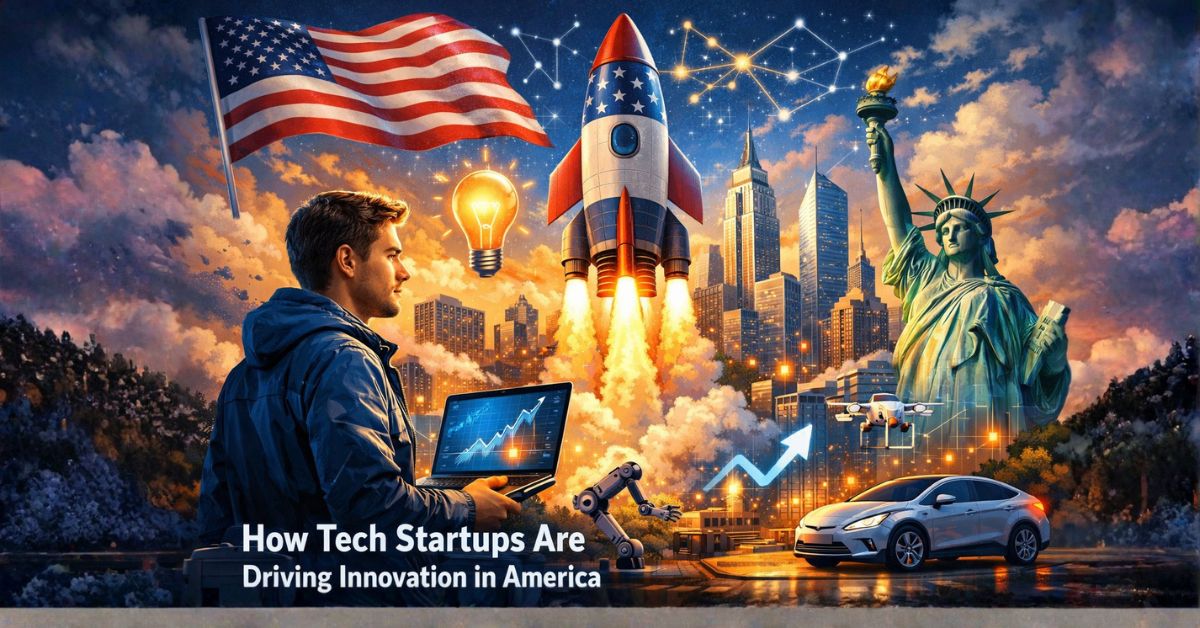
American tech startups are among the most powerful engines of economic growth, job creation, and technological progress in the world. From Silicon Valley to emerging tech hubs in Austin, Miami, and Chicago, U.S. startups are developing solutions to some of the most complex challenges facing industries, governments, and consumers.
In 2026, the startup ecosystem is evolving in response to tighter capital conditions, the rapid maturation of AI tools, and growing interest from corporates and governments in startup-derived innovation. This article explains how American tech startups are driving innovation, which sectors are seeing the most activity, and what the broader economic and social impact looks like.
What Makes American Tech Startups Distinctive?
The U.S. startup ecosystem has several structural advantages that drive sustained innovation. Deep venture capital networks, world-class research universities, a culture that accepts entrepreneurial risk, large and accessible domestic markets, and relatively strong intellectual property protections create conditions that are difficult to replicate elsewhere.
American startups have historically moved faster from idea to market than their counterparts in more regulated or risk-averse environments. This speed-to-market advantage has been particularly pronounced in software, AI, biotech, and clean energy.
Why Startups Matter More Than Ever in 2026
Established companies often struggle to innovate at the pace that technology now demands. Startups, unconstrained by legacy systems, existing business models, and bureaucratic inertia, can experiment, fail, and pivot in ways that large organizations cannot. In an environment where AI is reshaping entire industries in months rather than years, that agility is more valuable than ever.
Startups are also increasingly important as vendors to large enterprises, providing specialized AI tools, vertical software solutions, and infrastructure capabilities that corporations would take years to build internally.
Key Sectors Where Startups Are Driving Innovation
Artificial intelligence: AI startups are developing specialized models, agentic frameworks, developer tools, and vertical applications across every industry. Anthropic, Cohere, Mistral, and hundreds of smaller companies are advancing the state of the art while creating new product categories that did not exist three years ago.
Climate tech and clean energy: Startups are developing next-generation batteries, carbon capture technologies, alternative proteins, grid software, and green hydrogen solutions. Federal incentives from the Inflation Reduction Act have catalyzed significant private investment in this space, and U.S. climate tech startups are attracting record venture capital.
Healthcare and biotech: AI-powered drug discovery, digital health platforms, remote monitoring, and diagnostic tools are emerging from startup labs. Companies like Recursion Pharmaceuticals, Insitro, and dozens of others are using machine learning to compress discovery timelines and identify treatment options that traditional pharmaceutical research would miss.
Fintech: Payment processing, embedded finance, wealth management, lending, and insurance are all being disrupted by startups offering lower costs, better user experiences, and more accessible services. Stripe, Chime, Plaid, and newer companies are reshaping how Americans interact with financial services.
Defense and national security: A new wave of defense technology startups is building drones, autonomous systems, AI-powered intelligence tools, and advanced communications for the U.S. military. Companies like Palantir, Anduril, and Shield AI have demonstrated that startups can compete for defense contracts and deliver capability faster than traditional defense primes.
Space technology: SpaceX has demonstrated the startup model in aerospace, and a broader ecosystem of launch companies, satellite operators, and space infrastructure startups has developed around it. Rocket Lab, Relativity Space, and Astroscale are among many companies developing the commercial space economy.
The Economic Impact of U.S. Tech Startups
Startups disproportionately contribute to job creation, productivity growth, and export competitiveness. Research consistently shows that young, high-growth companies account for a substantial share of net new employment in the U.S. economy. Startup-derived companies including Google, Amazon, Apple, and Microsoft now constitute a significant portion of total U.S. market capitalization.
Challenges Facing American Startups in 2026
The 2022-2023 funding downturn forced many startups to extend runway, cut costs, and focus on profitability earlier than prior cohorts. While funding has partially recovered, the environment remains more selective than the 2021 peak. Startups that raised at high valuations must now demonstrate the fundamentals to justify those multiples or face difficult down rounds.
Talent competition remains intense, particularly for AI engineers and data scientists. Regulatory uncertainty around AI, data privacy, and digital health is creating compliance costs that disadvantage smaller companies relative to larger incumbents with dedicated legal teams.
Expert Take: Where Startup Innovation Is Heading
The next wave of impactful startups will likely emerge at the intersection of AI and domain expertise: healthcare AI that actually integrates with clinical workflows, manufacturing software that connects to factory floor systems, agriculture technology that works with existing farming operations. The pure software play is increasingly commoditized; the differentiated opportunity lies in combining AI capabilities with deep industry knowledge and real operational integration.
Frequently Asked Questions
Where are the most active tech startup hubs in the U.S. today? Silicon Valley and New York remain dominant. Austin has emerged as a major hub following migrations during the pandemic. Miami has a growing fintech and crypto scene. Boston leads in biotech. Seattle is strong in cloud and enterprise software. Chicago is growing in fintech and logistics tech.
How do startups get funding? Early-stage startups typically raise from angel investors and seed-stage venture funds. Later-stage companies raise Series A, B, and C rounds from institutional venture capital firms. Some startups also pursue government grants, particularly in climate tech, defense, and healthcare.
The Bottom Line
American tech startups remain one of the country’s most powerful tools for driving economic growth, creating jobs, and solving hard problems. In 2026, the ecosystem is maturing and becoming more selective, but the underlying engine of innovation is stronger than ever, particularly in AI, climate tech, healthcare, and defense. For more context, explore our articles on the future of artificial intelligence in everyday life, green tech innovations, and the intersection of AI and healthcare.