

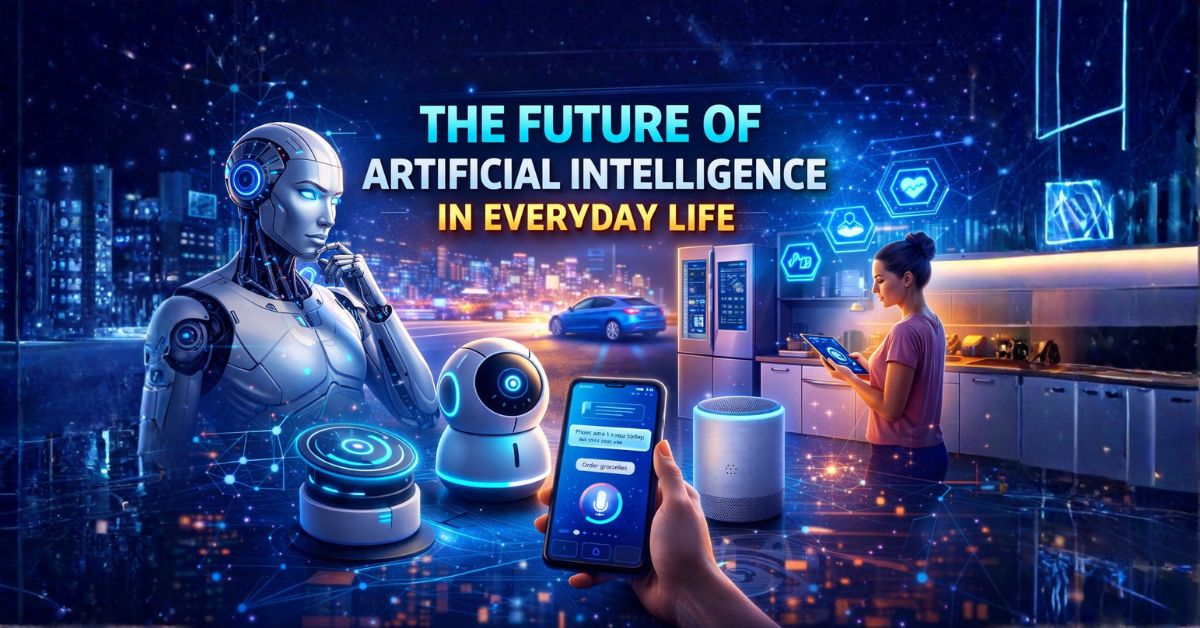
Artificial intelligence is no longer a futuristic concept reserved for research labs. It is quietly reshaping how Americans work, communicate, shop, and stay healthy every single day. From the recommendation engine on your streaming app to the fraud detection system protecting your bank account, AI is already embedded in the tools most people use without thinking about it.
By 2026, AI has moved well beyond simple automation. Today’s systems can understand natural language, interpret images, generate content, and execute multi-step tasks on your behalf. That shift changes what AI means for regular users, not just developers and enterprises.
This article explains what AI in everyday life actually looks like right now, why 2026 marks a genuine inflection point, how these systems work behind the scenes, and what you should realistically expect including benefits, risks, and real-world examples.
What Is Artificial Intelligence?
Artificial intelligence refers to software systems that can learn from data, recognize patterns, and make decisions or take actions with minimal explicit human programming. Modern AI combines language understanding, image recognition, and task execution in a single framework.
For everyday users, AI shows up in voice assistants, content recommendations, predictive text, fraud detection, navigation apps, and increasingly as AI agents that can plan and complete multi-step tasks on your behalf, such as scheduling, research, or drafting communications.
Why AI in Everyday Life Matters in 2026
Several forces are converging in 2026 to make AI genuinely transformative rather than just impressive. AI systems can now autonomously execute complex, multi-step projects, the kind that previously required a human working for hours or days. Analysts describe this as a shift from personal assistants to AI agents that orchestrate entire workflows.
For U.S. consumers and workers, that means AI is affecting hiring, job design, required skills, customer service, healthcare access, and everyday purchases. Companies that deploy AI effectively are already seeing competitive advantages in speed, personalization, and cost. Individuals who understand how to work alongside AI tools are gaining measurable productivity edges over those who do not.
How AI Works in Your Daily Apps
Most AI used in consumer apps relies on large language models and deep learning systems trained on enormous datasets of text, images, and behavioral data. These models predict the most relevant output given an input, whether that is the next word in a sentence, the most relevant product recommendation, or the best route to your destination.
- Streaming platforms analyze your viewing patterns to surface content you are most likely to watch next.
- E-commerce sites predict products you will buy based on browsing history, time of day, and similar users.
- Email clients suggest replies, detect spam, and now draft full messages on request.
- Navigation apps integrate real-time traffic data and AI route optimization to save time.
- Mobile cameras use AI to enhance photos automatically before you even look at the result.
By 2026, these individual systems are beginning to connect. AI agents can now operate across apps, browsers, and services on your behalf, completing tasks that previously required opening multiple apps and making judgment calls.
Key Benefits of AI for Americans in 2026
AI’s practical benefits extend well beyond convenience. Here is where it makes a measurable difference for everyday Americans.
Health outcomes: AI-assisted diagnostics are helping doctors detect cancers, eye diseases, and heart conditions earlier than traditional screening alone. Patients in rural areas increasingly access AI-powered triage and telehealth tools that reduce wait times and improve care access.
Work productivity: Tools that draft emails, summarize meetings, generate code, and build presentations let workers accomplish more in less time. Knowledge workers who use AI tools effectively show significant productivity improvements compared to those who do not.
Financial security: AI fraud detection systems protect bank accounts and credit cards by flagging unusual activity in real time, often before the account holder notices anything wrong.
Personalized learning: Adaptive educational platforms powered by AI adjust lesson difficulty, pacing, and style based on each student’s performance, producing better learning outcomes than static curricula.
Smarter home management: Smart home devices use AI to reduce energy consumption, improve security, and automate routine tasks based on household patterns.
Risks and Limitations of AI You Should Know
AI also carries real risks that affect everyday users directly.
Job displacement: As AI systems take on more routine tasks, some jobs will change significantly or disappear. Workers in roles built around repetitive, predictable tasks face the most immediate pressure. The transition is not painless, and the labor market is adjusting unevenly.
Bias and discrimination: AI models trained on historical data can encode existing biases. This has produced documented problems in lending decisions, hiring tools, facial recognition accuracy, and criminal justice risk scoring.
Privacy erosion: AI-powered systems collect and analyze behavioral data at scale. Many users do not know how much data is used to train models or to personalize experiences that influence their decisions.
Misinformation and deepfakes: Generative AI has made it faster and cheaper to produce convincing fake images, audio, and video. This creates serious challenges for media credibility, political discourse, and personal reputation.
Over-reliance: AI systems can confidently produce wrong answers. Trusting AI outputs without verification in high-stakes situations such as medical, legal, or financial decisions can lead to costly mistakes.
Real-World AI Use Cases You Can See Today
AI is not hypothetical in 2026. It is already embedded in mainstream products and services across every major sector.
Healthcare: Hospitals use AI imaging tools to detect cancers, fractures, and diabetic eye disease earlier than human review alone. FDA-cleared AI tools now assist in reading radiology scans at hundreds of U.S. hospitals.
Finance: Major U.S. banks use AI for real-time fraud detection, credit scoring, customer service chatbots, and personalized financial planning recommendations.
Retail and e-commerce: Amazon, Walmart, and Target use AI for demand forecasting, inventory optimization, dynamic pricing, and product recommendations that account for a significant share of total purchases.
Education: Platforms like Khan Academy, Duolingo, and Coursera use adaptive AI to personalize learning paths, identify struggling students early, and generate practice exercises dynamically.
Workplace tools: Microsoft 365 Copilot, Google Workspace AI, and Notion AI assist millions of U.S. workers with drafting documents, summarizing meetings, analyzing spreadsheets, and generating presentations.
Transportation: AI powers route optimization for logistics companies like FedEx and UPS, cutting delivery costs. Tesla, Waymo, and GM Cruise use AI for autonomous and semi-autonomous driving systems.
Expert Take: Where AI Is Heading Next
The direction is clear: AI is moving from individual tools toward orchestrated systems that manage workflows across entire digital environments. The question for most Americans in 2026 is not whether AI will affect their lives but how to position themselves to benefit from it rather than simply be affected by it.
Workers who develop skills in AI collaboration, including prompt engineering, AI-assisted analysis, and critical evaluation of AI outputs, are gaining measurable advantages. Companies investing in responsible AI deployment with human oversight and clear governance are building more durable competitive advantages than those racing to automate without controls.
The next major phase, expected to accelerate through 2027 and beyond, involves AI systems that can autonomously manage complex projects across organizations, handling research, coordination, compliance checks, and reporting with minimal human intervention.
Frequently Asked Questions
Is AI taking over jobs in the U.S.? AI is changing the nature of many jobs rather than eliminating them entirely. Roles built around routine, predictable tasks face the most disruption. Jobs that require creativity, judgment, empathy, and complex problem-solving are more resilient. The net effect on employment is still being studied, but most economists expect significant job transformation rather than mass unemployment in the near term.
Is the AI I use every day safe? Consumer AI tools from major platforms generally undergo safety testing before release. However, they can still produce errors, biased outputs, or confidently wrong information. Treat AI outputs as a starting point, not a final answer, especially in important decisions.
How can I use AI to improve my productivity today? Start with tools already built into software you use, such as AI writing assistants in Google Docs or Microsoft Word, AI summarization in meeting tools, and AI-powered search in browsers. These require no technical setup and deliver immediate time savings.
What does AI mean for my privacy? AI systems typically require data to function. Review the privacy settings of apps you use regularly, understand what data you are sharing, and opt out of data collection where possible. Avoid entering sensitive personal information into public AI tools.
The Bottom Line
Artificial intelligence in everyday life is no longer a future prediction. It is the present reality for millions of Americans, embedded in the apps, devices, and services most people use daily. The technology brings genuine benefits including better health outcomes, higher productivity, and smarter personalization, alongside real risks including job displacement, privacy erosion, and the spread of misinformation.
The most effective approach is not to fear or blindly embrace AI but to understand how it works, where it helps, where it falls short, and how to use it as a tool that amplifies your judgment rather than replacing it. For more on how AI is reshaping specific sectors, explore our articles on the intersection of AI and healthcare, the impact of AI on the U.S. job market, and how automation and robotics are shaping American industries.