


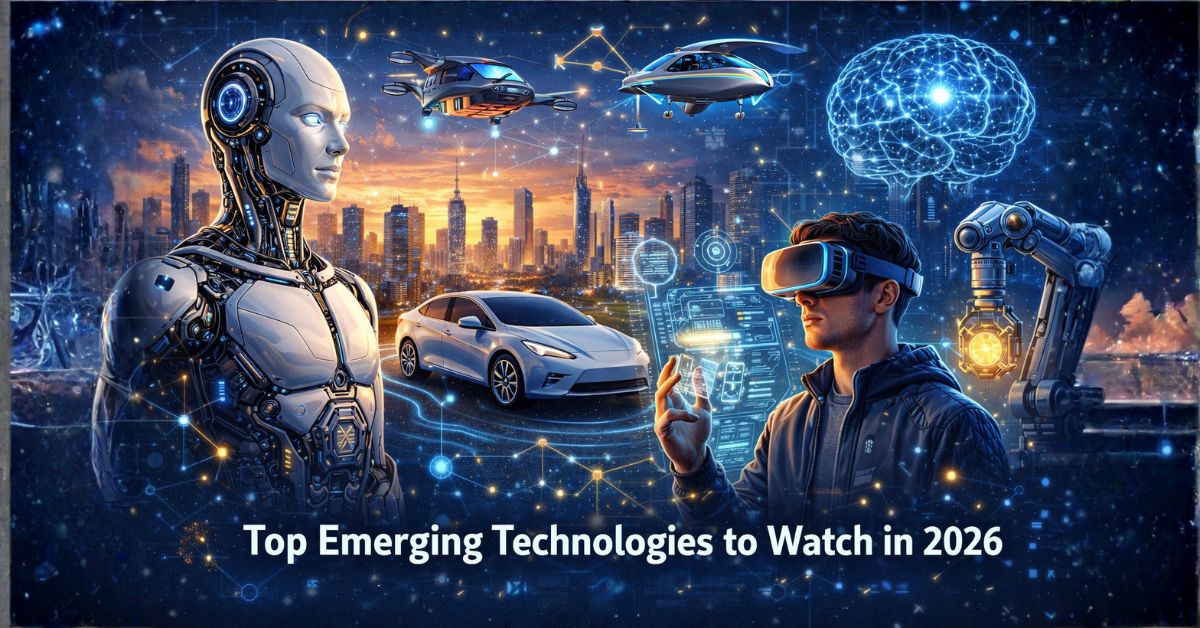
Emerging technologies are advancing at an unprecedented pace.Technology is moving faster than most people can track. From AI agents that can complete week-long projects autonomously to quantum processors solving problems classical computers cannot touch, 2026 is shaping up to be one of the most consequential years in recent tech history.
This article cuts through the noise and highlights the ten technologies most likely to reshape American industries, consumer behavior, and daily life in 2026 and beyond. Each one is past the hype stage and into real-world deployment, investment, or policy discussion.
What Are Emerging Technologies?
Emerging technologies are innovations that are transitioning from experimental or early-adoption stages into mainstream use. They differ from established technologies in that their full impact is not yet fully understood, their applications are still expanding, and the industries they will disrupt are still adapting.
For a technology to qualify as genuinely “emerging” rather than just hyped, it typically shows rapid investment growth, real enterprise or government deployment, meaningful improvements in capability or cost, and early signs of consumer adoption.
Why 2026 Is a Pivotal Year for Tech
Several technology trajectories are converging in 2026. AI is transitioning from tools to agents. Quantum computing is reaching fault-tolerant milestones. 5G infrastructure is maturing across the U.S. Biotech is combining with AI to accelerate drug discovery. And green tech is scaling rapidly as policy incentives align with falling costs.
For American businesses and consumers, this convergence means that ignoring these technologies is no longer a neutral choice. Early adopters are already gaining measurable advantages in efficiency, cost, and competitive positioning.
The Top 10 Emerging Technologies to Watch in 2026
1. Agentic AI Systems
AI agents that can plan, execute, and self-correct across multi-step tasks are moving into enterprise deployment. These systems go beyond answering questions to actively managing workflows, writing code, and coordinating other AI tools. Companies like OpenAI, Google, and Anthropic are racing to deploy production-ready agent frameworks that handle tasks requiring days of human work.
2. Quantum Computing
Quantum processors are approaching the fault-tolerant milestones needed for practical commercial applications. IBM, Google, and startups like IonQ and Quantinuum are making measurable progress. Early use cases in drug discovery, financial modeling, and cryptography are moving from research into pilots at major enterprises and government agencies.
3. Advanced 5G and Early 6G Research
5G deployment across U.S. cities is enabling ultra-low latency applications in manufacturing, healthcare, and logistics. Simultaneously, early 6G research is underway at universities and defense labs, targeting speeds and capabilities that will define the next decade of connectivity.
4. Spatial Computing and Mixed Reality
Headsets like Apple Vision Pro and Meta Quest are maturing into enterprise tools for design, training, and remote collaboration. Spatial computing, which blends digital content with physical environments, is moving beyond gaming and entertainment into surgery, architecture, and industrial maintenance.
5. AI-Accelerated Drug Discovery
Companies like Isomorphic Labs (a Google DeepMind spinoff) and Recursion Pharmaceuticals are using AI to compress the drug discovery timeline from years to months. This has major implications for the pharmaceutical industry and for patients waiting on treatments for rare and complex diseases.
6. Energy Storage Breakthroughs
Next-generation battery technologies, including solid-state batteries and grid-scale storage systems, are moving toward commercial production. This is critical infrastructure for electric vehicles, renewable energy integration, and grid stability, particularly as the U.S. scales up solar and wind capacity.
7. Humanoid Robotics
Companies including Figure AI, Tesla Optimus, and Boston Dynamics are deploying humanoid robots into warehouse and manufacturing settings. These robots are designed to work in environments built for humans, reducing the need for facility redesign while automating physically demanding tasks.
8. Generative AI for Media and Design
Tools that generate images, video, audio, and interactive experiences are maturing into professional-grade platforms. The creative and marketing industries are being reshaped by the ability to produce high-quality content at a fraction of traditional cost and time, while raising urgent questions around intellectual property and authenticity.
9. Neuromorphic Computing
Chips designed to mimic the structure of the human brain are achieving energy efficiency levels that traditional computing architectures cannot match. Intel’s Loihi chips and IBM’s neuromorphic research are showing promise for always-on, edge AI applications in sensors, wearables, and smart infrastructure.
10. Synthetic Biology and Biomanufacturing
Engineering biological systems to produce materials, fuels, and medicines is gaining commercial traction. Ginkgo Bioworks and other biotech platforms are enabling the design of microorganisms that manufacture products more sustainably than petrochemical processes, with applications in food, agriculture, pharmaceuticals, and materials science.
Key Benefits and Opportunities
These technologies share common benefit themes: they reduce costs, increase speed, expand access, and enable capabilities that were previously impossible. For American businesses, the opportunity is to identify which of these technologies intersects most directly with their industry and begin pilots now rather than waiting for full maturity.
For individuals, understanding these trends helps in making smarter career choices, educational investments, and decisions about which tools to adopt early versus which to wait on.
Risks and Limitations to Understand
Not every technology on this list will fulfill its potential on schedule. Quantum computing still faces significant engineering challenges at scale. Humanoid robotics remains expensive and limited in dexterity. AI agents still make mistakes that require human oversight. Energy storage costs are falling but not yet at parity for all applications.
The risks include regulatory uncertainty, supply chain dependencies for critical materials like rare earth elements, and the risk of hype cycles that attract investment but delay realistic timelines. The biggest mistake for businesses is treating these as binary, either fully transformative now or irrelevant, rather than tracking them as a portfolio with varying timelines.
Expert Take: Which Technologies Deserve Immediate Attention
Based on current deployment velocity and capital investment, three technologies deserve immediate attention from U.S. business leaders in 2026: agentic AI, energy storage, and humanoid robotics. Each is moving faster than most enterprise planning cycles account for, and competitive advantages are forming now among early adopters.
Quantum computing and neuromorphic chips are worth monitoring closely but not betting the organization on yet. Spatial computing is sector-specific; businesses in healthcare, architecture, and manufacturing should already be running pilots.
Frequently Asked Questions
Which emerging technology will have the biggest impact by 2026? Agentic AI has the broadest near-term impact because it affects productivity across virtually every knowledge-work sector without requiring physical infrastructure changes. Energy storage technology has the largest infrastructure impact over the same period.
Are these technologies available to small businesses? Several are already accessible via software subscriptions, including agentic AI platforms, generative AI tools, and spatial computing development kits. Energy storage and humanoid robotics require more capital and are primarily enterprise-scale today.
How should I stay updated on emerging tech trends? Follow primary sources including company announcements, peer-reviewed research preprints on arXiv, and regulatory filings. Supplement with tech-focused publications and analyst reports, but always distinguish reporting from speculation.
The Bottom Line
The technologies on this list are not equally ready or equally relevant to every reader. The value of tracking them is not to chase every trend but to build informed judgment about which ones intersect with your industry, your role, or your organization’s strategic priorities.
Start by identifying the one or two technologies most directly connected to your work. Understand how they function, who is deploying them, what the realistic timeline looks like, and what risks remain. That is the foundation for smart technology adoption rather than reactive scrambling. For deeper dives, explore our articles on how 5G is transforming U.S. connectivity, the rise of quantum computing, and the role of IoT in smart homes and cities.